
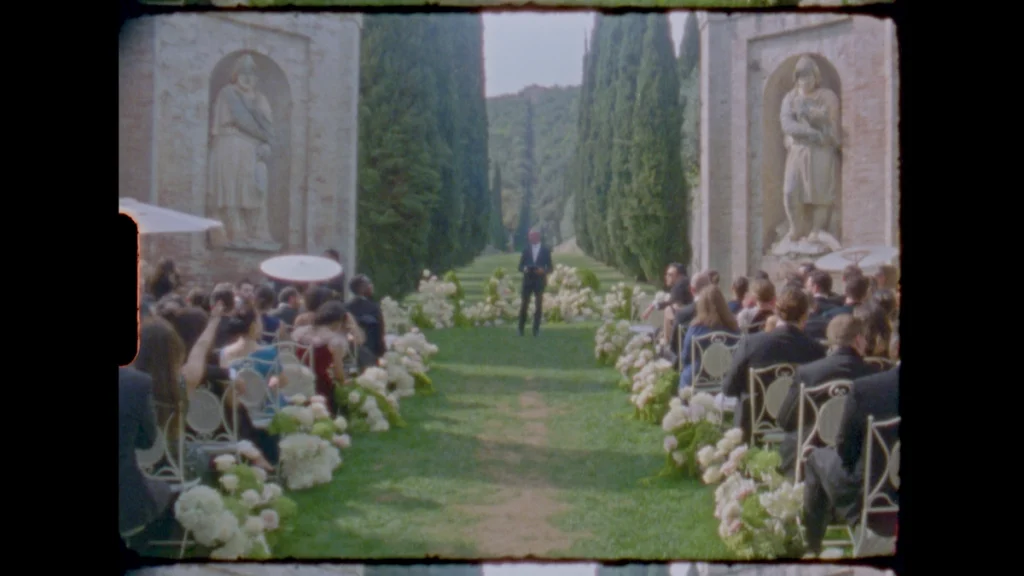
Italy occupies a particular place in the wedding imagination. Say the word and certain images arrive uninvited: cypress trees lined up like punctuation marks against a hillside, stone facades holding centuries of weather in their cracks, light that seems to know exactly where to fall. Couples who choose Italy are rarely choosing a country so much as a feeling, one that painters and filmmakers have spent generations trying to pin down and never quite managed to exhaust.
What tends to go unspoken is everything that stands between that feeling and the day itself. Behind the postcard version of an Italian destination wedding sits a long sequence of decisions, most of them unglamorous, some of them genuinely tricky, that rarely make it into the glossy features or the curated grids couples scroll through while dreaming up their day. Vendors have to be found and understood from a distance. Assumptions about timing and season need quiet correcting. Somewhere in the planning, a couple has to decide who will be trusted to translate the day into something they can hold onto once it has passed, and that choice carries more weight than most people expect going in.
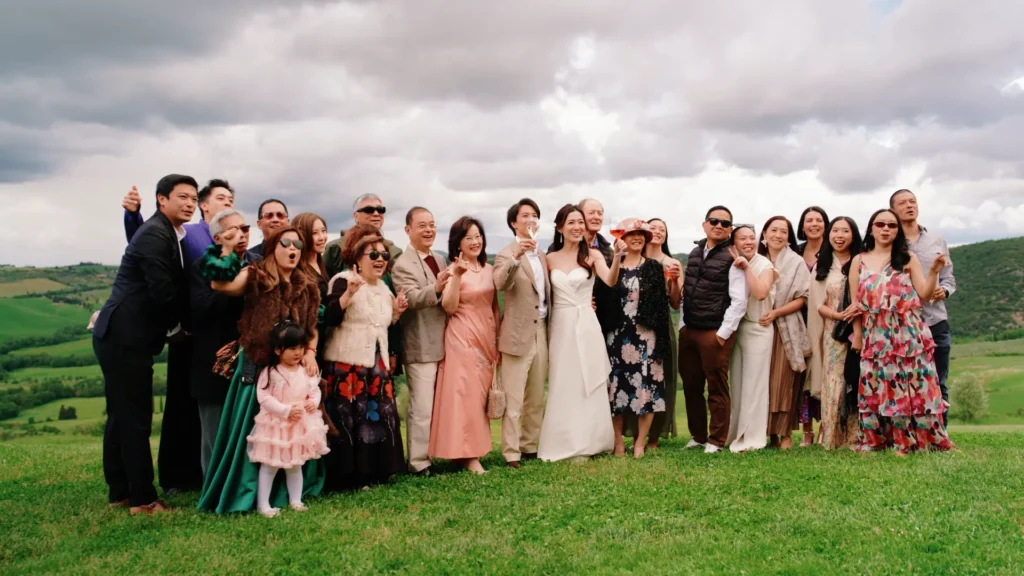
This is where a wedding film earns its place, not as a formality tucked at the bottom of the vendor list but as the discipline that determines how the day will be remembered by everyone who wasn’t standing close enough to see it firsthand. A skilled videographer isn’t simply present with a camera; they’re reading the rhythm of the day as it unfolds, making choices about light and distance and timing that shape the final story long before editing begins. What follows is an attempt at honesty: the practical groundwork, the missteps worth avoiding, and the reasoning behind decisions that, done well, let the day’s own beauty do most of the work.
Read also: Mistakes Couples Make That Ruin Their Wedding Video
The Right Videographer Is Never Found by Chance
Finding a wedding videographer in Italy takes more patience than most couples anticipate, particularly when the search happens from another country, in another language, guided mostly by algorithms that reward volume over discernment. A name surfacing at the top of a search result says nothing about whether that person’s eye matches the couple’s own. Proximity to the venue matters too, since a local videographer carries an understanding of regional light, of how a Tuscan afternoon behaves differently from one on the Amalfi coast, knowledge that no amount of remote research fully replaces.

The harder work, though, lies in defining what a couple actually wants to see when the footage comes back. Wedding videography spans a wide spectrum, and the ends of that spectrum produce genuinely different objects. A cinematic approach treats the day as a story with structure, deliberate pacing, a score, moments arranged for emotional build rather than chronological accuracy. A documentary sensibility resists that shaping, trusting the day to generate its own drama and choosing observation over orchestration. Neither is superior. What matters is whether a couple recognizes their own temperament in one or the other before signing anything.

Texture adds another layer worth considering early. Some couples are drawn to the grain of Super 8 or the soft degradation of VHS spliced between crisper modern frames, a choice that lends a wedding film a sense of memory already in progress, as though the footage had been waiting decades to be found. Others prefer their imagery clean and untouched by nostalgia. Neither instinct should be treated as a footnote. A videographer’s portfolio reveals not just technical skill but a worldview, a consistent way of seeing that either aligns with a couple’s sensibility or quietly doesn’t, and that alignment, more than any credential, determines whether the finished film will feel like theirs.
Read also: Documentary vs Cinematic Wedding Film: Which Style Is Right for You?
Beyond Instagram: Watching the Full Films
A ninety-second reel can be beautiful and still tell a couple almost nothing useful. Highlight clips are built for social media that reward immediacy, cut to their most striking frames, scored to whatever track is trending that month, designed to hold attention for the length of a scroll rather than the length of a story. Judging a videographer by these fragments is a little like judging a novel by its cover, understandable given how visually persuasive a well-cut reel can be, but ultimately incomplete.

Full-length wedding films ask something different of the viewer, and reveal something different in return. Watched from beginning to end, a film shows whether a videographer understands pacing across an entire day rather than across thirty seconds, whether quiet moments are given room to breathe or rushed past in pursuit of the next visually impressive shot. It shows how a ceremony’s own rhythm is respected or reshaped, how transitions between locations and hours are handled, whether the editing serves the emotional arc of the day or simply assembles pretty footage in sequence. These are the details that separate technical competence from genuine directorial sensibility.
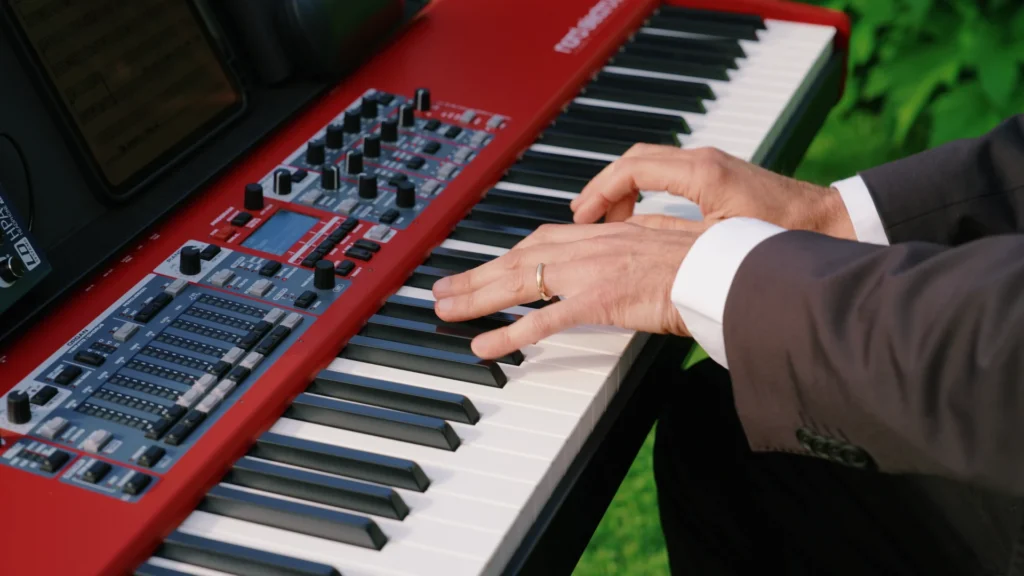
Sound and music deserve equal attention here, something reels rarely allow room for. A vow spoken with a slight tremor, the specific timbre of a father’s toast, the ambient hush before a first kiss: these details carry weight that a trimmed highlight reel, dependent on music to carry emotion, simply cannot replicate. A full film lets a couple hear whether a videographer trusts silence, whether real sound is woven into the score or drowned beneath it entirely. Requesting complete films, not curated samples, is the closest a couple can come to previewing their own wedding video before it exists. It tells them honestly whether a particular eye and a particular ear will know what to do with their day.
The Seasons No One Considers
May through September holds an almost gravitational pull on couples planning a wedding in Italy, and it’s easy to understand why. Warm evenings, long daylight, gardens in full bloom, an entire country seemingly arranged for celebration. What fewer people account for is what that popularity does to the experience itself. The most coveted venues book years in advance for these months, the best local vendors juggle several weddings across a single weekend, and a couple’s own day, however carefully planned, becomes one thread in a very busy season.
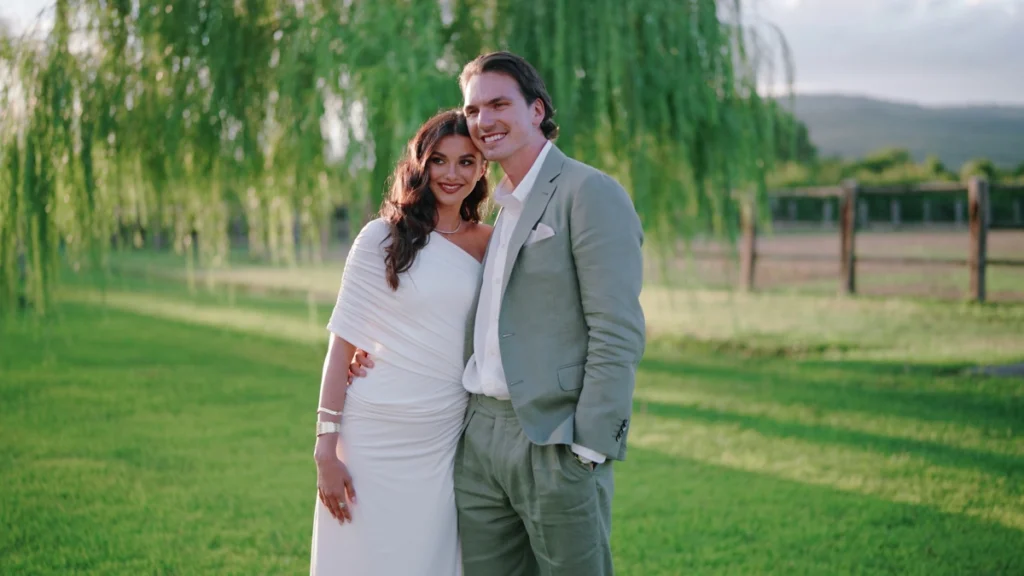
Late spring and early autumn tell a quieter story. April, early June, September into October: these windows offer a version of Italy that feels less rehearsed, less shared with a parallel wedding happening two hundred meters away at the neighboring estate. Venues that seem impossibly booked in July often have real availability in these months, and that availability tends to bring with it a different kind of attention from every professional involved, more time, less fatigue, greater flexibility around a couple’s specific vision. Light changes too, and for anyone thinking seriously about how their wedding film will look, this matters more than it might first appear.

Autumn light in Tuscany carries a lower, warmer angle that lasts through most of the afternoon. Spring brings a clarity and freshness to outdoor color that high summer, with its haze and heat shimmer, rarely offers. A videographer working with this kind of light has more room to build atmosphere into a wedding video, more texture to draw from across the day rather than racing against a narrow window before harsh midday sun flattens everything. Choosing an off-peak month isn’t a compromise. For couples prioritizing intimacy over convention, it’s often where the more interesting version of an Italian wedding is quietly waiting.
Tuscany, Como, Puglia: Three Faces of the Same Wonder
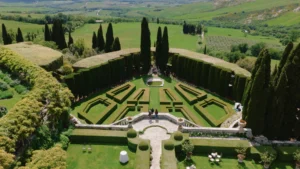
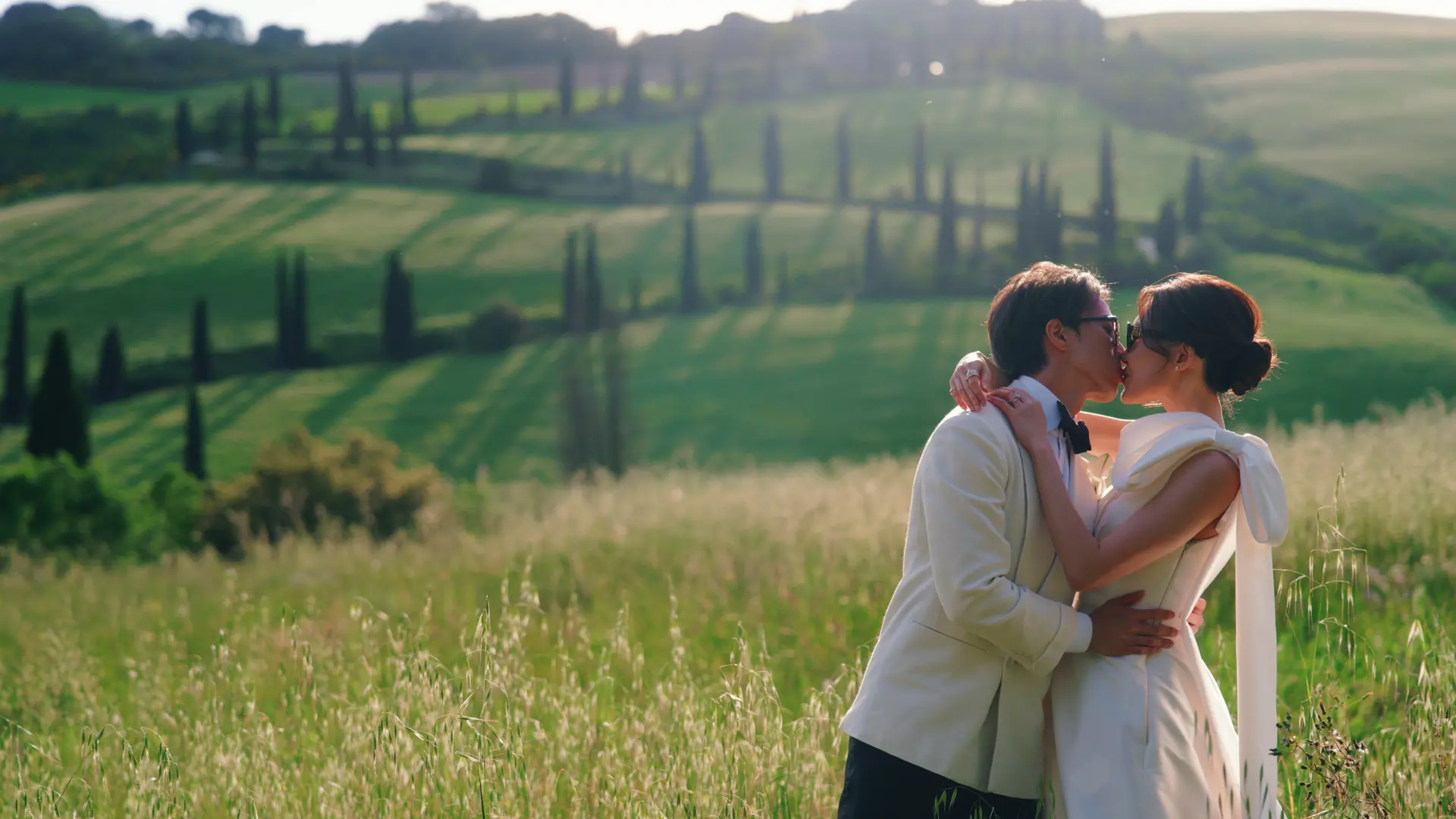
Italy resists easy summary, and nowhere is that more obvious than in how differently its regions perform in front of a camera. Tuscany has long served as shorthand for Italian romance, but what actually distinguishes it visually is a particular geometry: cypress-lined roads carving soft diagonals across rolling hills, stone farmhouses catching amber light in late afternoon, a landscape that seems arranged by centuries of careful cultivation rather than chance. For a videographer, Tuscany offers depth and layering, foreground and background separated by real distance, ideal for the kind of wide establishing shots that give a wedding film its sense of scale.
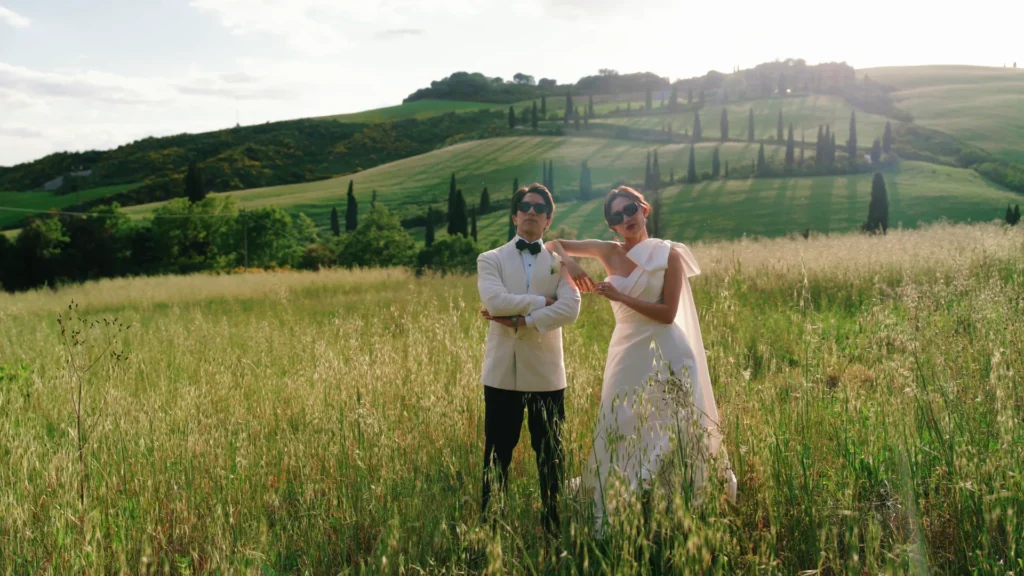
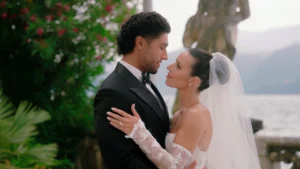
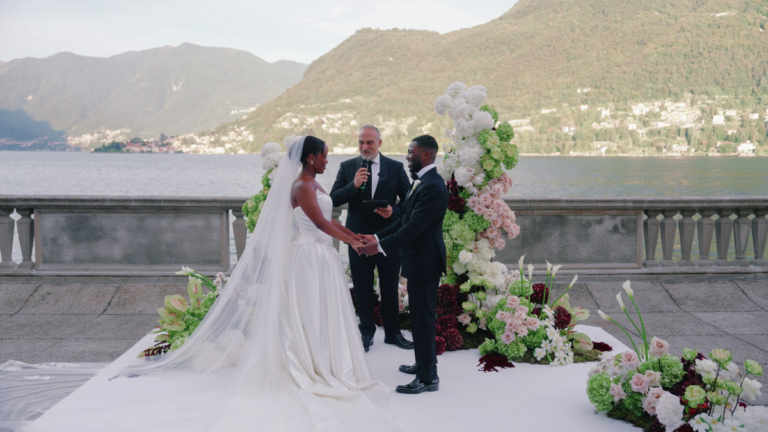
Lake Como operates on entirely different visual logic. Water changes everything about how light behaves, scattering and doubling it, turning villa facades and mountain silhouettes into reflections that add a second, shifting layer to every frame. The stillness of the lake at dawn creates a kind of visual silence rare elsewhere, useful for a videographer building quieter, more contemplative sequences into a wedding video, moments where atmosphere carries more weight than movement.

Puglia offers something rougher and more textural. Whitewashed masserie, dry stone walls, olive groves stretching low and silver toward a coastline that alternates between dramatic cliffs and pale sand, all of it under a harsher, more direct southern light that renders color with unusual saturation. Where Tuscany invites softness and Como invites reflection, Puglia rewards contrast, strong shadows, architectural lines that read almost sculptural on screen. None of these regions is better than the others. Each simply asks a different kind of attention from behind the lens, and a videographer who understands the place, rather than applying one visual formula everywhere, is the one capable of letting each landscape speak in its own register.
Read also: Destination Weddings in Italy: North, Central & South Compared
Art Cities and UNESCO Heritage as Living Set Design
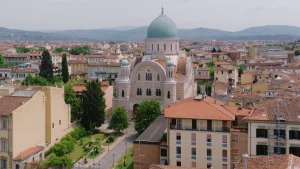
Florence, Venice, Siena, Rome: cities that have spent centuries being looked at, painted, photographed, studied. Marrying within them means borrowing a kind of visual authority no set designer could fabricate, facades and piazzas shaped by Renaissance ambition or Baroque excess, streets that have already been composed by architects and artists working in eras when beauty itself was treated as civic duty. A couple exchanging vows beneath a fresco cycle or crossing a bridge older than most nations isn’t simply choosing a backdrop. They’re placing their day inside a visual language centuries in the making.
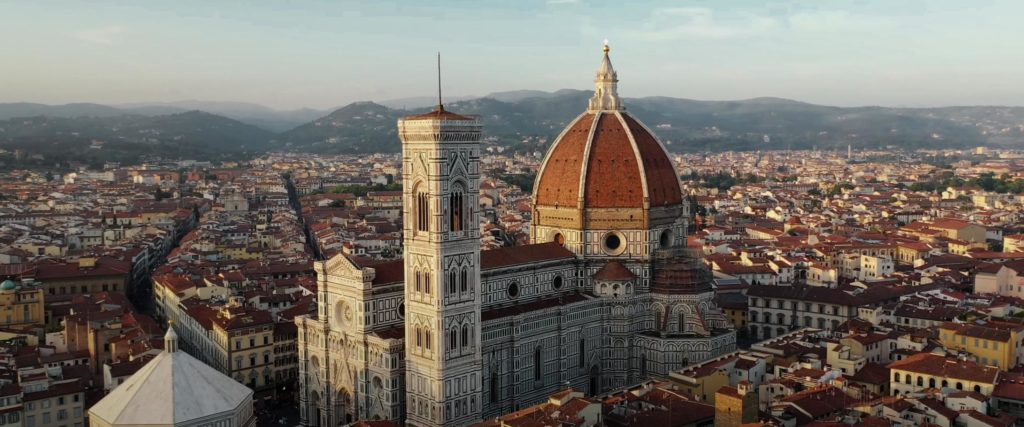
For a videographer, this changes the nature of the work in ways that go beyond obvious grandeur. Framing a shot against a UNESCO-listed courtyard requires restraint as much as ambition, an understanding of when the architecture should lead the eye and when it should recede so two people remain the actual subject. Rome’s Roman travertine holds and releases light differently through the day than Venice’s water-reflected marble, and a videographer attuned to these differences builds a wedding video that feels specific to its location rather than interchangeable with any other elegant setting.

There’s also weight to consider, the kind that comes from history rather than scale. A ceremony held in a courtyard where centuries of footsteps have worn smooth the stone carries an implicit gravity. Capturing that requires a certain patience behind the camera, a willingness to let the architecture breathe in wider shots before drawing close for more intimate framing. These cities don’t need embellishment. What they ask of a videographer is closer to a director working within an existing set, someone skilled enough to work with what history has already built rather than compete with it.
Read also: Weddings in Italy’s Art Cities: Celebrating Love Amidst History and Beauty
The Quiet Trap of Searching for Vendors Online
Planning a wedding from another country leans heavily on the internet, and increasingly on tools that summarize, rank and recommend without much regard for accuracy. Ask a general AI assistant for the best wedding videographer in Tuscany, and it will answer confidently, drawing on scattered mentions, outdated listings and sheer frequency of a name online rather than genuine quality of work. The result sounds authoritative. It often isn’t.

This matters more in videography than in almost any other vendor category, because the gap between an experienced professional and an inexperienced one shows up unmistakably in the final wedding film, yet remains invisible in a name pulled from a generic list. A search engine cannot watch a full-length video and judge whether the pacing holds, whether the color grading matches the light of an actual Italian summer, whether the storytelling instinct behind the editing reflects real command of the craft. Only a human eye, ideally one already familiar with the visual language of weddings, can make that call. Verification, then, becomes its own discipline. Real portfolios show complete films, not isolated highlight clips assembled to impress. Genuine reviews reference specific weddings, specific venues, specific details that couldn’t be fabricated or generated.

Direct conversation with a videographer, even a brief one, reveals more than any algorithm-curated shortlist: how they talk about light, how they describe their approach to a ceremony, whether they ask thoughtful questions about the couple’s own vision rather than reciting a standard package. For couples planning at a distance, the most reliable path often runs through people who have already been there. Such as former clients willing to speak honestly, planners with established relationships to trusted vendors, venues that have watched enough weddings unfold to know which videographers consistently deliver work worth the investment. Technology can widen the search. It cannot replace the judgment needed to narrow it well.
What You Cannot Control, and Why That’s Fine
Every wedding planned in Italy eventually meets a moment that refuses to follow the schedule. A sudden shower interrupts an outdoor ceremony. A vendor runs late. The light changes faster than anticipated, or a gust of wind sends a veil somewhere no one expected. Couples who have spent months coordinating timelines often meet these moments with a flash of panic, as though a single disruption might unravel the entire day. It rarely does. What tends to happen instead is something more interesting, and this is where an experienced videographer’s instincts become genuinely valuable. Rain moving a ceremony indoors can produce softer, more intimate light than the original plan ever offered. A delay that pushes photos later into the afternoon sometimes delivers exactly the golden tone a couple had hoped for from the start.

The day recalibrates itself, and a videographer accustomed to working within real conditions rather than rigid shot lists knows how to follow that recalibration rather than fight it. There’s a deeper benefit hidden in this unpredictability, one that has more to do with how people appear on camera than with weather or scheduling. Couples who arrive expecting everything to go precisely as planned often carry a certain tension, visible in posture, in expression, in the small stiffness that shows up when someone is monitoring the clock instead of the moment. Couples who accept early that some things will shift tend to relax into the day itself, and that relaxation reads on screen. Genuine laughter, unguarded glances, the particular ease of two people simply being present, these are the moments that make a wedding film feel alive rather than staged. Letting go of control doesn’t diminish the final result. More often, it’s precisely what allows the more honest, unrepeatable moments to surface, the ones no amount of planning could have scripted in advance.
Read also: Does the Perfect Wedding Exist? Tips for Managing Challenges and Surprises
Why a Good Wedding Planner Changes Everything
Behind nearly every Italian wedding that unfolds with apparent ease sits a wedding planner who has already solved a dozen problems the couple never saw. Permits secured months in advance, backup locations scouted in case of rain, timelines negotiated between vendors who don’t share a language or a working style, logistics untangled long before guests arrive. This work is largely invisible by design. Its absence, on the other hand, is impossible to miss. An experienced planner functions as something closer to a producer than a coordinator, someone thinking simultaneously about flow, atmosphere and the practical mechanics that let both exist. That producing sensibility matters enormously to a videographer, because a well-run day gives light, timing and movement room to align rather than fight each other.
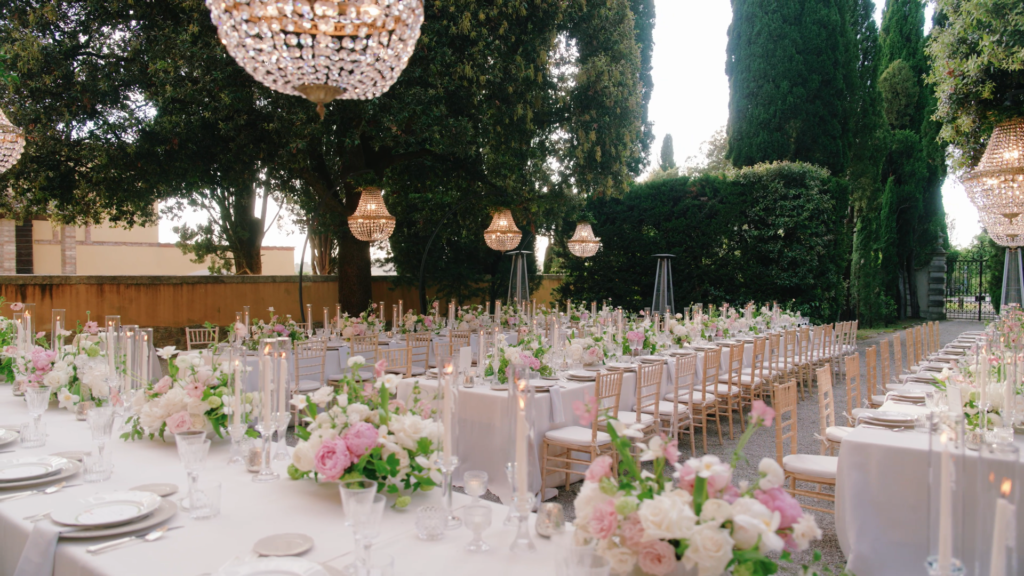
A ceremony that starts on schedule, in the right light, with guests seated where sightlines actually work, hands a videographer far more to work with than one thrown into disarray by poor planning. The finished wedding film reflects this difference more than most couples realize. What emerges, when planning and visual storytelling work in genuine coordination, is something more than a well-organized event captured on camera. The planner shapes the conditions. The videographer interprets them, translating the specific rhythm of that specific couple’s day into a film that feels unmistakably theirs rather than assembled from a template. Neither role substitutes for the other, and the strongest results tend to come from mutual respect between the two, an understanding that good direction happens both in front of the camera and behind the entire day’s architecture. Italy will offer its beauty regardless. What determines whether that beauty gets seen clearly, felt fully and carried forward long after the wedding itself has ended is the quality of the team entrusted to shape and, ultimately, to tell the story.