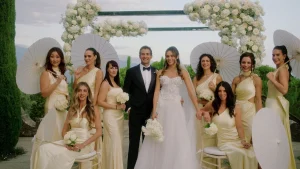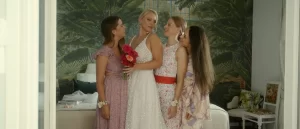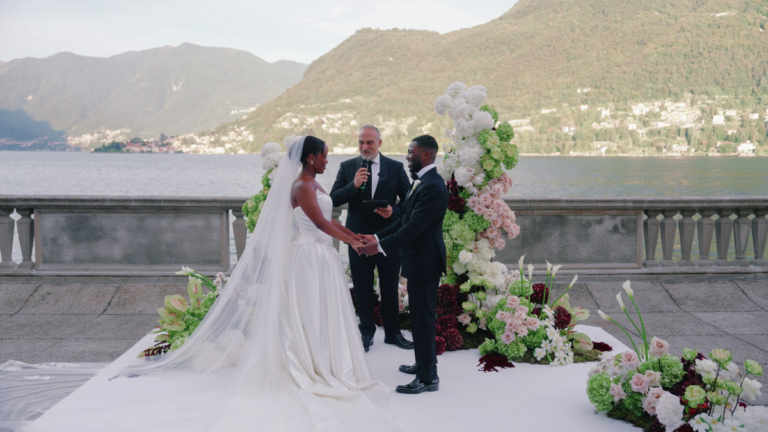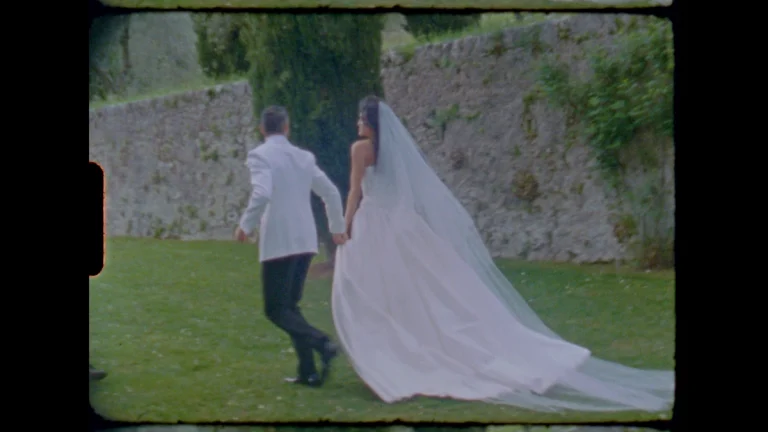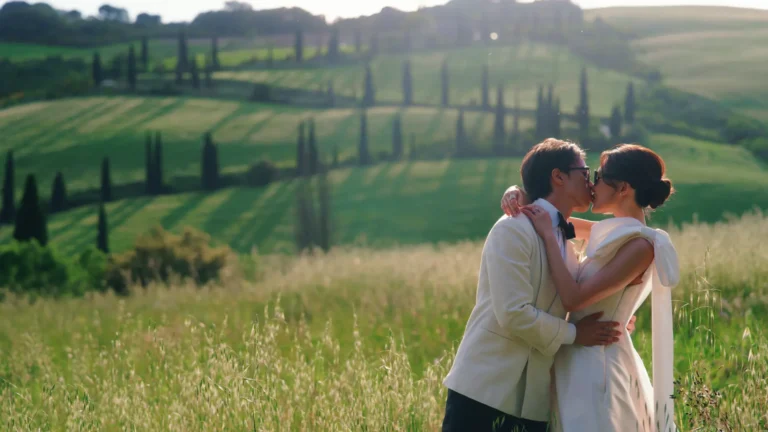


The Amalfi Coast occupies a peculiar place in the collective imagination. Everyone holds an image of it in mind before arriving: the cliffs dropping into turquoise water, the lemon groves clinging to impossible terraces, the pastel villages stacked above the sea. It is one of the most photographed stretches of coastline on earth, which creates a particular challenge for anyone hoping to marry here and walk away with something that feels genuinely their own rather than a reproduction of a thousand other images. The answer, more often than couples expect, lies in timing rather than location. Summer is when most people picture an Amalfi wedding, and summer delivers exactly what it promises: heat, crowds, a coastline at full capacity. But there is another version of this place that exists for only a few weeks each year, quieter and more revealing, and it belongs to spring.

April and May change the character of the coast in ways that go beyond temperature. The light softens. The terraces, heavy with new growth, take on a density of color that the flattening glare of August tends to erase. The towns themselves slow down, not yet absorbed into the rhythm of peak tourism, and something closer to the coast’s actual character becomes visible beneath the postcard surface. For a wedding film, these conditions matter enormously. They shape what is possible to capture: the texture of a garden in full bloom, the particular quality of afternoon light against stone and stucco, an atmosphere unhurried enough to let genuine moments surface rather than be staged around logistical pressure. What follows is an examination of exactly why spring, more than any other season, allows the Amalfi Coast to be filmed as it actually is, rather than as it is imagined to be.
A Coastline Coming Into Focus
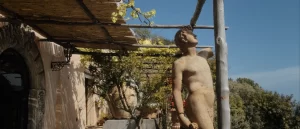
Spring on the Amalfi Coast announces itself first in color. The lemon groves that hang above every terrace, dormant and merely green through the winter months, fill out into something dense and almost architectural by April, the fruit still small and waxy among leaves that have taken on a darker, more saturated tone. Bougainvillea begins its slow climb up the walls of village houses, not yet at its summer excess but present enough to interrupt the white stucco with bursts of magenta and coral. Wisteria appears briefly along certain pergolas, and then is gone, which is part of its appeal. What spring offers, more than abundance, is contrast. The sea takes on a particular clarity in these months, a blue that has not yet flattened under the white-hot glare of July, when intense overhead light tends to bleach color out of everything it touches, including the water itself.

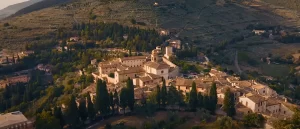
In April and May, the Mediterranean still holds depth and gradation, shifting from pale turquoise near the rocks to a darker, more saturated blue further out, and this range becomes genuinely visible rather than washed into uniformity. The same logic applies to the terraced hillsides that define the coast’s architecture. In summer, the strength of the sun tends to compress everything into a single register of brightness, erasing the subtle variation between one shade of green and the next. Spring light, gentler in its intensity, allows that variation to remain legible. Olive trees read differently from lemon trees, which read differently again from the wild vegetation clinging to the cliffs above the water. For wedding videography, this distinction is not a minor technical detail. It is the difference between a landscape that simply exists in the background of a film and one that contributes to its visual structure, offering depth, texture, and a sense of dimension that the camera can actually use.
Read also: Seasonal Flowers and Wedding Videography: Aesthetics, Ecology and Luxury
The Particular Light of April and May
Anyone who has spent time on the Amalfi Coast in August knows the specific difficulty of its summer sun. It arrives nearly vertical at midday, throwing shadows that are short, harsh, and unflattering, carving deep contrast into faces and flattening color in the landscape behind them. It is a light that demands compromise: terraces shaded with awnings, ceremonies scheduled around the worst hours, portraits postponed until evening simply to find something usable. April and May operate under a different physics entirely. The sun sits at a lower angle even at midday, closer to the angle summer light only achieves in the late afternoon. This single fact changes nearly everything about how a wedding day can be filmed. Shadows lengthen and soften. Faces hold detail rather than disappearing into harsh contrast or blown highlights. The architecture of a coastal villa, its arches, its tiled floors, its stone balustrades, picks up texture and dimension that the flatter light of summer tends to erase.

There is also the matter of color temperature, which shifts subtly across the seasons in ways that affect everything captured on camera. Spring light on this coast carries a particular clarity, neither the cooler cast of winter nor the slightly overexposed warmth of peak summer. It renders the sea in genuine blues rather than the bleached, almost white-hot tone that midsummer noon often produces. It allows the deep green of a lemon grove to remain a deep green, rather than collapsing into a single washed-out value. For wedding videography, these are not abstract preferences. They are the conditions that determine how much usable footage can be shot across an entire day, rather than being confined to a narrow golden hour at either end. A ceremony at eleven in the morning in May can look as considered, as cinematically resolved, as one filmed at sunset, and that flexibility is one of spring’s most valuable, least advertised gifts.
Temperature, Rhythm, and Ease
There is a comfort to spring on the Amalfi Coast that has nothing to do with aesthetics and everything to do with how a wedding day actually feels to live through. Average temperatures in April and May sit in a range that allows people to move freely between sun and shade without seeking refuge from either. Guests are not retreating indoors at two in the afternoon to escape the heat, nor are they wilting through a ceremony in formal clothing under a sun that shows no mercy. This matters more than it might initially seem. A wedding day in summer on this coast often requires a kind of negotiated truce with the climate: ceremonies scheduled early or late to avoid the worst of midday heat, receptions that retreat into shaded courtyards by necessity rather than design, guests fanning themselves through speeches in temperatures that can climb uncomfortably high by early afternoon.

Spring removes that negotiation almost entirely. A terrace overlooking the sea can be inhabited at noon, at three, at six, without anyone needing to think about it. This continuity changes the day’s actual rhythm. Couples are not forced to compress their celebration into the cooler bookends of morning and evening. They can move through a villa’s gardens at any hour, linger over an aperitivo on an open terrace without retreating, let a reception unfold across the full arc of the afternoon into evening with genuine ease rather than careful management of exposure. For wedding videography, this expanded comfort translates into expanded opportunity. A videographer working in mild spring conditions can follow the day’s natural movement rather than working around climate-driven constraints, capturing guests genuinely at ease in environments they are not trying to escape. The footage reflects that ease. People who are comfortable look different on camera than people who are enduring something, and spring, more than any other season here, allows for the former.
Less Crowded, More Exclusive
Positano in August is a place under siege, however beautiful the siege. Ferries unload hundreds of day-trippers onto a beach already at capacity. The single road that threads through town becomes a slow procession of cars and pedestrians. Ravello‘s famous viewpoints fill with tour groups by early morning, and even the coast’s most storied properties, however well insulated by walls and reservations, exist within the general pressure of a region operating at full tourist throughput.

Spring changes this equation substantially. April and May fall before the coast’s high season fully arrives, and the difference is immediately legible in the texture of daily life. Streets that will be impassable in July remain walkable. Restaurants take reservations without weeks of notice. The light over Ravello’s terraces falls on hillsides and gardens with comparatively few onlookers, which transforms not just the experience of the day but the visual character of everything filmed during it. For a wedding film, the absence of crowds is not a minor convenience. It is the difference between footage that captures a place and footage that captures a place fighting for space against thousands of strangers.

Villa Cimbrone‘s famous Terrace of Infinity, with its sweeping Mediterranean views, reads entirely differently when the surrounding pathways are quiet rather than thick with visitors waiting their turn for a photograph. The same applies to the gardens and belvederes that define properties like Belmond Hotel Caruso, with its eleventh-century architecture overlooking Ravello’s coastline, where spring’s relative quiet restores a sense of privacy that summer simply cannot offer at any price. This is, in many respects, what couples are actually paying for when they choose an exclusive venue on this coast: the sensation of having a place to themselves. Spring is the season that makes good on that promise most convincingly, and the wedding videography that results carries an intimacy that no amount of high-season grandeur can fully replicate.
Venues That Show a Different Face
Some of the coast’s most storied properties are, in effect, two different venues depending on when a couple chooses to marry in them. Villa San Giacomo, an eighteenth-century residence built in 1741 on the historic Liparlati hillside above Positano, photographs as a study in restrained Baroque elegance for most of the year. By April and May, its gardens of bougainvillea, lemon, and orange trees reach a density of color and fragrance that the same terraces, viewed in the bleached light of August, simply cannot replicate. The colonnade that frames its three hundred meters of terraces becomes, in spring, a corridor of dappled shade and shifting light rather than a strip of stone baking under direct sun.

Capri offers an equally instructive contrast. Punta Tragara, designed by Le Corbusier in 1920 and later headquarters for the Allied command during the Second World War, sits directly above the Faraglioni rocks with an architectural boldness that holds up in any season. But spring changes the quality of the encounter between building and landscape. The pathway leading to the hotel, lined with brightly colored Mediterranean flowers cascading over garden walls, becomes, in April, considerably more vivid than the same approach in summer’s flatter heat, and the lower angle of the sun gives the property’s modernist lines a sculptural quality that midday light tends to compress.

What spring offers, across these properties and others like them, is not simply prettier flowers. It is a redistribution of visual emphasis. Materials that read as merely present in summer, stone, stucco, wrought iron, weathered shutters, regain texture and dimension under softer light. Gardens stop functioning as decoration and start functioning as architecture in their own right, structuring the frame rather than filling its edges. For wedding videography, this means a richer visual vocabulary to draw from across an entire day, and a sense that the venue itself, in this particular season, is collaborating with the camera rather than simply being recorded by it.
Read also: Top 3 Destination Weddings In Capri
The Sea in Spring
There is a stretch of water beneath every villa on this coast that changes character with the season more than most people notice. In summer, the Mediterranean here performs a kind of theater: boats crossing constantly, swimmers scattered along every visible inlet, a surface broken into a thousand small disturbances by the sheer volume of human activity upon it. It is beautiful, but it is beautiful in the way a crowded piazza is beautiful, full of motion that the eye must work to see past. Spring asks less of the eye. The water in April and May carries a stillness that comes from genuine quiet rather than constructed calm: fewer boats, fewer swimmers, a coastline that has not yet been called into its summer choreography.

The sea holds longer, slower movements, the kind that a camera can actually follow rather than simply record. Light falls across it differently too, with a particular silvery quality at the horizon in the early hours that gives way, by midday, to a blue with genuine depth rather than the white glare that intense summer sun tends to impose on open water. This matters more than it might seem for anyone composing a wedding film along this coastline.
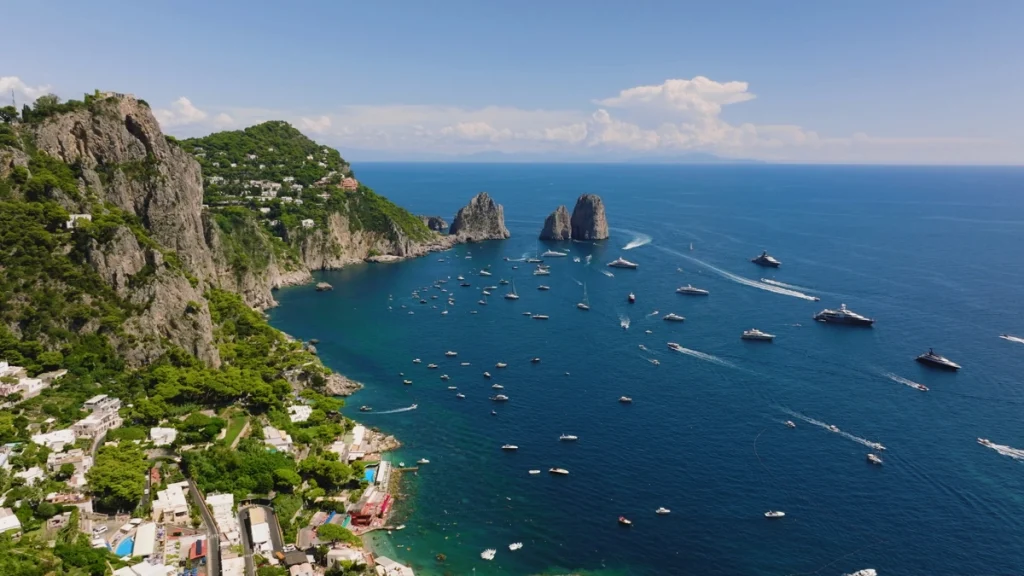
The sea is not simply scenery here. It is a constant presence in the frame, visible from nearly every terrace, every window, every garden path, and its character on a given day shapes the emotional register of everything filmed in front of it. A contemplative shot of a couple standing at a balustrade, the water behind them unhurried and luminous, asks nothing of artifice. It exists because the season allowed it to exist. What spring offers, in this sense, is a sea that behaves less like a backdrop and more like a collaborator: patient, reflective, willing to hold a single quality of light for long enough that a videographer can actually build something from it rather than chase a moment that has already passed.
Planning a Spring Wedding on This Coast
Spring carries a practical advantage: the planning window, while still meaningfully ahead of the day, tends to be somewhat more forgiving than the relentless lead times demanded by peak summer. Venues that require eighteen months of notice for a June Saturday may offer slightly more flexibility for an April date, and the same applies to the photographers, florists, and videographers whose calendars fill earliest around the months everyone defaults to first. This flexibility should not be mistaken for a lower bar of seriousness. A spring wedding on the Amalfi Coast still depends entirely on the quality of the local team assembled around it, and this coastline, fragmented across cliffside roads and narrow village streets, rewards genuine familiarity with its logistics in ways that few other destinations do.

A wedding planner who knows which routes between Positano and Ravello slow to a crawl on a Saturday afternoon, which boat transfers are reliable and which depend too heavily on sea conditions, which suppliers can be trusted with a property’s specific quirks, brings a kind of value that no amount of remote planning can replace. For couples traveling from abroad, the coast’s geography adds its own layer of consideration. Many of its finest properties are reachable only by narrow roads, steps, or boat, which affects everything from guest transportation to the practical movements of a film crew across the day.

A local videographer who has worked this terrain before understands these constraints instinctively, knowing where to position for a ceremony at a venue with limited access, how to plan transitions between locations without losing time or light. What this amounts to, ultimately, is a wedding built on local knowledge rather than improvisation. Choosing spring is itself a considered decision. Surrounding that choice with a team who understands this particular coastline, its rhythms, its constraints, its light, is what allows that decision to result in a day, and a film, that feels genuinely effortless rather than merely fortunate.
Read also: 4 Reasons Why You Should Book Your Wedding Videographer Early
The Light That Stays in Frame
Years later, watching your wedding video hits differently. It’s less about remembering exactly what happened, and more about reliving the exact way it felt. On the Amalfi Coast, that feeling is inseparable from spring: the particular slant of April light against a terrace wall, the sound of a quiet sea rather than a crowded one, the sense of a place that seemed, for one afternoon, to exist only for them. This is what a thoughtfully chosen season ultimately offers a wedding film: not just better conditions for shooting, but a visual signature that becomes permanently fused with the couple’s own story. The lemon groves at their fullest, the gardens before the summer crowds arrived, the coastline lit with a gentleness that no other month quite replicates. These are not incidental details. They become, over time, the texture through which the couple remembers the entire day.
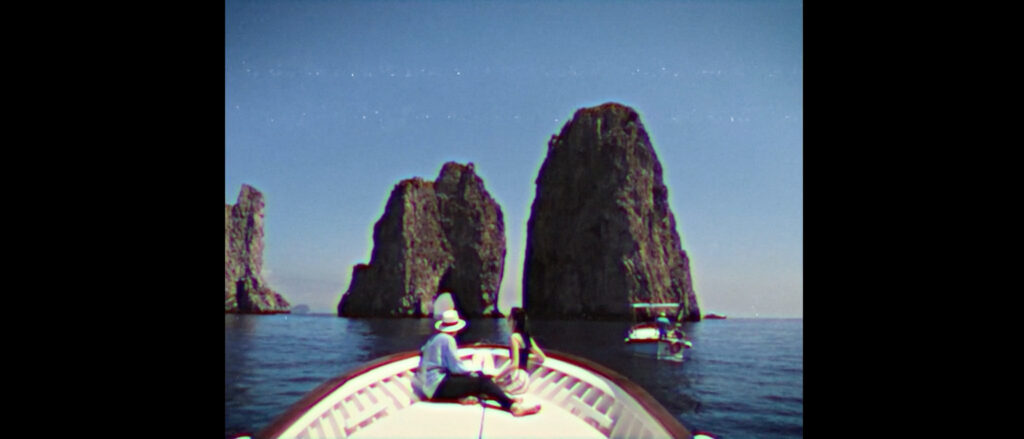
Watching that footage a decade later carries a different weight than watching a film shot under generic conditions. It feels less like archival record and more like something closer to memory itself, soft at the edges, atmospheric, faintly dreamlike in the way only genuine spring light on this coast can produce. It’s not easy to name this feeling: the film simply feels right, feels like the place was somehow in on the secret of how beautiful that particular version of itself could be. This is, in the end, the deeper argument for choosing spring deliberately rather than by convention. A wedding film made along this coastline in April or May carries something that summer cannot offer at any price: a landscape caught at its most legible, most luminous, most genuinely itself. What remains afterward is a cinematic rendering of a place and a season working, quietly, in the couple’s favor.