

At a certain point, almost imperceptibly, what has been experienced stops belonging to the present and begins to settle into memory. Wedding videography steps in at that subtle threshold, giving continuity to gestures, glances, movements and memories that would otherwise fade away. In this way it does not simply record, but builds a future presence. A voice that trembles slightly, the light shifting over the course of the day, the way two people move toward each other in space: everything takes on a different weight when translated into moving images. A professional wedding video works through selection and deliberate choices, with careful attention to rhythm and to the quality of the gaze.

Direction is felt in the pauses, in the duration of a shot, in the dialogue between sound and silence. There is an almost invisible precision in the way sequences follow one another, a construction that does not impose but accompanies, allowing what truly carries emotional substance to emerge. Even the smallest details find their place when observed with this sensitivity, without the need to be stated. Today the wedding film moves within a dual territory. On one side it preserves a deeply intimate, almost domestic dimension, tied to the time of personal memory. On the other it enters a visual ecosystem where sharing is immediate, widespread, often expected.

Images begin to live multiple lives, they move across different contexts, they are viewed with varying levels of attention, without necessarily losing their original coherence. Within this balance, the contemporary value of wedding videography takes shape: not only memory, but interpretation. A visual object capable of moving across different contexts while maintaining its own identity, recognizable in the care of light, in the construction of atmosphere, in the precision of the gaze. Even over time, that subtle quality remains intact, allowing one to recognize themselves, each time, in what they watch again.
The emotional value of a wedding video
A still image cannot capture every nuance of memory. It preserves what is visible, but only a fraction of the perceptions experienced by those who lived the moment as it unfolded. Wedding videography works within this more subtle dimension, where time is not frozen but lived through. A wedding video restores duration, breath, hesitation. The power of a wedding film lies precisely in this sensory layering. Sound and image do not move separately; they seek each other, support each other, build a rhythm that feels deeply human. Editing helps shape emotional intensity, choosing when to remain and when to let go; the final work retains the trace of the videographer’s hand, capable of giving form to a presence that continues to resonate even years later.

The wedding film thus becomes a renewable experience, where each viewing activates details that had remained in the background, bringing out new nuances. It offers the privilege of a dynamic memory, not a fixed one. A memory that deepens, shifts, finds new connections. Although photography always retains its undeniable iconic strength, the wedding video introduces a different, new depth. It does not aim to replace traditional photography, but to stand alongside it. It adds voice, rhythm, atmosphere. It offers a form of presence that engages the eye, but also and above all hearing, time, and the perception of space. This is how it is able to convey a more complete dimension, where there is room not only for what happened, but for how it was experienced.
Sharing happiness: a natural gesture
Human beings carry an instinctive impulse to tell what matters most to them. It does not begin with social media, nor with technology. It belongs to an older dimension, shaped by storytelling, by images passed down, by stories that seek to be heard. A wedding video therefore fits into a clear cultural continuity: the desire to give visible form to one’s experience and to offer it to the gaze of others. Today this passage takes place in a much broader and more immediate public space. Digital platforms have transformed the way all experiences, including the wedding film, are perceived, reducing the distance between those who live and those who watch.
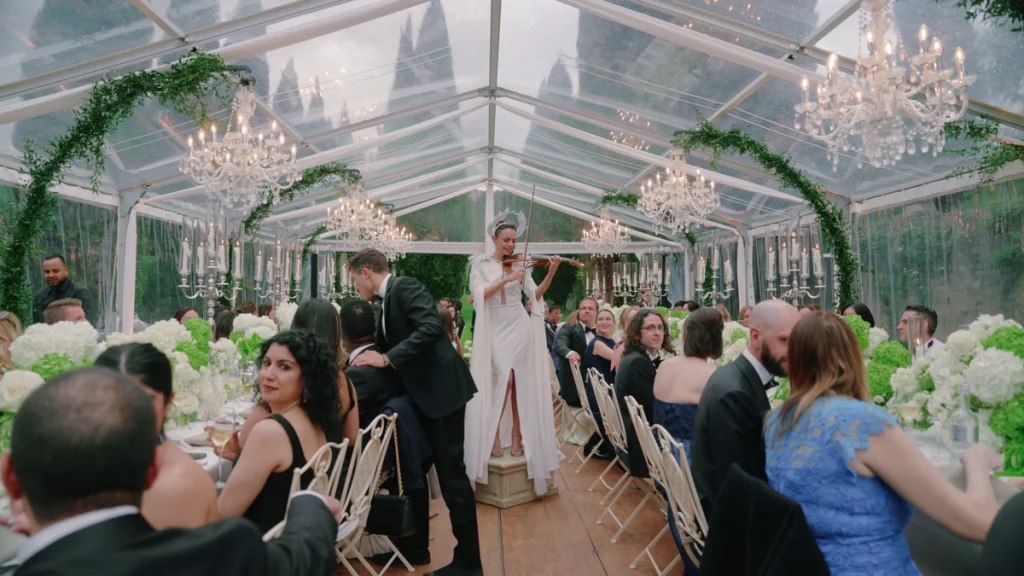
A shared fragment can reach distant people, create unexpected connections, restore a sense of presence that goes beyond the physical boundaries of the event. In this new dynamic, wedding videography takes on a new responsibility: images no longer remain contained, but enter a continuous flow where context shifts quickly. And yet, behind every post, a deeply human gesture remains. Showing a meaningful moment does not necessarily imply display. It can be a way of acknowledging the importance of what was lived, of extending that perception across time and space.
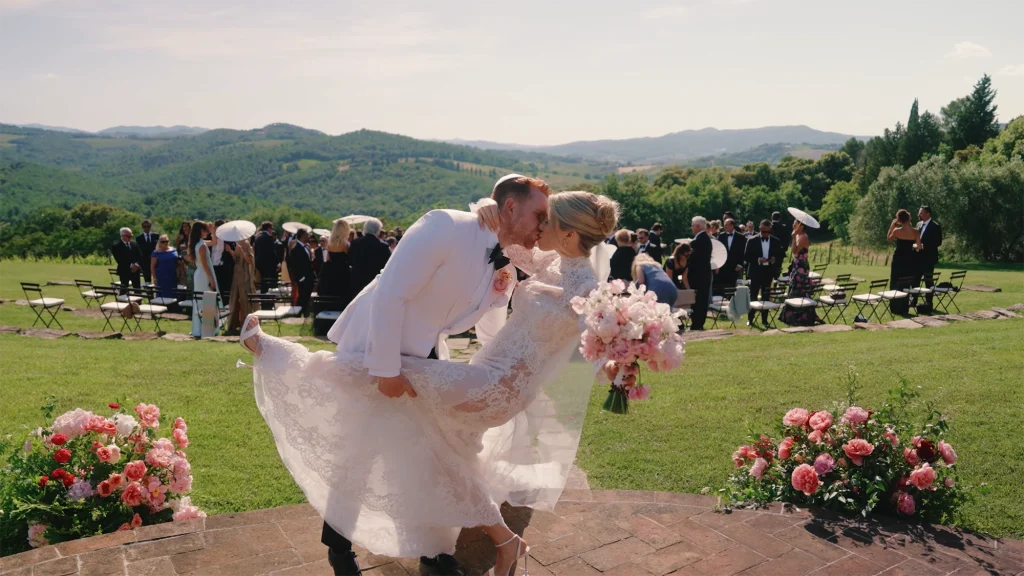
The work of the videographer allows the visual narrative to remain coherent even in these transitions, preventing emotion from dissolving in the speed of consumption, regardless of the couple’s choices. Some prefer to share short excerpts, others keep the wedding video within a more intimate dimension. Within these countless possibilities moves a quiet reflection on the intention behind sharing, a reflection that gives meaning to the gesture and allows a balance between openness and discretion, between public presence and personal memory.
Between intimacy and visibility
Every wedding is an intimate ritual, even as it unfolds before many eyes. The videographer respects this space and captures moments that escape collective perception. When these images are shared, their status changes. They enter a context where the gaze is quick, often distracted, sometimes guided more by exposure than by attention. The risk does not so much concern a loss of formal quality, but a quieter transformation: what begins as a private experience can take on a different function, more oriented toward representation than memory. This shift calls for a certain awareness, a deeper reflection. There is no clear line separating what should be kept from what can be shown.

Instead, an individual sensitivity emerges, varying from couple to couple, and one that the videographer is called to interpret with precision. Some choose to keep their wedding video within a more intimate dimension, others select fragments that convey atmosphere and style without revealing too much. Direction and editing play a decisive role here as well. The choice of shots, the construction of rhythm, the use of light all contribute to shaping a visual narrative that can be layered and exist on multiple levels. A reel, for instance, can suggest an aesthetic, evoke a mood, leaving space for what remains unspoken. The rest stays elsewhere, protected. This balance reflects the way each person chooses to inhabit the gaze of others, while preserving their own private dimension.
The wedding film on social media
A wedding film in its full form and complexity is created for a different kind of time than the one imposed by digital platforms. It needs to breathe, to gradually build its own rhythm, to leave space for images to settle. On social media, perception is shaped in just a few moments. Attention is fluid, fragmented, driven by a continuous sequence of visual stimuli, and this new context presents new challenges for contemporary wedding videography. A videographer working with a clear vision understands the value of synthesis, without giving up the quality of the visual narrative.

Formats such as the trailer or the reel arise from this awareness: they condense an aesthetic, suggest an atmosphere, hint at a broader story. They do not tell everything, but carefully select what can exist within a fast-paced context, maintaining a recognizable stylistic coherence. The construction of these fragments requires a different level of attention compared to editing a full film. A sharper rhythm is needed, a more essential choice of images, and the relationship between sound and vision must capture attention immediately. Light, camera movement, and the quality of the shots remain central, as they are the elements that allow a wedding video to stand out even when viewed on a small screen, in less than ideal conditions.
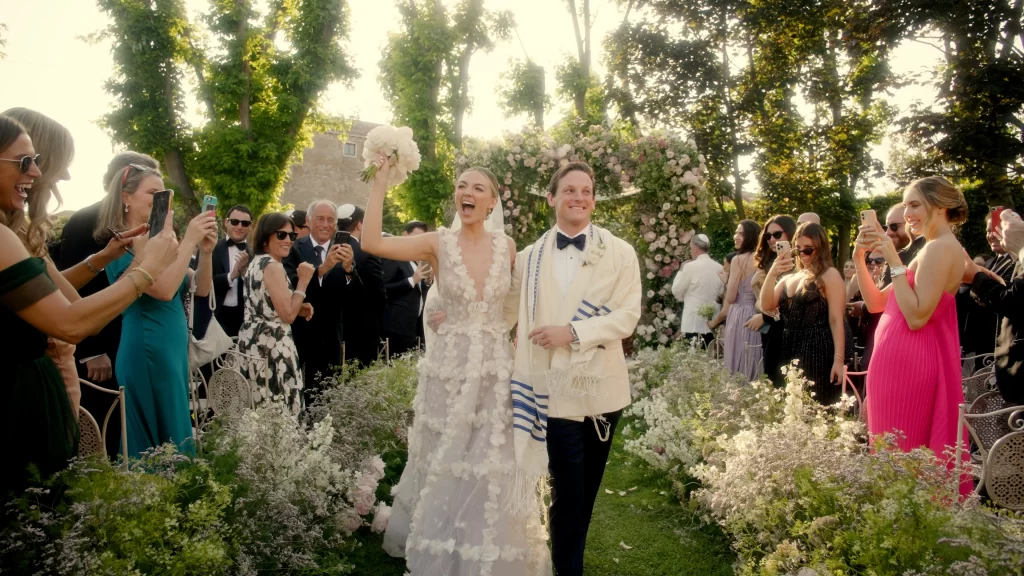
Wedding videography, once amateur, imperfect, and confined to a private family setting, now finds itself responding to two seemingly distant needs. On one side, there is the creation of a work meant to last over time and to be shared with loved ones, sitting close together on a living room sofa. On the other, there is the ability to engage with contemporary visual languages that demand immediacy. When these dimensions find a point of balance, the result retains elegance, emotion, and visual strength, without losing depth. Even in just a few seconds, a thoughtful gaze can leave a mark.
Read also: How Long Should a Wedding Video Be? A Guide for Couples
The cinematic language as a defining element
A professional wedding film stands apart from an amateur one not so much for what it shows, but for the structure that organizes each fragment. Direction guides the gaze, light shapes volumes and defines a distinct atmosphere, editing acts as a silent form of writing that structures time, suggests connections, holds back or accelerates. Within this set of choices, a syntax takes shape that is rooted in cinema. Within wedding videography, different sensibilities coexist. There is a more observational approach, close to a documentary dimension, which favors continuity of events and a discreet presence. Alongside this, a more authorial approach develops, where aesthetics take on a central role and the visual narrative is built with a stronger intention. This is not a rigid opposition, but a line along which each wedding videographer defines their own position.

When a wedding film is also conceived with sharing in mind, certain narrative choices become more refined. The duration of sequences, the opening and closing of an edit, the selection of the most representative moments respond to a dual need: to maintain depth and to ensure clarity in fast viewing contexts. Authenticity is not questioned by these decisions, as long as direction remains consistent with what unfolds. It is in this ability to convey a recognizable visual identity, even in shorter formats, that cinematic language continues to stand out, preserving elegance and precision even as it moves through more exposed digital spaces.
Read also: Documentary vs Cinematic Wedding Film: Which Style Is Right for You?
Construction and spontaneity
Every act of sharing carries an intention, even when it is not made explicit. Posting a wedding video can arise from an immediate, almost instinctive impulse, tied to the desire to extend a moment one wishes to hold onto a little longer. In other cases, a more defined awareness emerges, a care in selecting images, in shaping the narrative, in the quality of the visual result. Much of the content we encounter every day moves between these two tensions. Spontaneity holds a real value, one that is difficult to replicate. It can be recognized in the choice to share a frame that preserves imperfections, uneven timing, details that have not been refined. It is a form of openness that privileges closeness and direct perception. Alongside this approach, there is a more constructed dimension, where the wedding film becomes part of a broader image, coherent, measured in tone and style.
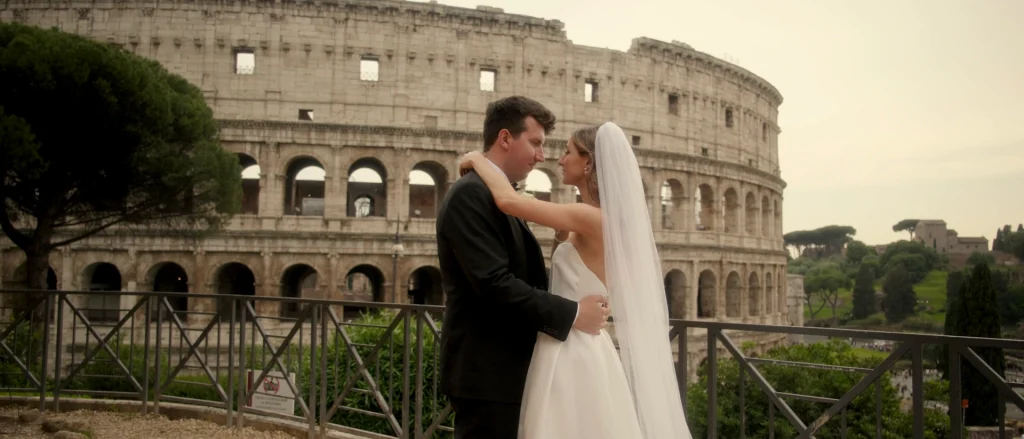
Here the visual narrative moves closer to an editorial sensibility, where each element is shaped to relate to a specific context. The work of the videographer takes place within this space with a subtle role. Direction does not impose, but offers possibilities. The quality of light, the choice of framing, the rhythm of editing allow the wedding video to sustain both readings without losing coherence. A well-constructed image retains its strength even when shared immediately; at the same time, an authentic moment gains depth when placed within a wider narrative. Between construction and spontaneity there is an intermediate space, often the most compelling, where the narrative holds both truth and form without needing to declare itself.
When the video continues to live
A wedding video, by its nature, moves through different seasons, shifts in meaning over the years, and gathers nuances that remain in the background during the first viewing. Online sharing represents only one of its possible trajectories, perhaps the most immediate, but not necessarily the most profound. A wedding film created with care and professionalism carries an intrinsic duration that goes beyond the digital context. It returns during family occasions, in quiet Sunday afternoon viewings, in moments when one seeks a connection with what has been. The voice of a loved one, a gesture that belonged to a daily life now distant, a light that defined a specific moment: these elements take on a different weight over time, often more intense than during the first experience.
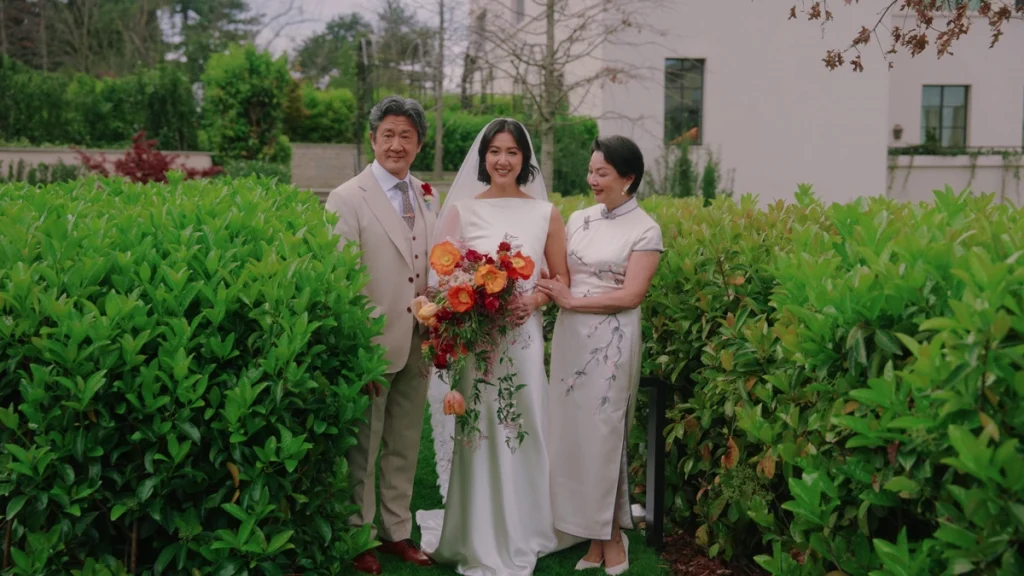
This is why wedding videography responds not only to the logic of visibility. On one side, it is certainly capable of drawing attention, but its greatest value lies in preserving a form of presence across years and time. The visual narrative becomes a living archive that moves through generations, to be watched and rewatched by those who were there and by those who will come. The quality of the images, the care in editing, the consistency of the aesthetic do not answer only an immediate need, but help make the wedding video meaningful and readable even after a long time. This does not exclude the public dimension, but places it in perspective. What is shared today may have a brief life within the continuous flow of images, while the full film retains its integrity, ready to reemerge in more intimate settings. It is within this dual layer that the strength of a well-crafted work can be measured, capable of existing in the present without being consumed by it.
A choice that tells who you are
At times, reflecting on sharing touches deeper levels of meaning. Whether or not to publish a wedding video becomes a matter of coherence, of tone, of naturalness. Every couple builds their own way of being in the world, of presenting themselves, of preserving what they consider essential. The wedding film enters this space with discretion and attentiveness, respecting and adapting to the couple. Some feel it is natural to open a part of their visual narrative, to let it circulate, to meet different gazes, to enter the contemporary flow of images. Others prefer to preserve their intimate dimension, where the wedding video remains tied to a private time, shared within a close circle.

Between these positions there are many nuances, and none appears more legitimate than another. What matters is the alignment between the gesture and the identity behind it. The videographer, of course, is not only the one who creates images. Even before the day itself, they speak with the couple and gather their impressions, searching within details for their distinct sensitivity, in order to translate into visual language a deeper essence that cannot be expressed in words. Direction, the choice of light, the construction of rhythm become tools to convey an aesthetic that belongs more to those being portrayed than to the one portraying.
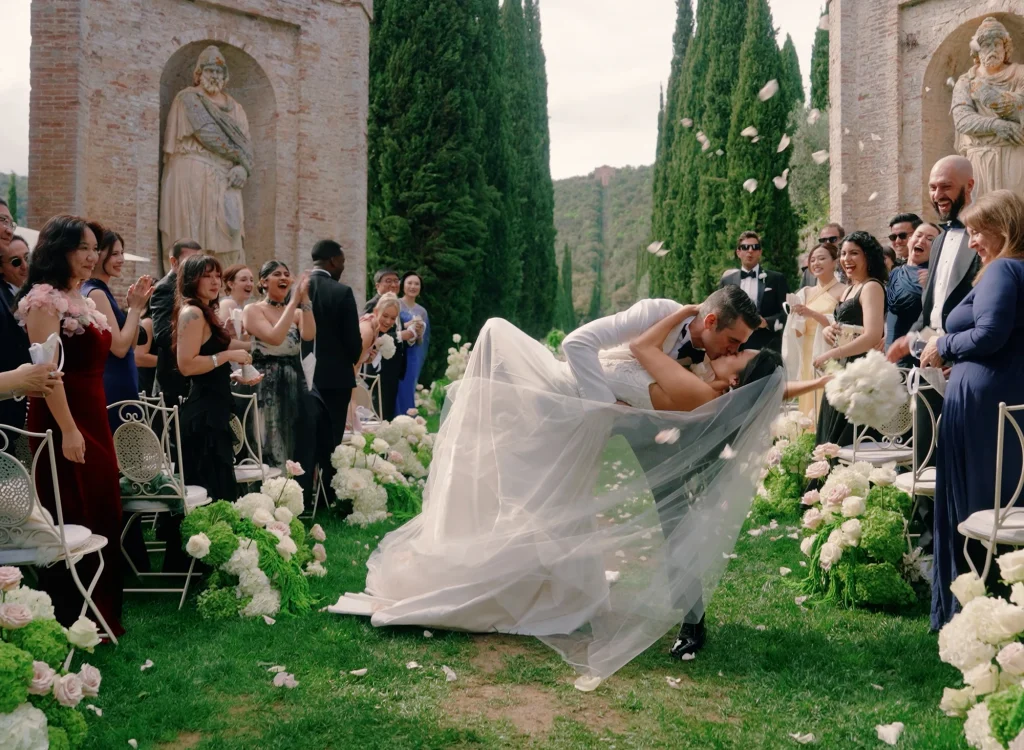
The possibility of shaping the wedding film into different versions, more intimate or more open, also comes from this ability to read with depth. The final decision, therefore, does not concern visibility itself, but the way one wishes to be remembered, seen, recognized. A professional wedding video, layered, shaped with sensitivity and awareness, preserves this intention and makes it perceptible over time. Whether it is shared or kept private, it continues to speak with a clear voice, faithful to what it represents.
Read also: 10 Original Ideas for an Unforgettable Wedding That’s Truly Yours