

When does a wedding film begin to take shape? I am certain that most of you will say: well, on the wedding day, of course, when the camera is turned on. And yet, you may be surprised: the first seed of a wedding video does not coincide with the bride’s entrance, nor with the click of the “on” button. It begins instead months and months before the wedding day, with a simple conversation between the couple and the videographer, sometimes shy and hesitant, at other times already surprisingly clear. In this very important initial phase, the videographer listens more than they speak, gathers nuances, records emotional inclinations, and grasps the deep essence of the couple.

It is a task that belongs as much to sensitivity as to experience: understanding how two people wish to be seen requires attention, visual culture, and a certain ability to read between the lines. The most sensitive wedding videography requires a deep and layered construction, made of references, intuitions, and choices that develop over time. Some couples arrive with already defined images, clear suggestions gathered elsewhere; others rely completely on the professional’s vision. In both cases, what matters is the quality of the exchange: from this, the boundaries within which the direction will move begin to take shape, the tone the final video will assume is defined, and the degree of proximity and what to give greater weight to during filming are established.

This first contact in fact guides every subsequent decision, even the more technical ones, mostly invisible to those who do not work in the field. The choice of lenses for the camera, the preference for a certain rendering of light, the approach to ambient sound or to voice recording: every element contributes to defining a coherent aesthetic, unique to each couple. At this stage, the visual narrative still exists in a latent form, but it has already acquired a precise direction, shaped by a defined and linear vision.
The meeting: listening, sensitivity, direction
The first meeting, then, leaves a deep mark: it is the first step of the entire journey, the one that influences everything that follows. It is the moment in which the subtle understanding at the base of every subsequent moment and visual choice begins to take shape. The videographer moves within a delicate space, and their listening is never passive. From observation, the boundaries of the narrative already begin to emerge, along with its tone and its emotional temperature. Some couples speak through images, evoke atmospheres, refer to films, to lighting seen elsewhere, to a certain way of inhabiting space. Others express themselves in a more intuitive way, allowing a sensitivity to surface that requires interpretation.

It is here that the professional’s expertise becomes decisive: translating perceptions, in whatever form they arrive, into concrete choices, accurately grasping the couple’s desires. During these exchanges, operational decisions also begin to take shape, often implicitly. The number of operators, the use of lightweight cameras or more structured setups, the use of drones. Every element contributes to defining how the wedding film will be experienced and perceived. In this way, a gradual trust is built, essential for working naturally on the day of filming. An authentic harmony is the key that allows the videographer not to chase images, but to recognize them, anticipate them the moment before they appear, and receive them with a precision that was born well before the camera was turned on.
Read also: Documentary vs Cinematic Wedding Film: Which Style Is Right for You?
Visual identity and shared imagery
Every couple carries an imagery with them, even when they do not express it explicitly. It can emerge through visual references, saved photographs, films they love, or through a particular way of inhabiting space and light. The videographer’s work is also to recognize these traces and place them within a coherent language, capable of conveying a solid visual identity that is never accidental. Some prefer incisive images, with deep blacks and sculpted light; others identify with a softer palette, with muted contrasts and an almost imperceptible grain, that can only be achieved with vintage cameras such as VHS and Super8.

The framing format, the depth of field, and the use of longer or more immersive focal lengths also contribute to building a personal aesthetic, tailored to measure. The direction is guided by this imagery, shaping distance, movement, and the duration of the shots. In the initial phase of dialogue with the couple, a precise narrative timing also begins to take form. Some stories require a relaxed rhythm, others a more dynamic structure. The wedding video is born precisely from this harmony between vision and interpretation: a delicate balance that transforms personal impressions into a visual narrative that is both compelling and recognizable.
Silent direction: presence and distance
On the wedding day, the videographer’s presence is measured by their ability not to impose themselves. There is a fine line between observing and intervening, and the quality of the result often depends on how this distance is calibrated. Attentive direction does not seek to guide events, rather it accompanies and supports them, intercepts them as they happen, allowing them to find their form in front of the lens. This approach requires experience and very refined technical control. The use of compact cameras, discreet stabilizers, and fast lenses: the latest technologies make it possible to work with agility, adapting quickly to lighting conditions and spaces.

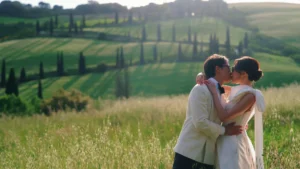
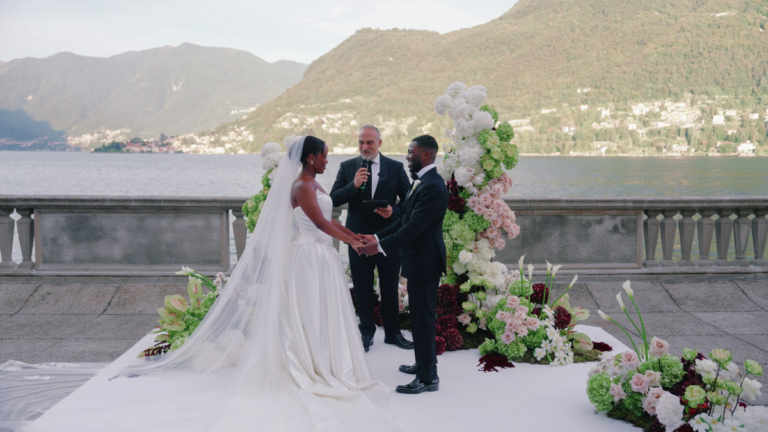
Indoors, where natural light can vary unpredictably, the management of ISO and color profile becomes essential to preserve image quality without altering the atmosphere. Outdoors, beetween terraces on Lake Como or beautiful italian gardens, movement opens up, but always remains measured and discreet. In this way, the videographer builds a presence that does not interrupt the flow of the day. They move naturally among the guests, anticipate gestures, their attention is always at its highest level. Within a wedding film, this quality of gaze translates into images that retain their own truth, even within a solid narrative construction. Direction is not perceived as intervention, but as coherence, as structure. Every choice, even the most imperceptible, contributes to conveying a sense of balance, in which the videographer’s presence remains discreet, yet decisive.
Light, movement, composition
The quality of a wedding film lies in the details. It is in the light, in the way it caresses faces or moves through a space, that the presence of a conscious gaze can be felt. Working with light means knowing how to wait for it, but also how to shape it when necessary. Movement, in turn, introduces a subtle narrative dimension. A static shot can hold a precise tension, while a slow forward movement builds proximity, inviting the viewer into the scene. The use of a gimbal, when integrated with restraint, brings fluidity without drawing attention to itself. In other cases, a controlled handheld camera, with barely perceptible micro oscillations, maintains an organic quality that resonates with the breath of the moment.

Every choice carries weight and contributes to defining the internal rhythm of the visual narrative. Composition completes this balance. Lines, volumes, relationships between subjects and background: nothing is left to chance, even when the image appears spontaneous. The use of different focal lengths alters the perception of space, bringing closer or creating distance, isolating a gesture or placing it within a broader context. An experienced videographer works with these variables in real time, adapting to situations that change quickly. The technique remains invisible, but supports every image, making the narrative of the wedding film credible, precise, and coherent.
The time of filming: building without forcing
The time of filming does not follow a rigid structure. It flows with its own logic, made of waiting, sudden accelerations, moments that stretch beyond expectations. Within this flow, wedding videography finds its balance when it manages to fit in without altering the rhythm. The videographer works along a fine line: they observe, they prepare, but avoid influencing or anticipating what has yet to happen. The image arrives when the conditions are ready, not when it is requested.
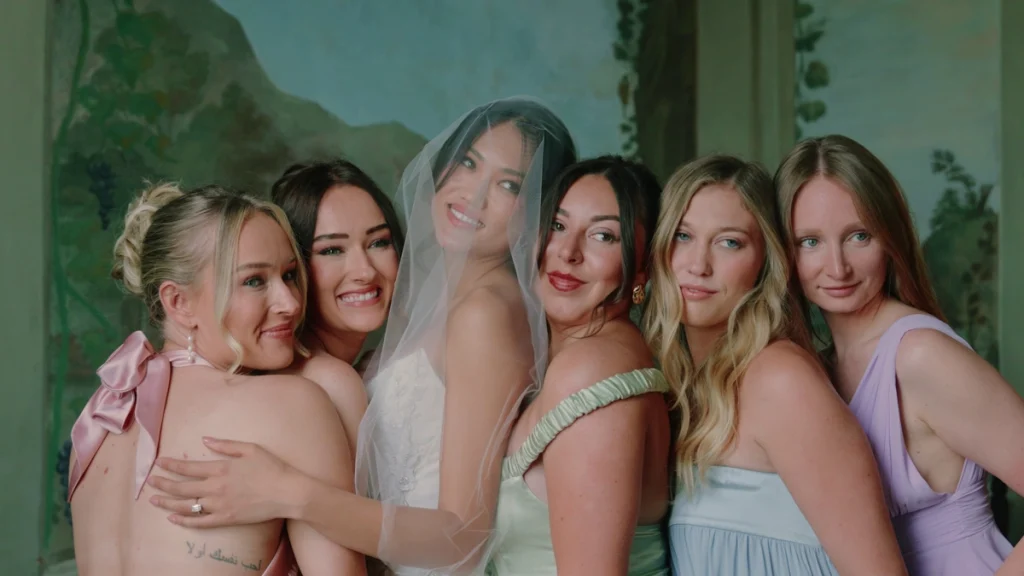
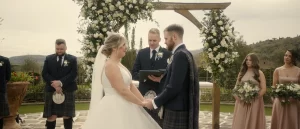
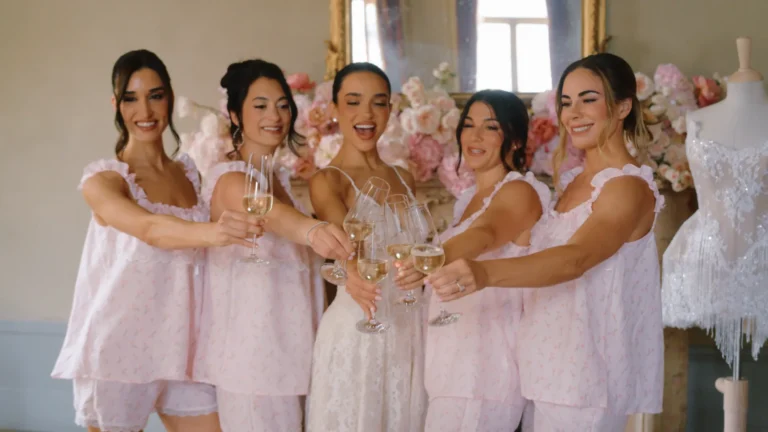
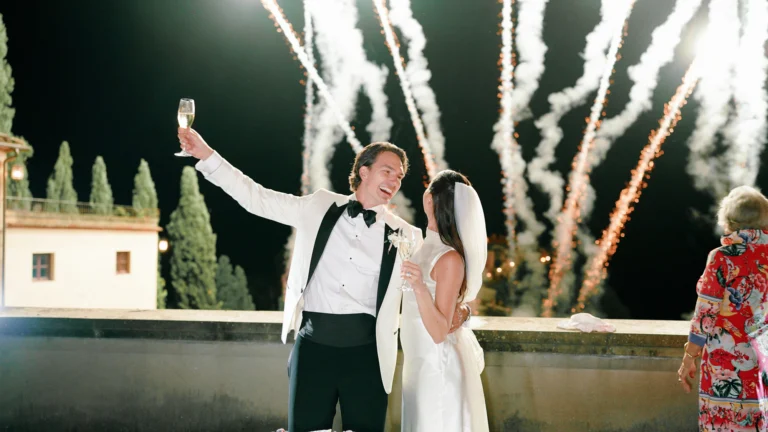
During the day, each phase presents a different quality of light and attention. The preparations have a quiet intimacy, often shaped by silence and repeated gestures; the ceremony imposes a more formal rigor, with structured timing and limited points of view; the reception opens to a freer dimension, where movement becomes broader and the visual narrative can breathe with greater flexibility. Recognizing these variations (and also facing unforeseen event such as rainy sudden skies!) means continuously adapting the gaze, modulating the direction in relation to what is happening. On a technical level as well, this fluidity requires quick and precise choices.

The management of memory cards, the control of audio levels, the transition between different shooting setups all take place without interrupting the continuity of the work. A change of lens, an adjustment of exposure, a variation in frame rate to suit the available light: every intervention remains invisible, yet it affects the final quality of the wedding video. The narrative is built in this way, through accumulation and subtraction. Not everything is filmed, and not everything that is filmed will find a place in the wedding film. What matters is the ability to recognize moments that hold an authentic tension, an internal balance that makes them necessary. It is in this instinctive and continuous selection that the time of filming already becomes a form of writing.
After the day: the invisible substance of the narrative
When filming ends, the work enters a quieter phase, less visible, but decisive. The hours of footage collected during the day form a complex, layered, often discontinuous material. Fragments of light, gestures, ambient sounds, barely suggested dialogue: everything coexists in an archive that requires order, time, and clarity. The structure of the wedding video already exists at this point, but it is still hidden. The first step in revealing it concerns selection. Each clip is reviewed with attention, evaluated not only for its technical quality, but for its ability to support the narrative.

Sequences that may seem marginal can acquire unexpected value, while images that are formally perfect sometimes lack narrative tension. The videographer works with a refined editorial sensitivity, developed over time, which allows them to recognize at first glance what deserves to be kept. From an operational point of view, this phase takes place within professional software, tools that make it possible to manage large amounts of material with precision. File organization, audio synchronization, and the creation of an initial narrative structure require a rigorous method.

Every choice is made with an overall vision already present, even if still evolving. Wedding videography finds here one of its most delicate moments. The transition from recorded reality to visual narrative implies a position, an authorial responsibility. Nothing is left to chance: the duration of the film, the sequence of images, the way one scene connects to the next. The wedding film takes shape slowly, through a process of subtraction and construction, in which the invisible becomes structure, and memory is organized into a precise language.
Read also: From Raw Footage to Masterpiece: The Process of Creating the Perfect Wedding Video
Editing and rhythm: writing with images
When the selected material finds its first arrangement on the timeline, the narrative begins to breathe. Editing does not proceed by accumulation, but by internal tension: each sequence is placed in relation to what comes before and what follows, in a balance that requires precision and attentiveness. The wedding film takes shape through a visual writing that is anything but random. The duration of a shot, the choice to anticipate or delay a transition, the decision to leave an empty space between two moments define the rhythm with an almost musical sensitivity.

Sound plays a decisive role. The voices and the speeches recorded during the day, often captured with lavalier microphones or directional shotgun mics, are cleaned, isolated, and restored with a natural presence. In post production, the use of software such as Pro Tools or the integrated audio sections in DaVinci Resolve makes it possible to work on frequencies, dynamics, and spatiality. A held breath, a whispered phrase, the distant noise of an environment can support a scene more than any visual intervention.

Music enters this balance with great care. It does not accompany, but guides perception, suggests a progression, introduces an emotional quality that must remain consistent with the overall aesthetic. Silence also gains value: it creates suspension, leaves space for the gaze, allows images to exist without mediation. Editing, in this sense, is the place where wedding videography finds its most complete form. It is not only about the order of images, but about the way they interact with one another. The result is a visual narrative that maintains its own internal continuity, in which every choice appears necessary, calibrated, part of a construction that rests on balance and restraint.
Read also: The Mastery of Editing: Creating Emotion and Narrative in Your Wedding Video
A tailored narrative: uniqueness and interpretation
Every wedding film carries a subtle responsibility: to convey a presence, not to construct a model. Uniqueness is not achieved through recognizable formal solutions, but through a careful reading of what happens and of what remains implicit. The videographer works within an interpretative space, where the material collected during filming is filtered, organized, and understood. It is not a matter of adhering faithfully to events, but of recognizing their meaning, their internal direction, the emotional quality that runs through them. At this stage, the visual narrative moves closer to a more authorial form.

Editing choices, color treatment, and the use of sound contribute to defining a vision that is both personal and deeply connected to the couple. An intervention in color grading can guide the perception of light, making it softer or more incisive; a variation in the rhythm of sequences changes the overall reading of the film, shifting attention to details that would otherwise remain marginal. The wedding video thus becomes a meeting point between two sensibilities. On one side, that of the couple, with their story, their gestures, their way of being together; on the other, that of the professional, who organizes and returns all of this through a precise language.

The balance between these two dimensions requires restraint. An intervention that is too pronounced risks distancing the narrative from its origin, while a presence that is too discreet can leave it without direction. When this synthesis succeeds, the result has a recognizable quality, yet is never replicable. Wedding videography finds here one of its most complete expressions: a work that preserves the identity of the couple and, at the same time, reflects a gaze capable of interpreting it with rigor and sensitivity.
Beyond memory: the value of a visual work
Over time, a wedding film changes its nature. It moves away from the urgency of the moment, from the sequence of events as they were experienced, and acquires its own autonomy. The images begin to engage with the viewer in a different, more layered way. What initially belonged to documentation transforms into a form of presence, capable of conveying atmosphere, rhythm, and the quality of light with a precision that memory alone does not preserve. Careful wedding videography maintains this consistency over time. It does not depend on immediate impact, nor on visual solutions tied to passing trends.

The coherence of the narrative, the care in direction, the attention to sound and editing allow the wedding video to remain readable even years later. This is where the value of a work conceived as a visual piece emerges: every choice, even the most discreet, contributes to creating a continuity that endures. On a technical level as well, this longevity is considered from the outset. Files are archived in high quality formats, with redundant backups, ready for possible future reworking. Color grading is developed with criteria that favor balance and depth, avoiding interventions that could appear dated over time.

These are precautions that are not immediately perceived, but that ensure a stable and coherent viewing experience. Watching a wedding film years later means encountering a version of oneself that no longer exists, immersed in the most unforgettable moments, yet remains accessible through images and sound. The visual narrative thus becomes a space in which time gathers, organizes itself, and finds a form. It is not a nostalgic return, but a living experience, capable of conveying a presence with a clarity that continues to surprise, year after year.