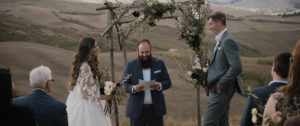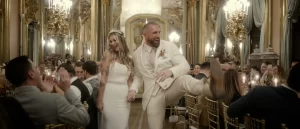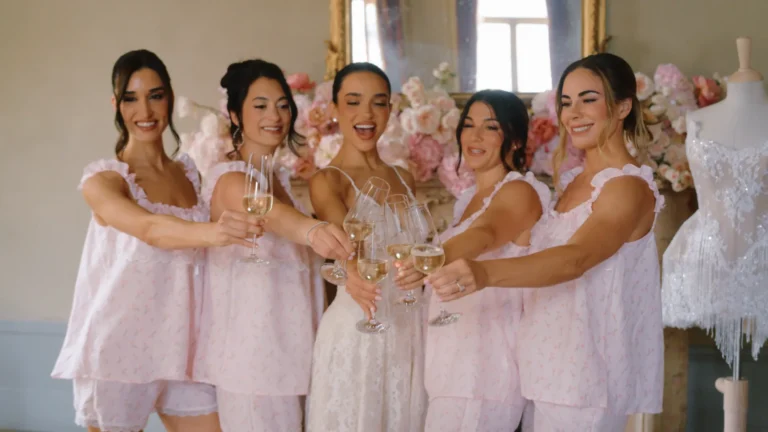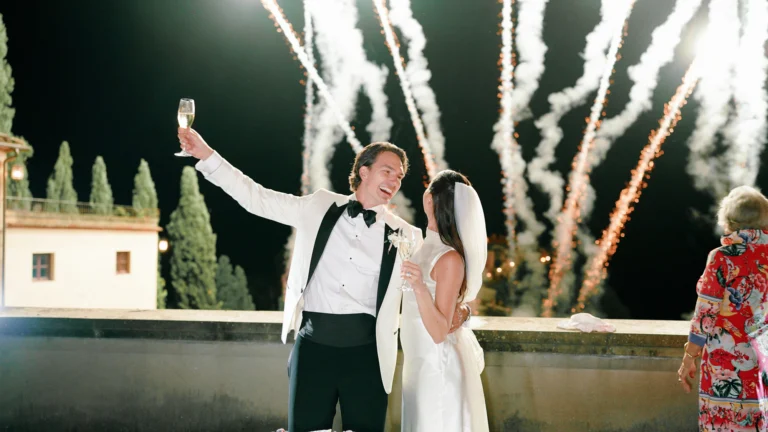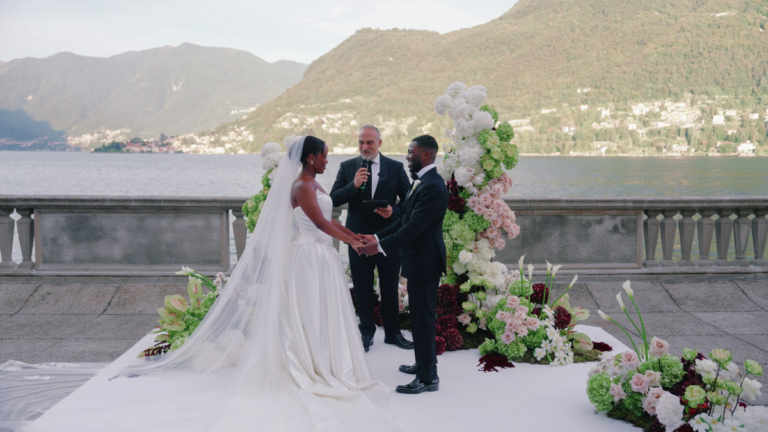


Choosing where to hold a destination wedding is also, implicitly, choosing what kind of film you want to end up with. The venue is not a backdrop: it is an active force that shapes the quality of the light, the texture of the sound, the freedom of movement, the visual breathing room of the entire day. The distinction between an indoor and an outdoor ceremony goes beyond guest comfort or seating logistics. It touches the very nature of the images that can be built, the optical choices available, and whether the working conditions will be predictable or not.

Every environment imposes its own visual grammar, and a wedding film born inside a nineteenth-century villa with tall windows and raking light cannot resemble one shot outdoors in the shifting wind and variable light of a Tuscan afternoon in June. This article moves through both dimensions. It covers natural and artificial light, how rain can become one of the most powerful visual elements in a wedding film, acoustics and soundscape, and how a videographer plans their movements according to the space.

It also looks at the character of venues, those that speak for themselves and those that need to be constructed from within. And at how the unexpected, so often feared, is sometimes exactly what the most memorable films are made of. There is no universally right answer to the question in the title. There is, instead, a visual awareness that helps you choose well, or at least understand what that choice means for the story you are trying to tell.
How Light Changes
There is a widespread assumption that natural light is automatically the best ally of a wedding film. In reality, outdoor light is one of the most complex variables a videographer has to deal with, and learning to read it requires an experience that sits somewhere between pure technique and the trained eye of a painter. Midday sun, for example, is often the worst companion for an outdoor ceremony. It creates harsh shadows under the eyes and chin, flattens faces, and produces contrasts that are too sharp to work well on camera. A videographer who knows their craft anticipates this and works closely with the wedding planner and the couple to orient the scene, position guests thoughtfully, and use areas of shade as compositional elements rather than fallbacks.

Backlight is a different matter. When handled with intention, it produces highly evocative images: silhouettes that stand out cleanly, hair lit with a golden halo, an atmosphere that feels almost suspended. Left unmanaged, it burns out detail and returns flat images with no depth. The difference has nothing to do with equipment. It comes down to the eye behind the lens. During an outdoor ceremony, light shifts, often significantly. What was an elegant backlight at five in the afternoon becomes harsh front light twenty minutes later, as the sun moves or a cloud changes the scene. A videographer reads these shifts the way a director reads changes in a screenplay, adapting without losing the visual coherence of the story. The quality of an outdoor wedding film depends largely on this: the ability to turn a constantly moving condition into a luminous grammar that feels consistent and intentional throughout.
Four Walls, Endless Possibilities
Indoor spaces have an unfair reputation. In the popular imagination, an indoor ceremony conjures up overlit rooms, flat artificial lighting, and an atmosphere that reads as cold or characterless on camera. It is a prejudice that an experienced videographer tends to dismantle fairly quickly. A church with tall windows and stained glass on the sides, for example, lets in a quality of light that is genuinely remarkable: it enters at an angle, spreads across stone surfaces, and creates areas of brightness and shadow that would not look out of place in a Kubrick film. Candelabras, crystal chandeliers, candles on reception tables: for an attentive videographer, these are light sources to be incorporated into the composition, used to build depth, to separate subjects from the background, to achieve that painterly quality that in high-end wedding films you notice immediately without quite knowing why.

Reflections on polished surfaces, on glassware, on parquet or marble floors add another visual layer with a character quite different from anything you get outdoors. There is also another significant factor: in enclosed spaces, the light does not change during the ceremony, or changes very little. That chromatic consistency makes it possible to maintain a uniform visual palette across the entire film, a continuity of tone that in the final edit produces a result that feels more cohesive and more immediately recognizable. This is not a minor technical advantage. For certain aesthetics, for certain wedding films that aim for an almost painterly quality, it is precisely what makes the difference.
What if it Rains?
Rain is perhaps the one thing couples fear more than any logistical setback. Years of expectation built around a specific image, clear skies, golden light, perfect gardens, and then water beginning to fall on the morning of the wedding. And yet, among wedding videographers working at a high level, there is a widely shared and almost unspoken awareness: some of the finest films have been made precisely in the rain. This is not a rhetorical consolation. It is a matter of light physics and visual dramaturgy. When it rains, the sky becomes one large diffusion panel: light softens, shadows disappear, and colors saturate in a way that clear days rarely produce. The result, through the lens of a cinema camera, is often of exceptional visual quality.

Then there is the emotional dimension, which in the visual storytelling of a wedding film carries as much weight as the technical one. Rain introduces tension, complicity, a particular kind of intimacy. Couples sheltering under a portico, laughing as the flowers are rushed inside, looking at each other with the quiet understanding of two people who have chosen to be together even when things do not go as planned. Rain does not ruin a wedding. It changes the film that was about to be made and, often, makes it more honest. What it takes is a professional who does not wait for it to stop, but steps outside with the camera while it is still falling.
Read also: Rainy Wedding Day? How a Videographer Can Turn It Into Something Magical
The Sound a Venue Carries
Of everything that makes up a wedding film, sound is probably the most overlooked element when choosing a venue. Couples think about light, photographic angles, capacity, catering. They rarely think about acoustics. And yet it is sound, more often than one might expect, that determines whether a wedding film truly works on an emotional level or remains a beautiful sequence of images that are, in the deepest sense of the word, silent. Open-air spaces carry a soundscape that can be extraordinarily rich or deeply problematic, and sometimes both within the same afternoon.

Wind is the first adversary: even a light breeze can render the audio of an outdoor ceremony unusable, drowning out the couple’s voices and turning the speeches into an indistinct murmur. An experienced videographer knows this and prepares accordingly, placing microphones with care, using redundant audio recording solutions, and paying close attention to the wind direction at that specific venue. But there is the other side as well: the sound of a distant fountain, birdsong among the olive trees, the soft rustle of leaves stirred by the breeze can give the film a sensory quality that no composed soundtrack can replicate with the same naturalness.

Indoor spaces present a different kind of complexity. Churches and historic villas often have pronounced reverberation, and that acoustic tail, when captured well, lends the atmosphere an almost physical depth. Handled poorly, it makes voices unintelligible and the film hard to follow. The architectural silence of certain spaces, that muffled and suspended quality you sense when entering a room with high ceilings and thick walls, is itself a narrative element that in the final edit carries as much weight as a well-composed shot. Sound does not accompany the images. It inhabits them.
Read also: Music and Audio: Transforming Your Wedding Video into an Emotional Experience
Moving Through the Scene
A ceremony is a space in constant flux, with people shifting position, light changing angle, and moments that last only a few seconds and demand immediate responsiveness from the videographer. In this setting, the ability to move with precision and discretion is one of the skills that sets a professional wedding videographer apart. Outdoors, movement is theoretically free in every direction, but that freedom is more apparent than real. Guests occupy space in unpredictable ways, the sun moves, and areas of shade migrate as the ceremony progresses. The videographer must have already worked out, during the location visit, where to be at each point in the day: where the light will fall at four in the afternoon, where congestion will build up, which angle captures the depth of the venue without pulling unwanted elements into the frame.

None of this can be figured out on the spot without losing something. In enclosed spaces the challenge becomes more precise. The naves of churches, the grand halls of historic villas, the rooms of castles all have defined geometries that the videographer must learn to read the way an actor learns the layout of a stage. There are positions that allow several consecutive moments to be covered without moving at all, avoiding the abrupt shifts that read as intrusive to guests and as rough cuts in the film. The fluidity of a wedding film is often built on this capacity to anticipate: reading how a situation is developing, sensing where you will need to be thirty seconds from now, and getting there before the moment arrives. Invisible movement is the kind that is never noticed in the finished film. But when it is absent, you feel it in every wrong angle, in every cut that betrays a hesitation, in every sequence that could have been something and was not.
What to Ask Your Videographer Before Deciding
Some spaces have a voice of their own, a character so well defined that every visual choice that follows feels almost inevitable in the best sense: guided, coherent, necessary. An eighteenth-century villa with frescoed ceilings and terracotta floors is not a neutral backdrop against which a ceremony takes place. It is a visual text already written, with its own chromatic palette, its own quality of light, its own implicit sense of time. The wedding video born in that space inherits all of this, and a videographer who understands it knows how to work with it without being overwhelmed by it. The shot that includes a stone arch, the sequence filmed along a cypress-lined corridor, the close-up of a wrought-iron door handle just before the couple enters: these are not decorative choices, they are dramaturgical ones that establish the tone of the visual story.

The same applies to outdoor spaces with a strong geometry. A formal Italian garden, with its symmetries and calculated perspectives, hands the videographer a compositional structure that is essentially already solved. The lines converge, the depth is built in, the light falls on surfaces that seem designed to be filmed. The risk in these cases runs in the opposite direction: leaning too heavily on the beauty of the location and losing the narrative tension of the film, turning the wedding video into an elegant postcard with nothing living inside it. The character of a space is a resource, not a guarantee. It needs to be interpreted, and sometimes even pushed against, to produce a film with its own visual intelligence rather than one that simply reflects a location that was already beautiful on its own.
Read also: Don’t Book a Wedding Videographer Without Asking These 40 Questions!
The Unexpected as the Signature of an Authentic Wedding Film
There is a subtle but substantial difference between a videographer who works by following a plan and one who works with a plan. The first stiffens when something changes. The second uses the change as material. The wedding films that couples keep returning to years later, the ones they show friends and let play silently on the television on an ordinary evening, rarely come from the most anticipated sequences. They come from the moment the officiant lost his thread and the couple looked at each other with an expression that was unexpected but full of meanings no words could reach. They come from the storm that pushed everyone under the portico, creating an intimacy that was unplanned and quietly beautiful. They come from the light that came through a side window at exactly the moment someone said something that was worth the whole film.

What almost never gets said, though, is that the unexpected does not produce good images on its own. It produces chaos, and chaos only becomes cinematic material if there is someone capable of reading it as it happens, not after. The difference between a videographer who reacts and one who anticipates shows up precisely in these moments: in the ability to already be in the right position when the scene shifts, to adjust the exposure within seconds when the light turns, to choose instinctively which moment to prioritize when three are happening at once and only one can be caught. This readiness is not pure instinct. It is the result of years spent watching how situations unfold, building a mental library of possibilities, and learning that weddings, whether indoor or outdoor, always reach a point where they stop resembling what was planned. And it is exactly there, in that gap between the expected and the real, that a wedding film finds its most authentic voice.