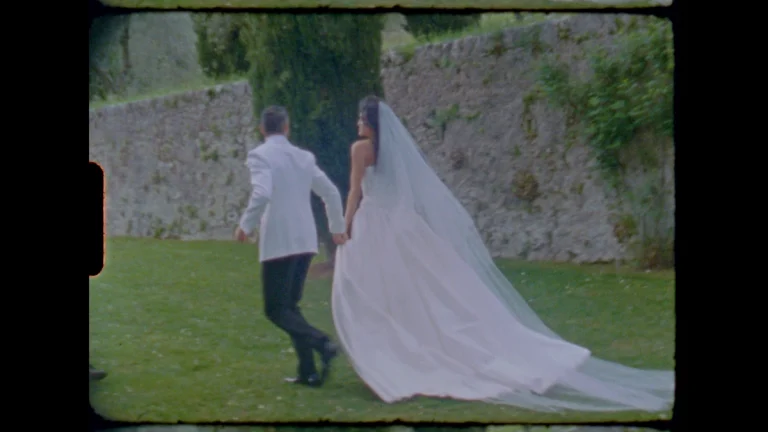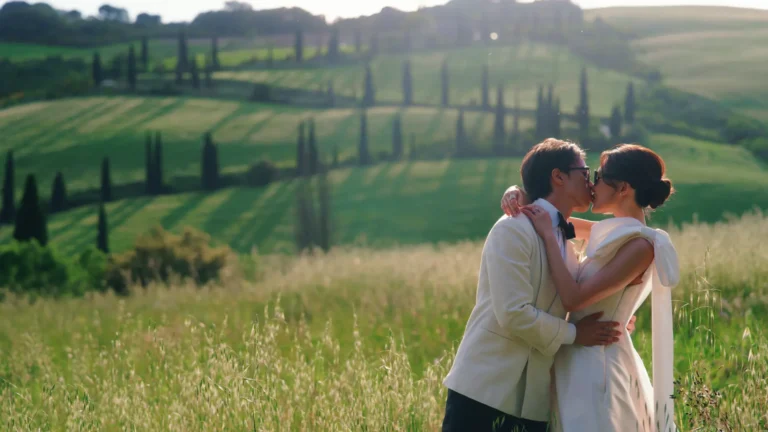


Between the last church bell and the first light on a terrace, Lake Como enters a hidden hour. The water turns the color of old brass and the mountains seem to lean in. Anyone who has stood on a balcony in Bellagio or watched a boat cut through the mist near Villa Balbiano knows it instinctively: this place needs no staging. It is already complete. This is what sets Como apart from every other wedding destination on earth. Elsewhere, elegance is often assembled piece by piece, borrowed from florists, stylists, lighting technicians, each element working to manufacture an atmosphere that feels effortless. Here, the effort has already been made, centuries ago, by the villas, the cypress-lined driveways, the stone staircases descending straight into water that has reflected weddings since long before anyone owned a camera.

A couple exchanging vows on these shores inherits a visual language that took generations to write. For a wedding videographer, this changes the nature of the work entirely. The camera is not asked to invent beauty out of ordinary rooms or flat gardens; it is asked to notice it, to follow it, to let the architecture and the light do what they have always done. A wedding film shot on Lake Como carries a different weight from the outset, not because of any trick of editing, but because the raw material itself is cinematic. Every frame inherits history before a single scene is even composed. What follows is an exploration of why this stretch of water, framed by some of Italy’s most storied villas, continues to draw couples who understand that a wedding video is not simply documentation. It is the record of a place that was already, long before their arrival, waiting to be filmed.
A Landscape That Rewrites Itself by the Hour
Morning on Lake Como belongs to mist. It settles low over the water before sunrise, softening the outline of the mountains and turning the villas along the shore into pale silhouettes, half-revealed. Anyone filming at this hour learns to work with restraint, because the light itself is doing most of the storytelling. A wedding videographer who arrives early to scout a terrace or test an angle will notice how quickly this haze burns away, how the lake shifts from silver to a clearer blue within the space of an hour. By midday, the light turns sharper and more direct, less forgiving but far more architectural. This is when the stone facades of villas like Balbianello or Pizzo reveal their texture fully, when shadows fall in clean geometric lines across gardens and staircases. It is a demanding light to shoot in, one that rewards precise framing over improvisation, and it explains why so much of the visual planning for a wedding film on Como happens around these shifting conditions rather than against them.

Then comes the hour most couples remember without quite knowing why. Late afternoon light on this lake carries a warmth that photographers and videographers alike describe simply as gold, though the color changes subtly with the season, cooler in early spring, richer and almost amber by September. It lasts only briefly, catching the water at an angle that makes every ripple look deliberate, every departing boat look staged, though nothing has been arranged at all. This is the paradox at the center of filming here. The same ceremony, held one hour earlier or later, produces an entirely different atmosphere on screen. No two weddings on Como are lit alike, which means no two wedding films can ever really repeat each other, regardless of how similar the locations might appear on paper.
Villa del Balbianello: A Set Cinema Had Already Chosen
There is a particular kind of confidence a location carries once Hollywood has already trusted it with a story. Villa del Balbianello, perched on its wooded promontory at Lavedo, has that confidence written into every terrace and archway. Long before couples began choosing it for their weddings, directors had already recognized what the eye instinctively senses here: a composition so complete it barely needs framing. Its loggia, its cypress-lined paths, its staircases descending toward the water were used as settings for Star Wars and for a James Bond installment, chosen precisely because the villa offered something no set designer could easily replicate, a sense of history married to visual perfection. This inheritance matters enormously for anyone filming a wedding here.
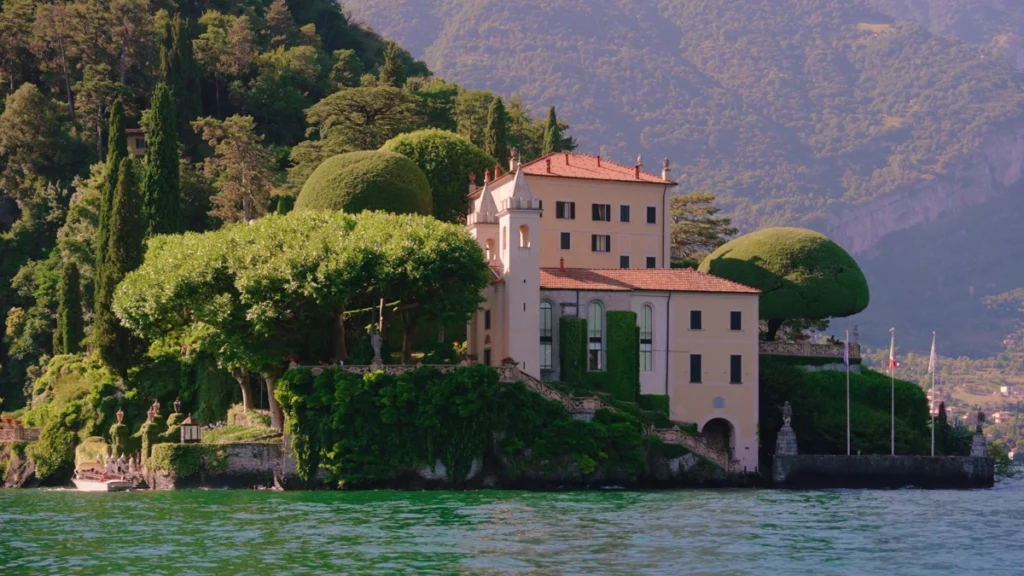
A location that has already been studied by cinematographers, lit by professional crews, and framed by some of the most demanding visual standards in the industry arrives with a kind of built-in grammar. The videographer working here is not inventing angles from nothing; he is stepping into a place that already knows how to be photographed, where the relationship between architecture, garden and lake has been tested and proven on screen. What results is a wedding film with a different register entirely. Guests walking the same paths once crossed by film crews, a ceremony held beneath a loggia recognized by audiences worldwide, an arrival by boat mirroring scenes shot for global cinema, all of this seeps quietly into the footage without ever needing to be announced. The couple may never mention the villa’s cinematic past to their guests, yet it lives in every wide shot, every slow pan across the water, giving their wedding video a visual authority that few other locations on earth could offer so naturally.
Read also: Villa del Balbianello Weddings: A Love Story Like No Other
Villa Balbiano: The Measure of Quiet Luxury
Some villas announce themselves. Villa Balbiano simply stands, and lets its proportions do the talking. Built by Cardinal Tolomeo Gallio at the close of the sixteenth century and later expanded under Cardinal Durini, the residence occupies the western shore with a symmetry so precise it reads almost like a study in restraint. Nothing here relies on excess. The largest private property on the lake achieves its grandeur through order, through the careful spacing of terraces, through gardens laid out with a mathematical sense of balance that award-winning designers have long recognized. For a videographer, this geometry becomes an instrument. The Italian garden unfolds in symmetrical lines toward the water, offering the kind of depth and structure that transforms a wide shot into something closer to architecture in motion.

Frescoes by the Recchi brothers and Agostino Silva line interiors furnished with pieces sourced from Sotheby’s and Christie’s, giving indoor sequences a texture rarely found even among Como’s finest residences. Every room composes itself before the camera arrives. What makes Balbiano particularly compelling on screen is its clarity. There is no clutter to navigate around, no competing focal points fighting for attention within a frame. The private pier extends toward the mountains in a straight, uninterrupted line, ideal for the kind of long, patient shots that let a wedding video breathe rather than rush. The pool, the boathouse, the manicured lawns descending toward open water, each element occupies its place with a discipline that mirrors the villa’s own history of hosting careful, considered elegance rather than spectacle. This is why editorial names like Harper’s Bazaar and Vogue continue returning to Balbiano when describing Como’s most photogenic addresses. The villa does not perform for the lens. It simply holds its form, and lets the wedding video inherit that same sense of measured, unshakeable composure.
Villa Pizzo and the Terraces Suspended Over Water
Approach Villa Pizzo by boat, as centuries of visitors have done, and the villa reveals itself gradually, one terrace at a time, until the full architecture of the promontory comes into view. This is a residence built to be seen from the lake rather than the road, which explains why its relationship with water feels less like proximity and more like conversation. The terraces here do not simply overlook Como. They extend the interior logic of the villa outward, dissolving the boundary between room and garden, garden and shoreline, shoreline and open water. For a videographer, this layering becomes an extraordinary tool. Standing on one of Pizzo’s suspended terraces, the camera can hold a foreground of stone balustrade, a middle layer of cypress-lined garden, and a background of open lake all within a single frame, each plane moving at its own visual rhythm.

Few locations on Como offer this kind of built-in depth, where architecture itself does the work of separating narrative layers rather than requiring multiple setups to achieve the same effect. The gardens compound this advantage. Baroque fountains and flowering hedges break up the geometry of the lawns, giving wide shots texture without clutter, while frescoed interiors flooded with natural light allow for smooth transitions between indoor ceremony moments and the terraces beyond. A wedding film shot here can move fluidly from an intimate close-up beneath painted ceilings to a sweeping exterior shot without ever feeling like two separate locations. What results is a sense of continuous space rarely found elsewhere, one where every terrace functions less as a backdrop and more as an active stage. Villa Pizzo does not simply host a ceremony. It choreographs it, offering a videographer the rare chance to build an entire visual narrative using nothing but the natural progression from one balcony to the next.
Read also: Beryl and Jimi, The Story of a Marriage on Lake Como
The Boat Arrival: Where the Story Truly Begins
Before vows are exchanged, the wedding on Lake Como has already started, the moment the first boat pulls away from shore. There is something about crossing water toward a ceremony that changes the emotional register of the entire day. The bride and the groom seated in a wooden Riva boat watch the villa grow larger against the mountains, experiencing their own private passage across the lake before stepping into a scene already populated by everyone they love. For anyone filming this moment, the boat arrival functions less like a transition and more like an opening sequence. The wake trailing behind the vessel, the light catching spray off the bow, the slow reveal of a staircase or terrace as the boat approaches its landing point, all of it builds anticipation in a way few other wedding traditions can match.

There is a rhythm to it that mirrors classic film openings, where a character enters a world gradually, framed first at a distance, then closer, until the audience finally understands where they have arrived. This explains why couples researching a wedding videographer for Como so often mention this exact sequence first. It is not simply an aesthetic preference. The arrival by boat carries genuine narrative weight, offering a beginning with built-in tension and release that a car pulling up to an entrance rarely achieves. Lake tradition itself supports this, boats having ferried guests, goods and celebrations across Como for centuries, long before cameras existed to record them. What makes the sequence irresistible for a wedding film is its unrepeatability. Wind, light, the particular angle of approach to a specific pier, none of it can be staged twice in quite the same way. Each arrival becomes its own unrepeated scene, quietly setting the tone for everything that follows.
The Invisible Direction of Flowers
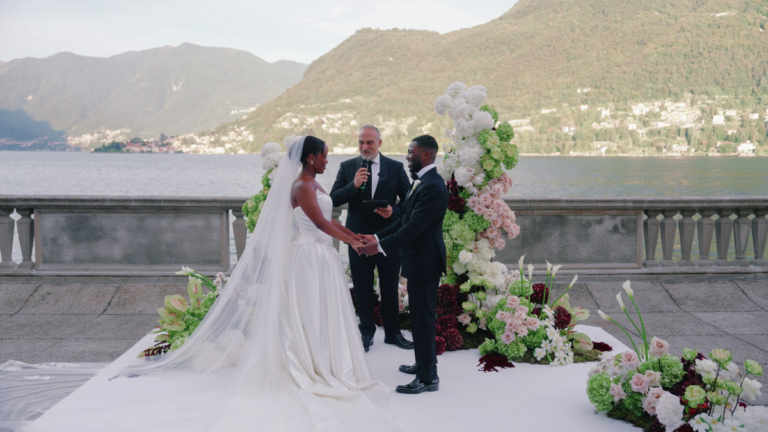
Nobody watching a wedding film thinks consciously about who chose the flowers, yet their influence runs through nearly every frame. A floral designer working at this level operates less like a decorator and more like a silent collaborator in the visual language of the day, someone whose choices about color, density and placement determine what the camera will ultimately see long before filming begins. On Lake Como, where villas already offer such rich architectural backdrops, this role becomes even more consequential, because flowers either harmonize with the existing palette of stone and water or compete against it. Consider how differently a ceremony reads on screen depending on whether the arch framing the couple leans toward soft ivories and greens, echoing the muted tones of an eighteenth century facade, or bursts with saturated color that pulls focus away from the surrounding architecture.

An experienced designer understands this interplay instinctively, selecting varieties and arrangements that respond to the specific light of a location, the texture of its stone, even the season in which the wedding takes place. This is not decoration for its own sake. It is composition, worked out in petals rather than pixels. For a videographer, this collaboration matters enormously. Flowers create depth in a frame, softening hard architectural lines or adding warmth to interiors that might otherwise read as cold on camera. A well-considered floral scheme guides the eye exactly where the couple wants attention to fall, drawing focus toward a face, a gesture, a shared glance, while everything else recedes gently into atmosphere. This is why couples planning a wedding on Como increasingly treat their florist selection with the same seriousness they apply to choosing a venue or a videographer. Long before a single shot is filmed, the visual identity of the entire wedding film has already begun taking shape in someone else’s careful hands.
Film Grain, Texture, and the View from Above
Every format carries its own temperament, and part of a videographer’s craft on Lake Como lies in knowing which one suits a given moment. Super8 and VHS bring a warmth that modern digital sensors simply cannot replicate, a softness in the highlights, a faint flicker in motion, colors that lean slightly toward amber even in neutral light. Used sparingly, these formats capture something closer to memory than documentation, particularly suited to intimate moments, a hand reaching for another across a table, laughter caught between courses at a lakeside dinner, where the imperfection of grain adds intimacy rather than distraction. Contrast this with what a drone offers. From above, Como reveals a geometry invisible at ground level, the way villas align with the curve of the shoreline, the sudden scale of a garden against the mountains, the pattern boats leave on otherwise still water.
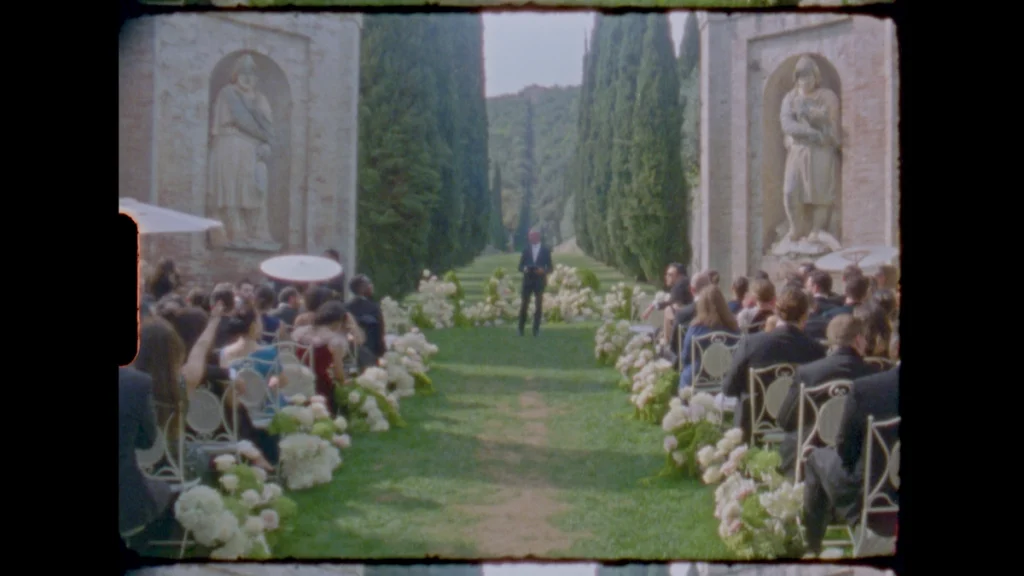
This is not simply a wider shot. It is a different narrative register entirely, one that situates the couple within something larger than themselves, a landscape shaped over centuries rather than a single afternoon. The skill lies in moving between these registers without either feeling arbitrary. A ceremony might open with an aerial pass establishing the villa within its wider setting, then descend into the tactile closeness of Super8 for the exchange of rings, before returning to crisp digital footage for a formal group portrait later in the day. Each format answers a different question about the same event, distance versus proximity, spectacle versus tenderness, and Como’s varied terrain, its water, its terraces, its elevated gardens, gives a videographer genuine reason to use all of them within a single wedding film. What emerges from this layering is texture rather than repetition, a sense that the day has been observed from multiple distances and multiple emotional temperatures, each format doing precisely what it does best.
Read also: Super 8 Wedding Videography in Italy: The Vintage Film Trend Every Couple Loves
A Setting No Other Place Replicates
Other lakes have beauty. Other regions have history, architecture, even their own particular quality of light. What Como offers is the rare convergence of all three, refined over centuries into something that functions less like scenery and more like a collaborator in whatever story unfolds against it. Villas that once hosted cardinals and philanthropists now open their loggias to modern ceremonies, carrying forward an aesthetic lineage no newly built venue could manufacture regardless of budget or ambition. This is why comparisons to other destinations tend to fall apart under scrutiny. A villa on the Amalfi coast offers drama through elevation and sea. A château in the Loire offers grandeur through scale. Como offers something quieter and, for a videographer, considerably more valuable: proximity.

Water sits close enough to reflect the architecture directly, mountains rise near enough to frame every wide shot without needing distance, and gardens step down toward the shoreline in a continuous visual line rarely found where geography is less generous. The particular alchemy of Lake Como, its shifting light through the day, its villas already fluent in cinematic language, its terraces built for layered depth, its tradition of arrival by boat, cannot be transplanted elsewhere. Attempt to recreate it and something essential goes missing, the specific angle of afternoon sun off this particular water, the exact tone of these particular stone facades weathered by exactly this much time. For couples choosing where to marry, and for anyone shaping the visual record of that day, this matters beyond aesthetics. It determines whether the finished film feels like documentation of an event or like something closer to authorship, a place that contributed as much to the story as the two people at its center. On Como, the landscape does not simply witness the wedding. It writes alongside it.