

When a couple starts looking for a wedding videographer, the internet drowns them in 60-second content. Reels built around a single perfect frame. Trailers cut to swelling orchestral music. Sneak peeks engineered to catch attention in the first three seconds before the algorithm scrolls on.
All of this is useful for understanding a studio’s aesthetic. It is not enough to understand whether that videographer actually knows how to make a film.

A reel does not show how a videographer handles the dead time between the ceremony and the cocktail hour. It does not show what they do with a flat, harsh light at three in the afternoon, when there is nothing remotely romantic about the air. It does not show whether they can hold a narrative rhythm for ten minutes without losing the attention of someone who is not the couple watching their own wedding back through tears, but anyone else who opens that file.
We have chosen to show our complete films. Not the best moments. The entire film, exactly as it was delivered to the couple. Because we believe it is the only honest way to answer the question every couple should ask before signing a contract: what, exactly, am I going to receive?
Below you will find five films. Five weddings, each different in location, atmosphere, culture, and emotional register. Watch them with attention. Then decide.
Before You Watch: What to Actually Look for in a Complete Film
Most couples watch a wedding film and feel emotion. That is good. But before choosing a videographer, it is worth knowing what separates a well-made film from one that only seems well-made in the trailer.
The rhythm over time. A trailer can be built around six perfect shots. A complete film has to sustain its rhythm for ten, twelve, sometimes fourteen minutes. This requires a narrative ability that has nothing to do with camera technique. It is editing. It is knowing what to keep and what to leave out. It is a sense of time that either exists or it does not.

Light management in uncontrollable moments. The getting-ready shots in a hotel room with mixed artificial light. The outdoor ceremony under midday sun. The cake cutting at eleven at night with a single ambient source. These are the moments where the difference between a videographer and a filmmaker becomes impossible to hide.
How speeches are handled. A complete film almost always includes at least part of the guests’ speeches. The way they are treated reveals everything: are they a narrative element, integrated into the story? Or are they a clip spliced in because the couple asked for it?
The audio. In reels, the original sound is almost always replaced by music. In complete films, it coexists with it. The quality of ambient audio, the voice during the vows, the sound of the room during dinner — these are things only a complete film can reveal.
Film One: Helen and Joshua – Villa Cetinale, Tuscany
Helen and Joshua are an American couple who chose one of Tuscany’s most private and architecturally severe estates for their wedding. Villa Cetinale, near Siena, is not a venue that forgives lazy filmmaking. Its light is theatrical and demanding. Its spaces alternate between open courtyards, dense woodland, and interiors that shift from monastic to intimate. For a videographer, it is a location that asks you to make constant decisions.
What makes this film worth watching closely is the format choice. We shot it blending digital cinematography with real Super 8 and VHS footage, not as an effect, but as a structural decision. The grain and warmth of the analog material carry a different emotional register than the digital frames: rawer, more immediate, more private. Watch how the two formats speak to each other across the edit. The result is not a stylistic experiment. It is a coherent visual argument about what memory actually feels like.
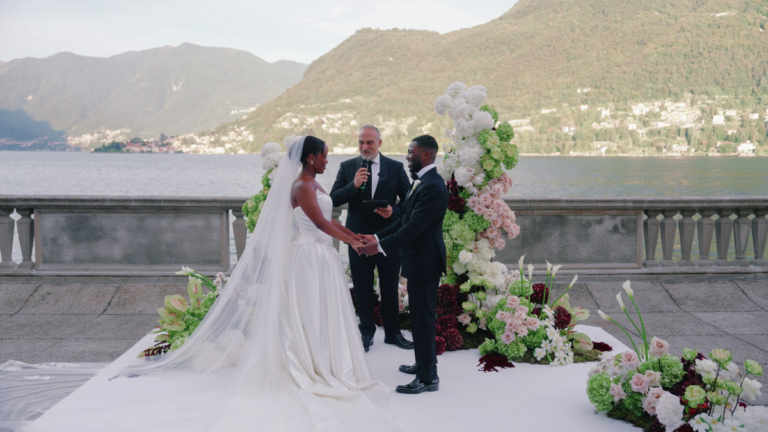
Film Two: Beryl and Jimi – Villa Pizzo, Lake Como
Lake Como is one of the most photographed places in the world. It is also one of the most difficult locations to film a wedding without falling into postcard territory. The light on the water changes every hour. The depth of the gardens creates exposure challenges that cannot be solved in post. And the energy of a wedding like Beryl and Jimi’s — vibrant, colorful, full of music and spontaneous movement — demands a camera that can follow without intervening.
Watch this film for two things specifically. First, the camera’s relationship to the guests: it is never intrusive, never staging, always finding the frame within what is already happening. Second, the way the lake itself is used — not as backdrop, but as a character with its own light and rhythm that shapes the pacing of the edit. The film breathes at the same rate as the water. That is not an accident.
Film Three: Claudia and Kyle – Belmond Hotel Cipriani, Venice
This is the wedding that Vogue covered. The Belmond Hotel Cipriani sits on the Giudecca island, separated from the rest of Venice by a stretch of water that catches light differently at every hour of the day. Claudia and Kyle’s wedding was a three-day celebration, and the film carries the weight of that duration without feeling long.
What makes Venice genuinely difficult to film is not its beauty but its architecture. The city does not have the open sightlines of Tuscany or the natural depth of a lakeside setting. Every frame is a negotiation with narrow calli, reflective water, and interiors that shift between gilded and shadowed within a few steps. Watch how the edit handles the transitions between inside and outside, between the intimate and the grand. And watch the ceremony sequence closely: the quality of the audio in a historic Venetian space, with natural reverb and the sound of water underneath everything, is something a trailer has never once shown you.
Film Four: Kristina and Kasil – Villa del Balbianello, Lake Como
Villa del Balbianello is perhaps the most cinematically recognizable location in Italy. It has appeared in Star Wars, in Casino Royale, in countless fashion editorials. Every couple who gets married here knows they are choosing a place with visual weight. The challenge for a videographer is precisely this: to make a film that belongs to Kristina and Kasil, not to the architecture.
What this film demonstrates, more clearly than any of the others, is the handling of a speech. Watch the moment Kristina’s mother speaks. The audio is clean. The framing is present but not intrusive. The edit lets the moment breathe at its natural length, without cutting to coverage too early or holding too long. That judgment — when to stay, when to move — is the hardest thing to teach and the easiest to get wrong. It is also something you will never see in a trailer.
Film Five: Amy and John – Tenuta Corbinaia, Tuscany
Tenuta Corbinaia is an organic farmhouse in Montespertoli, thirty minutes from Florence. It is not Villa Cetinale or Balbianello. It does not have their architectural prestige or their cinematic legacy. It is an estate that works through atmosphere: the quality of the light on the Tuscan hills in late afternoon, the cypresses casting long shadows across the lawn, the organic warmth of a place that has not been designed for photography.
This film is here precisely because it is the hardest kind of wedding to make beautiful. There is no iconic skyline. There is no lake. The work is entirely in the light reading, the framing of domestic spaces, the patience to wait for the right moment in a setting that does not hand them to you. Watch Amy walking through the Italian garden toward John. That sequence was not staged. That is what it looks like when a videographer reads a location correctly and is in the right place before the moment happens.
After Watching: What This Actually Means for You
If you have watched these five films, you now know more about what you are choosing than most couples ever find out before booking.
You know what our color palette looks like across different light conditions. You know how we handle audio. You know our relationship to the camera — when we move, when we stay still, when we let a moment unfold without cutting. You know what ten to twelve minutes of your wedding day will feel like when it comes back to you.
The reel is the introduction. The film is the conversation.
If you feel that what you have seen here reflects the way you want your wedding remembered, we would like to hear your story.
Frequently Asked Questions
How long is a complete wedding film? Our standard films run between 7 and 15 minutes. Alongside the film, couples receive a trailer of 1 to 4 minutes and, where requested, documentary extras including full speeches, first dances, and other specific sequences. The length of the complete film is always agreed on before the contract is signed.
Are these the actual films delivered to the couples? Yes. What you see on this page is exactly what the couple received. Nothing has been re-edited or recut for public presentation. The only difference is that some clips may be slightly shorter where couples have asked for personal moments to remain private.
Why do most videographers not show complete films? We cannot speak for others. We can say that publishing a complete film requires confidence in the full arc of the work, not only in the moments that are easiest to make look beautiful. We publish ours because we believe a couple deserves to know what they are choosing before they choose it.
What is the difference between a trailer and a complete wedding film? A trailer is an emotional summary, designed around the strongest visual moments and the music that carries them. A complete film is a narrative. It has a beginning, a middle, and an end. It includes the quiet moments, the transitions, the atmosphere between one sequence and the next. A trailer can be extraordinary and still tell you almost nothing about the filmmaker.
Can we see more complete films before contacting you? Our journal contains several complete films published alongside their stories. You can find them in the Film section of this site.