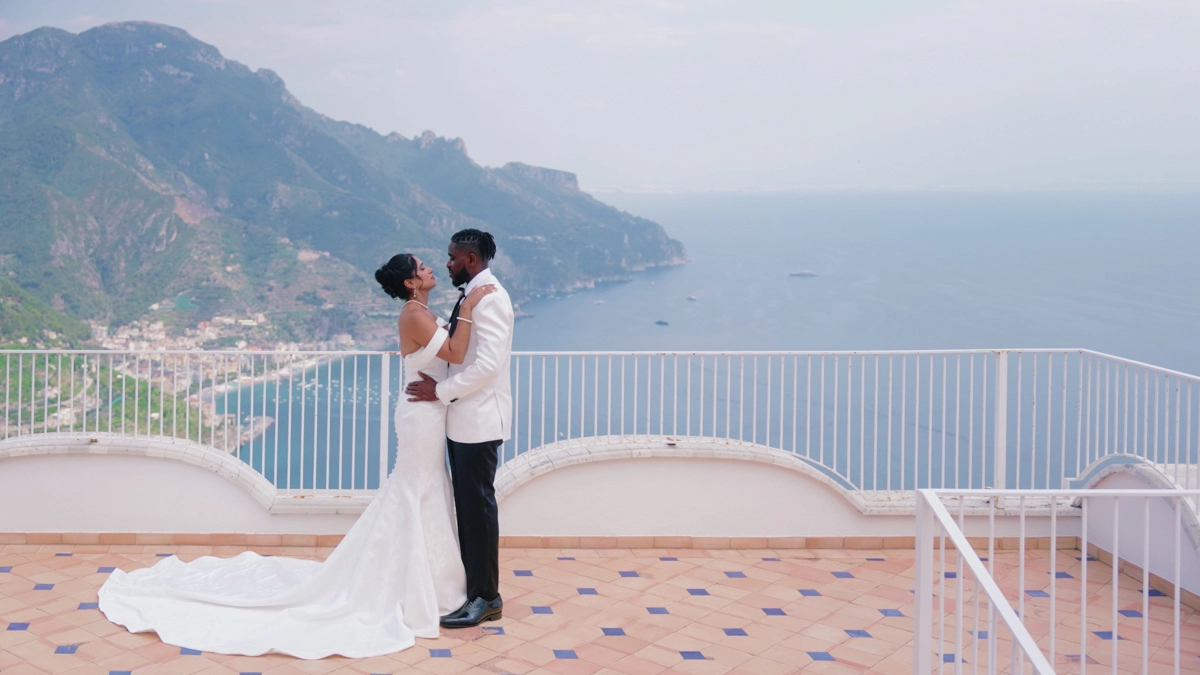

Among the questions that arise during conversations between videographer and couple, one remains among the most elusive: the one about the length of the video.It is not only a matter of minutes, and for this reason there is no single correct answer. It concerns the way a story is observed, interpreted, and returned: a wedding video shaped by a conscious vision is not measured in quantitative terms, but through the internal rhythm it is able to build, the quality of the gaze, the ability to hold attention and, above all, to describe with precision the essence of the couple. If you want to understand what that rhythm feels like across ten to fifteen minutes, watch five complete films here.

Contemporary wedding videography moves within a hybrid territory, where cinematic language and documentary sensitivity meet and rebalance. In this space, duration becomes a natural consequence of directorial choices: the time given to a gesture, a light that shifts, a silence that gains weight. This is where the videographer’s work takes shape, shaping a visual narrative that does not try to retain everything, but to return what truly remains. Within this perspective sit the different formats that we at Thirtyfive Studios have chosen to tell the soul of your day.

The wedding film in its most developed form, capable of building a complete narrative; the trailer, brief and incisive; the reel, designed for immediate viewing; the documentary film, built on a broader continuity that stays close to real time. Four distinct approaches, each with its own identity, not driven by a fixed rule but by a precise intention. Understanding which duration is most suitable therefore means entering into these differences, recognizing the value of each choice and, above all, understanding what kind of story you wish to inhabit over time.
Beyond minutes: why a wedding video?
Before considering the ideal length of a wedding video, it is worth pausing on a more essential question: why does a couple feel the need for a wedding film? The answer does not belong to the logic of archiving, nor to a simple desire to document. It concerns a form of deferred presence, the desire to return to a time that, as it unfolds, is already slipping away. Photography holds the moment, makes it definitive. Video, instead, preserves what moves and transforms, offering the possibility to relive the intangible. The tone of voices, a hand reaching for another, the uneven rhythm of the dances. These are details that do not reveal themselves immediately, they require time to emerge.
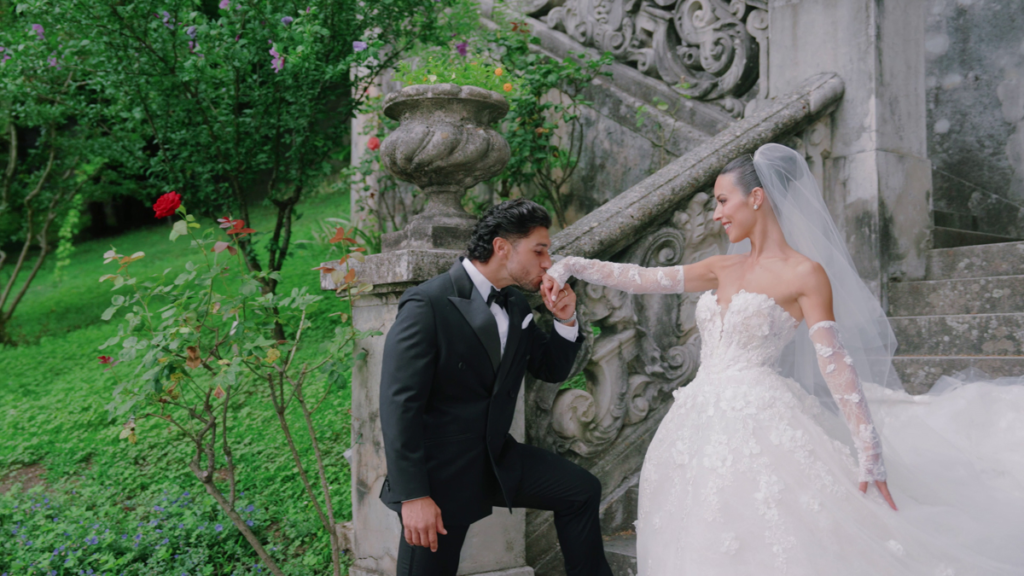
For this reason, wedding videography engages with a more subtle dimension, tied to perception and sensory memory. Speaking in terms of minutes therefore risks being misleading: the duration, in a meaningful wedding video, is not an arbitrary figure but a consequence of direction. It comes from the way images are conceived, from the time given to a glance, from the decision to interrupt or extend a sequence. Editing becomes an act of writing and narration, capable of shaping intensity and breath, of creating a balance between what is shown and what remains implied. A compelling visual narrative does not accumulate sequences, it selects them according to a coherent emotional trajectory. The videographer therefore becomes a guardian of time, and their work the instrument that preserves living emotion, transforming an event into an enduring narrative.
Our vision: the art of narrative synthesis
Our main format takes shape at that point of balance where the story finds a complete form without dispersing. It is a duration that ranges between seven and twelve minutes, a choice that reflects a precise idea of narration: intense, measured, yet capable of holding the gaze until the final frame. Here it becomes clear why editing and montage carry almost the same weight as filming: the videographer acts like a tailor, selecting and weaving together the most meaningful moments to distill the essence of an entire day into a fluid narrative. The collected material is observed, listened to, and each sequence is evaluated for what it adds to the story, for its ability to engage with other images, for the rhythm it introduces.

The videographer enters an almost artisanal dimension, where selection becomes an act of precision and responsibility. Technique here becomes narration, ensuring that every second is necessary and meaningful: some moments are allowed to breathe, others are only lightly touched, suggested through visual or sound associations. Light often guides these transitions, as does sound, which may emerge discreetly or remain suspended. Nothing is superfluous: each frame carries its own weight, each cut contributes to defining the internal rhythm of the visual narrative, and the experience unfolds naturally in all its depth.
Read also: Directing, Editing, Storytelling: Behind the Scenes of a Wedding Film
The trailer: a brief, incisive gesture
In our work, the trailer occupies a precise space, almost instinctive. It has a contained duration, between one and three minutes, and concentrates in a few passages a clear, recognizable vision. It does not try to tell everything, nor to suggest a linear sequence of events. It works instead on impression, on what remains caught at first glance. Direction here is more essential. Images are selected for their immediate strength, for the quality of light, for the tension they can generate even when isolated from context. Editing accelerates, shortens distances, builds a tight rhythm that carries the viewer without allowing distraction. Sound, often guided by a single musical choice, amplifies this intensity and defines the overall tone of the wedding video.

The trailer functions as a threshold. It introduces a visual universe and makes it accessible in a few moments, while preserving its aesthetic identity. It is one of the formats that most closely engages with the present, with fast and shared viewing, often experienced on small screens and within limited time. For this reason it requires even greater care: each frame must be clear, incisive, capable of communicating without relying on duration. The trailer represents a high impact synthesis, a statement of style. In just a few minutes it suggests atmosphere, rhythm, character. And it reveals, with almost immediate clarity, the essence of the couple.
The reel: immediacy and contemporary language
In the current landscape of wedding videography, the reel represents an agile form, built to capture a quick yet demanding gaze. Its short duration, around one hundred and twenty seconds, requires an extremely precise visual writing. There is no room for hesitation, nor for intermediate passages. Each image enters the scene with a clear function, each cut supports a rhythm without any dispersion. This format emerges in direct dialogue with the codes of contemporary viewing and social media. Vertical screens, fragmented attention, the need to capture interest within a few moments. Yet, when guided by experienced direction, the reel never slips into superficiality. On the contrary, it refines the language of the wedding video, making it more essential, more instinctive.

Here, the work of the videographer focuses on an even more radical synthesis than the trailer. Images are chosen for their immediate visual impact, for their ability to convey atmosphere without the need for context, and here too light takes on a decisive role. The key word is dynamism: movement is often more pronounced, more visible, and editing is tight yet controlled, in a progression where rhythm becomes the structural core of the narrative. In this short form, the wedding film moves closer to an almost editorial, artistic language. It captures, suggests, leaves a clear trace. It is a fragment that lives independently, designed to be shared, revisited, recognized. And precisely in its brevity it reveals a specific quality: the ability to condense a visual identity into a few seconds, without losing coherence or depth, like a moving still.
The documentary film: complete memory
There is also a form of wedding video that deliberately gives up synthesis to move closer to a more extended, continuous rendering, aligned with real time. Our documentary film belongs to this dimension, with a duration of around forty five minutes and a structure that follows the natural order of events. Here, direction becomes more discreet, steps back, and leaves space for the authentic progression of the day. In this format, the choice to retain original audio profoundly changes the perception of the visual narrative. Voices are not filtered through a soundtrack, but emerge in their real quality, with pauses, imperfections, and shifts in tone. Ambient sounds, co protagonists in other formats, gain substance here and move to the foreground. The passage of time is felt, the change of light, the genuine presence of spaces.

In this type of wedding videography, editing does not construct a narrative in the traditional sense, but works through continuity. Scenes follow one another with a more relaxed rhythm, more closely reflecting the internal duration of each moment. There is no intention of synthesis: the experience is presented in its entirety, with a fidelity that privileges memory in its most direct form. The documentary film requires a gaze capable of observing without intervening, of recognizing when to stay and when to let things unfold. The videographer accompanies, records, selects with restraint. The final perception is that of an almost private dimension, intended for a more intimate, more personal viewing, where time is not shaped but experienced.
Rhythm, music, silence: shaping internal time
The cinematic language applied to wedding videography has a complex, specific grammar. The perception of time almost never coincides with its actual duration, but arises from a more subtle construction, made of editing choices, sound, and the interplay between images. The day itself offers a structure rich in variation. The moments of preparation move with a contained slowness, shaped by repeated gestures, waiting, details that emerge in stillness. Light enters the rooms gently, accompanies movement, draws delicate figures within beautifully frescoed halls. Then the ceremony arrives, and time changes its texture. Pauses grow denser, gazes become steadier, voices take on a different weight. Editing respects this tension, allowing sequences to unfold while guiding attention with discretion, through the monumentality of spaces, terraces, and gardens.

In the final part of the day, during the celebration, the energy shifts again. Movement expands, the scene opens, the dynamics of dancing and toasts introduce a more pressing rhythm. Here the visual narrative can accelerate, fragment, play with sharper contrasts. Music becomes a structural element, not a simple accompaniment. This balance between fullness and absence, between presence and restraint, gives presence and substance to the wedding film. Internal time does not follow a uniform line, but is shaped according to the intensity of each moment. And when this modulation is coherent, duration is no longer perceived as a limit and becomes an integral part of the experience.
Read also: Music and Audio: Transforming Your Wedding Video into an Emotional Experience
Each couple has its own film
Every wedding film is born from a unique and unrepeatable alchemy. Each time, the people change, the locations, the quality of light, the way events unfold and are experienced. Even when the structure of the day appears similar, the perception is always different. It is precisely within this continuous and inexhaustible variation that the possibility emerges to build a visual narrative that does not replicate, but interprets. Duration therefore ceases to be a rigid parameter: it adapts to the density of the story, to the natural rhythm with which it develops, to the amount of narrative material that emerges during filming.

Some weddings require space, broader pauses, a time that stretches to accommodate gestures and relationships. Others call for a more compact construction, where intensity is concentrated and editing proceeds with greater incisiveness. The cultural dimension also plays a subtle but decisive role. Different traditions, rituals, and forms of collective participation influence the way the wedding film takes shape. The videographer engages with these variables, observes them, absorbs them, without standardized protocols but with curiosity and openness.

Direction adjusts accordingly, calibrating distance and involvement, choosing when to adhere and when to filter. This attention to specificity concerns not only aesthetics, but the very meaning of the narrative. A wedding video built with this sensitivity conveys an authentic presence, recognizable over time. There is no single correct duration. There is the one that belongs to that story, to that context, to that gaze.
The viewer’s experience
A wedding video does not exhaust its function at the moment it is delivered. Rather, it begins a second life, made of repeated viewings through ever changing eyes. The gaze of the viewer shifts, the context changes, even the way certain images are perceived evolves. This is the deeper meaning of wedding videography: the ability to remain engaging even as time moves further away from the event. The first viewing has an immersive, almost total quality. Familiar faces are recognized, voices are heard again, details are noticed that had gone unseen in the rush of the day.

Afterwards, the experience changes, renews itself. Some sequences gain prominence, others remain in the background only to return to the foreground in a later viewing. Careful editing, a conscious use of light, a well defined aesthetic coherence allow the visual narrative to maintain a living tension without losing intensity. A wedding video is meant to be revisited, relived, both in an intimate and private dimension and within shared contexts. It circulates, it is shown to different people, in different settings.
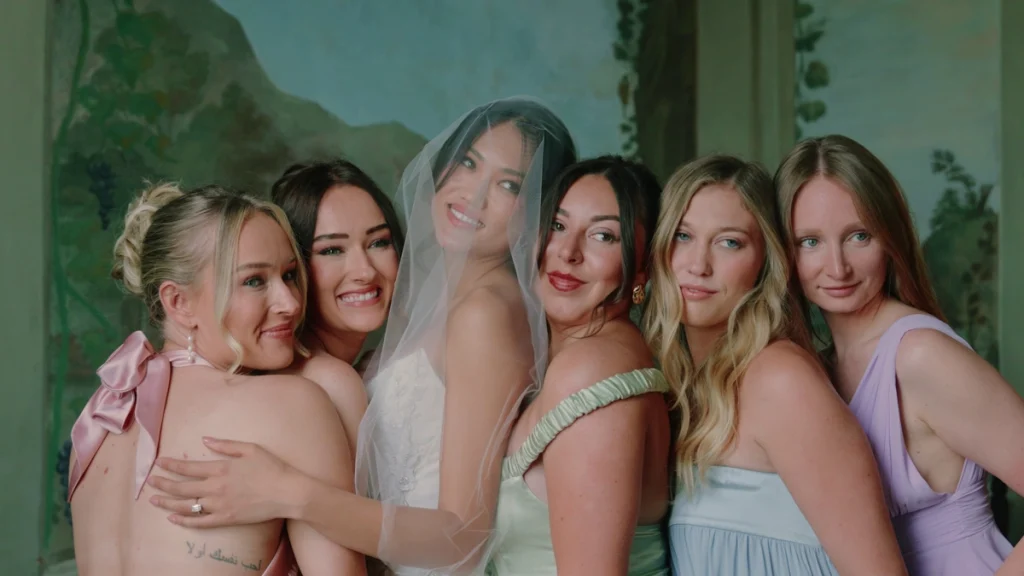
In every case, it retains its own identity, always recognizable. This dual nature requires a precise construction, capable of speaking to those who were present and, at the same time, to those observing from the outside. As the years pass, its value deepens. Certain gestures, certain presences and memories, take on different meanings. The videographer also works for this extended time, delivering a film that can be encountered by future gazes, perhaps still distant, yet already implied.
A recognizable signature
Every wedding film carries a precise trace, perceptible from the very first seconds. It is not only about aesthetics, but about the way images are conceived, placed side by side, allowed to breathe. It is a matter of perspective. Some works lean toward a more cinematic construction, where direction intervenes with clarity, shapes the light, lingers on the most refined details, and pursues a rigorous, editorial visual coherence. Others move closer to a more documentary sensitivity, allowing events to emerge with greater freedom, welcoming the unexpected, maintaining a more discreet distance.

The choice of tools also contributes to defining a unique style. The use of high definition digital cameras often coexists not only with drones, but also with the introduction of analog formats, capable of rendering a softer grain, a less uniform texture, a light that feels more nostalgic and emotive. These are decisions that influence the overall perception of the visual narrative, guiding the wedding video toward a specific atmosphere. Within this framework, duration takes on a more articulated meaning. It is not an isolated value, but a direct consequence of formal choices and the intentions of the film.

A certain type of editing requires space to unfold, to build rhythm and narrative continuity; another, more essential and immediate, concentrates intensity within a shorter time. The coherence between language and duration becomes essential. When this relationship is well balanced, the wedding video maintains a constant tension, without dispersion or forced compression. It is within this coherence that a soul becomes recognizable. Not an imposed mark, but a living presence that runs through the film with natural ease, offering the couple a narrative that could belong to no one else.
Read also: Documentary vs Cinematic Wedding Film: Which Style Is Right for You?