

The last light of the day hits the dry-stone walls at an angle that exists nowhere else on earth. Olive trees bent by the wind cast long shadows across pale stone. The Adriatic moves slowly on the horizon while the breeze carries salt and wild rosemary. Puglia is a region that gets under your skin and stays there, with its unhurried pace, its blinding light, its clean flavors and the smell of the sea that follows you everywhere.

This identity as a maritime, slow-living region is steadily establishing Puglia as one of Italy’s most visited destinations, drawing an ever-growing number of international couples to Southern Italy for high-end celebrations. The Puglia destination wedding has become, in recent years, a well-established phenomenon in the luxury segment, partly because the region has responded to rising tourist demand by raising the bar on services and hospitality. Couples who come to Puglia are looking for something specific: authenticity, genuineness, natural beauty that hasn’t been staged or manufactured, combined with an experience that is still refined and exclusive.

In many ways, Puglia has held on to something wild and unpolished. It entered the mainstream tourism circuit only relatively recently, which means it has managed to preserve a rich heritage of traditions and landscapes that remain largely untouched, elements that have become deeply defining features of this land over time. That authenticity shows up in rural architecture and open countryside, but also in everyday gestures, in the unhurried rhythms of local life and in a food culture that rejects artifice in favor of flavors that are essential and deeply rooted. In this fragile balance between openness and preservation, Puglia has found its strength: a place that knows how to welcome without losing itself, and how to tell its story without reducing it to a postcard.

This piece will take you into the heart of that untamed land. It offers a privileged look at what it truly means to have a luxury wedding in Puglia: the territory and its defining qualities, the venues that have shaped the history of Italian destination weddings, the story of Erica and Gerard’s wedding, and the essential role of the wedding film in crystallizing all of it into something that lasts.
Puglia, a region worth discovering
Puglia is layer upon layer of things. Crystal-clear water breaking against cliffs or dissolving into fine sand. Vast countryside dotted with dry-stone walls and whitewashed trulli. Fortified masserie, born as agricultural outposts, that have grown into architecture with an almost hypnotic pull. Hill towns painted entirely in lime-white, where the Lecce baroque erupts across facades of local stone carved like lacework. Byzantine art in cave crypts, rural minimalism in peasant buildings.

This complexity has deep roots. Puglia has been a crossroads of civilizations: Greeks, Romans, Byzantines, Normans, Swabians, Spaniards. Each left a mark on the architecture, the language, the food. And that is precisely where the difference lies between the postcard version of Puglia and the real one. The first is built on cliches and overexposure. The second reveals itself only to those who know how to look and are willing to explore. You might stumble on a masseria hidden among the olive trees, a small cove reachable only on foot, a family-run restaurant serving fresh raw seafood on bare tables. This is the Puglia that draws people who want exclusive experiences without ostentation, luxury that comes from substance rather than appearance.

Then there is the light. A fundamental element for anyone who works with images. The light in Puglia is strong, warm, almost tangible. In summer it burns away clean edges and flattens shadows. At sunset it turns to thick honey running down every surface. That quality of light cannot be replicated anywhere else. For wedding photography and videography, it is an enormous technical advantage.

A masseria wedding or a sea-view wedding in Puglia works so well precisely because of this combination of factors. The spaces are generous but hold a particular sense of intimacy. Privacy is built into the landscape itself: large properties, real distance between one venue and the next. The pace is naturally slow, never frantic. Local craftsmanship produces things that are genuinely unique. The food is rich, rooted in the territory, full of surprises. And the hospitality still carries something that feels like family.
Read also: Weddings in Italy’s Art Cities: Celebrating Love Amidst History and Beauty
Il Ristorante dell’Isola and Castello Monaci: two ways to experience a wedding
A wedding venue is not just a space. It is the stage where the story unfolds, the environment that sets the rhythm and atmosphere of your wedding day. Erica and Gerard chose two completely different locations for their celebration. Both luxury, but with opposite personalities. One intimate and suspended in time, Il Ristorante dell’Isola, and the other monumental and deeply rooted in its territory, Castello Monaci.

There is a precise moment when you know you have arrived at Il Ristorante dell’Isola: when the car stops and you leave solid ground behind. From that point on, there is only a walkway over water. Il Ristorante dell’Isola is an experience suspended between sky and sea, quite literally. It sits on a small island accessible only on foot along a narrow path that cuts across the lagoon. The isolation is physical at first, but it quickly becomes something internal too, as the sound of water replaces every other noise and the light, reflected off the surface, multiplies and softens into gentle shadows. It is a perfect setting for intimate moments like a welcome dinner the evening before the wedding or sunset aperitivos where the sun drops directly into the Adriatic.

Castello Monaci is an entirely different story. It is a historic estate set in the Salento countryside, surrounded by vineyards that stretch as far as the eye can see. Built in the 1500s, as documented in the Catasto Onciario of Salice Salentino, it takes its name from a community of Basilian monks who used it as a place of worship, meditation and shelter for those in need. The spaces are generous: tree-lined avenues, internal courtyards, frescoed rooms, panoramic terraces. The architecture carries centuries of accumulated history, visible in the eighteenth-century additions built around a medieval tower. That spatial complexity makes it an ideal setting for exclusive multi-day weddings in Puglia.
How Erica and Gerard celebrated their wedding in Puglia
Erica and Gerard are pure energy. You can see it in the way they look at each other, in how they fill a room, in the ease with which they move through every moment without forcing anything. You don’t need to know their whole story to understand that they are completely present, here and now, in everything they are living. The morning moves slowly, suspended. Preparations that carry the feeling of sweet anticipation, of that quiet moment just before everything changes forever.

Then comes the first look with the bride’s father. Erica turns, and he sees her in her full beauty as a woman about to become a wife. There is an endless pause, a look that holds years inside it. The emotion stops just at the edge of tears, held back but impossible to miss. Then the ceremony. When Erica walks toward Gerard, something in him gently gives way. The tears come naturally as he watches her move toward him, toward their life together. There is no embarrassment, only raw truth. It is one of those moments no screenplay could ever write, because it comes from a love so real it is almost painful in its beauty.

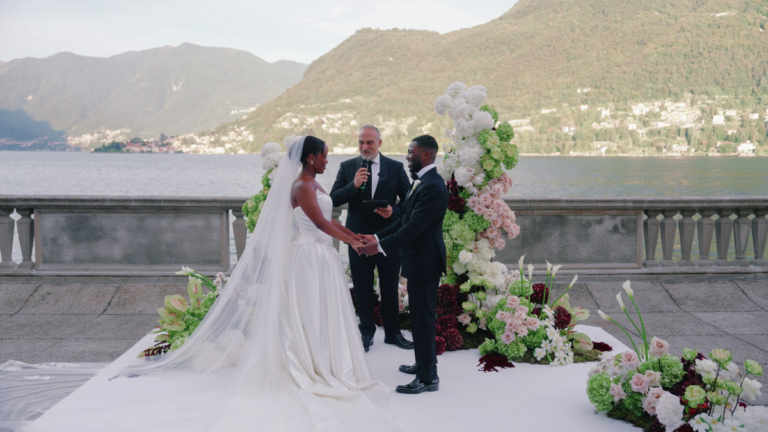
The rite they chose is a Filipino Christian ceremony, one that follows very particular traditions. The Yugal, a cord that physically binds the two spouses together, is a symbol of two lives becoming a single story. Then the white veil, draped over both their shoulders like a visible blessing, a protection that unites them under the same sky. These are gestures that speak of eternity, of promises that outlast time. After the ceremony, a vintage Italian car becomes their private world. Light playing across their faces, wind in their hair, smiles that say “We did it, we are husband and wife”. It is breath, it is closeness, it is the moment when everything slows down before it erupts.

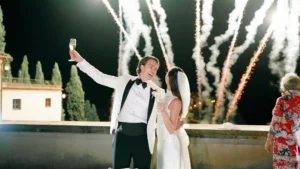
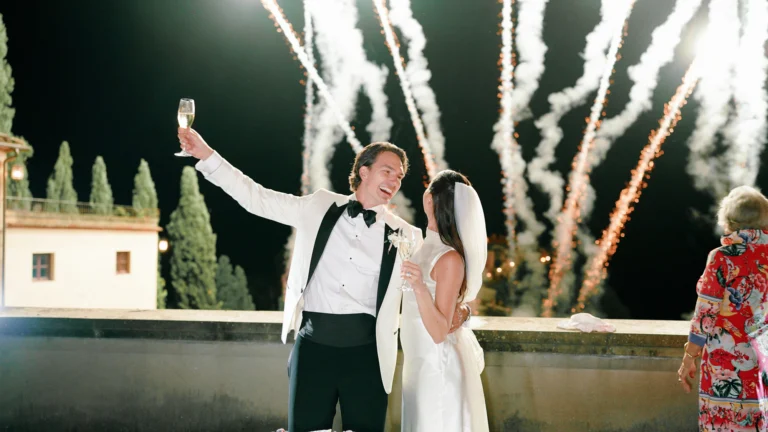
And it does erupt. The reception is not a reception at all. It is a celebration of love translated into music. Performers, singers and musicians turn the party into a concert where the only thing that matters is feeling, moving, letting yourself be swept away. The energy builds like a wave, bodies dancing without a single thought, nothing but pure joy filling every corner of the space. To witness Erica and Gerard’s wedding was to see love in all its forms: tenderness, passion, sacredness, celebration. A day lived with wide-open hearts, where every emotion found its perfect moment to bloom.
Read also: Beryl and Jimi, The Story of a Marriage on Lake Como
Why your wedding film is the only thing that truly stands the test of time
Modern trends in wedding videography are pushing the medium further and further from simple reportage and closer toward a genuinely cinematic language. Videography is becoming intimate cinema: an approach that borrows from auteur documentary the ability to observe without intruding, and from narrative filmmaking the construction of a story with a beginning, a development, an emotional climax. The result is a film that is not only visually beautiful but a work that holds up over time and lives on in memory. The difference becomes clear years later. A video built on effects and current trends ages quickly.

A video that chose substance and emotional honesty stays relevant, because it gives back what was actually there on that day: real looks, spontaneous gestures, authentic atmosphere. Puglia lends itself naturally to this kind of storytelling. The spaces don’t confine, they breathe. The light doesn’t need to be corrected or compensated for, it needs to be followed. The silences carry weight: wind through the olive trees, the sea in the background, voices echoing through an empty masseria. The rhythm is already written into the land itself, slow but never dull, dense without being heavy.

For us as wedding videographers, these elements are narrative tools before they are technical ones. Every location offers different possibilities, but all of them demand the same approach: waiting for the right moment without forcing it. Working with available light, not against it. Moving invisibly among the guests, capturing emotion without manufacturing it. The human connection matters as much as the technique. A wedding videographer working in the luxury segment understands that presence must be discreet but never absent.

Trust is built before the wedding day, through shared time. The couple needs to forget the camera exists, and that only happens when the person holding it knows when to disappear and when to be there. The wedding film starts from this understanding: it is not documentation, it is interpretation. Every choice, from framing to editing to sound design, serves the story. The craft is there, but it stays invisible, and what remains is the essence. Because in the end, when the party is over, when the flowers have wilted and the guests have gone home, the film is what’s left. And it is the only medium capable of giving back voice, movement, atmosphere. Photography freezes the instant. Film gives back lived time.
Read also: Film Frames: Telling a Wedding Story Through Video Alone