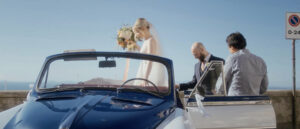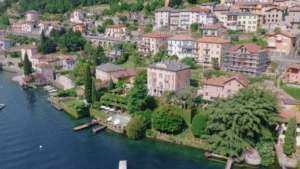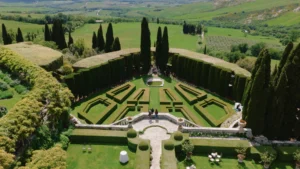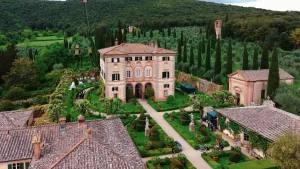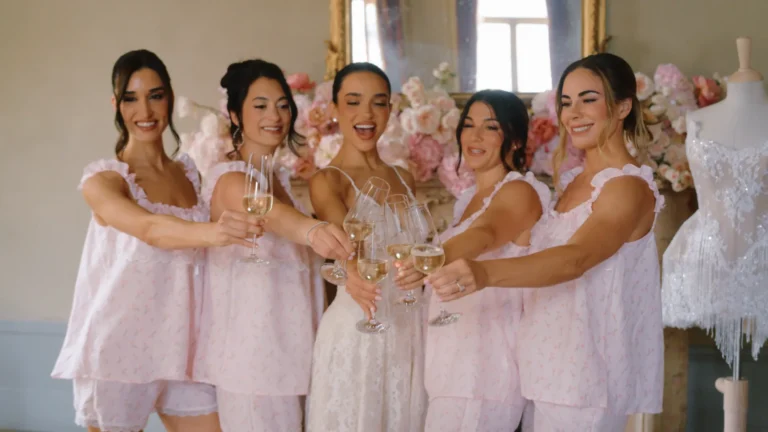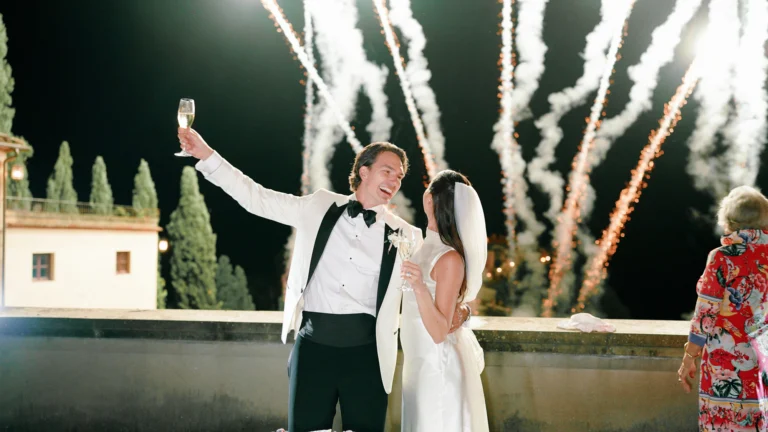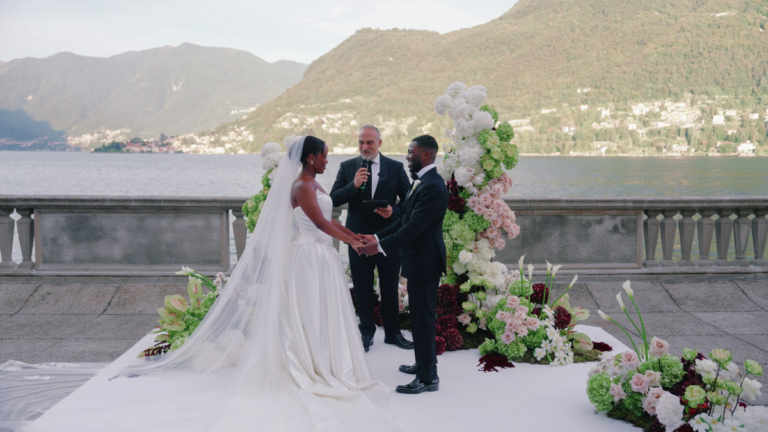


The images you are looking at appear to tell the story of a real wedding on Lake Como. Two elegant women, an intimate ceremony, Villa Balbiano in the background, one of the most iconic and recognizable wedding venues in Italy. The light is perfect, the atmosphere refined, every detail carefully curated. Everything looks authentic, plausible, real. It is exactly the kind of imagery many couples envision when they dream of getting married in Italy.

And yet, this wedding never happened. There was no couple, no special day, no celebration at Villa Balbiano. The images you see were generated using artificial intelligence. They are the result of a technology now capable of simulating reality with such precision that the line between what is real and what is not has become increasingly difficult to recognize.
This is not a provocation for its own sake. It is a concrete demonstration of how complex it has become to navigate the wedding industry today, especially when decisions are made almost entirely online and based on what we see.
The wedding industry and the power of imagination
The wedding industry has always been driven by imagination. Iconic destinations such as Lake Como, Tuscany or the Amalfi Coast are not just physical places, but symbols. They represent a lifestyle, an aesthetic, a promise of beauty and exclusivity. For many years, this imagery was built almost exclusively through real weddings, experienced and documented by professionals who were genuinely present on those days.

Today, that balance has shifted. Artificial intelligence is now capable of recreating environments, people and situations with an extremely high level of credibility. It can generate not only a lakeside villa or perfect sunset light, but also believable social contexts, such as a wedding between two women, making the entire scene feel completely authentic to the viewer. The result is imagery that appears to represent real experience, while having no connection to reality at all.
This is where the boundary between inspiration and deception becomes dangerously thin.
Artificial intelligence and the distortion of reality
Artificial intelligence itself is not the enemy. Like any powerful tool, its value depends entirely on how it is used. In the creative world, it can be helpful for researching visual languages, developing concepts and imagining atmospheres. We also use it as a tool for study and experimentation.

The problem arises when AI generated content is presented as real experience. When images that do not document an actual event are used to build a professional identity based on skills that have never been tested in real conditions. At that point, we are no longer dealing with inspiration, but with a distortion of reality.
In the wedding world, this is particularly delicate. Couples choose their vendors based on trust, perception and implicit promises. We explored this in depth in our guide on how to recognise a truly professional wedding videographer in Italy. If that perception is built on something that never actually happened, the decision itself becomes fundamentally flawed.
Why it has become so easy to be misled
Social media has completely transformed the way we evaluate professionals. Communication is fast, visual and immediate. It takes only a few seconds to form an opinion about a vendor. A carefully curated sequence of images can convey a sense of experience and reliability, even when that experience does not exist.

Artificial intelligence amplifies this dynamic. It produces coherent, emotional imagery perfectly aligned with what algorithms reward. In the endless flow of content, beauty alone becomes enough to persuade. Context, real experience and the story behind those images slowly disappear.
What makes this phenomenon particularly insidious is that it does not require obvious bad intentions. Sometimes it is enough not to clarify what is real and what is not. In this case, silence itself becomes part of the deception.
Destination weddings and the lack of verification
For couples planning a destination wedding, especially in Italy, the risk increases significantly. Many couples live abroad, are unfamiliar with specific locations and cannot easily meet vendors in person or verify what they see online. The entire decision making process often happens through a screen.

In this context, AI generated imagery set in iconic locations such as Villa Balbiano can create an extremely convincing illusion of experience. A couple may believe they are hiring a professional who regularly works at that venue, without knowing that those images do not represent a real wedding and that such experience has never actually taken place.
Working at a venue like Villa Balbiano means far more than simply being there. It requires knowledge of rules, timing, spaces, workflows and logistical constraints. None of this can be communicated through a perfect image alone. It comes only from real, repeated experience.
How to navigate the search for vendors with real experience
In such a complex landscape, developing a critical and informed perspective becomes essential. Not to distrust everything, but to understand more deeply. Often, the most reliable signals do not come from the images themselves, but from the context surrounding them.
Reviews on platforms such as Google Maps tend to reflect real experiences over time. They are not flawless, but they are difficult to fabricate consistently without a genuine business behind them. The same applies to established wedding platforms where reviews are tied to actual events and verifiable profiles.
Instagram can also be revealing, if observed carefully. Not so much through polished grid posts, but through tags, mentions and cross references. Real weddings leave digital traces across multiple profiles. Authentic work rarely exists in isolation on a single account.

Story highlights, especially behind the scenes content, can be even more telling. Imperfect moments, logistical challenges and fragments of the day often say far more than a flawless image. Artificial intelligence shows only the final result. Reality includes everything around it.
More and more couples also choose to speak directly with others who have already gone through a similar experience. International communities, forums and platforms like Reddit allow people to share honest feedback and firsthand stories. These spaces are far less controlled and make it harder to maintain an artificial narrative.
Finally, direct conversation remains irreplaceable. A video call can quickly reveal whether someone speaks from real experience, understands the dynamics of a wedding day and can answer practical, specific questions. Genuine experience is often recognizable by the way it is explained.
A real wedding is not an editorial shoot
A real wedding is not a sequence of perfect images. It is not an editorial shoot where everything is planned and repeatable. It is a complex, living day, full of unpredictability. Light changes, schedules shift, emotions take over. People act according to real feelings, not a script.

This is where the difference between real experience and constructed imagery becomes clear. Managing a wedding requires adaptability, quick decision making, anticipation and collaboration with other vendors. It means working under pressure and solving problems in real time.
An AI generated image cannot communicate any of this. It shows an ideal outcome without context or responsibility. And that is why, no matter how beautiful it looks, it cannot be a guarantee of competence.
Why we created a wedding that does not exist
We deliberately created this wedding between two women at Villa Balbiano to show how easily a convincing visual narrative can be built today. Villa Balbiano is one of the most recognizable and desired wedding venues on Lake Como. Including it in an artificial story immediately taps into a powerful collective imagination.

Our intention was not to confuse or provoke, but to raise awareness. If a wedding that never happened can look this real, then it becomes essential to question what we are actually seeing when we evaluate vendors online.
Technology can create extraordinary images. But experience, responsibility and knowledge can only come from real work. Confusing the two ultimately diminishes the value of genuine professional experience.
Truth as a value in wedding storytelling
In an era where almost everything can be simulated, truth becomes increasingly rare and increasingly valuable. A real wedding is made of real people, authentic emotions and moments that happen only once. It is not perfect, not fully controllable, and that imperfection is exactly what makes it meaningful.

Choosing your wedding vendors today requires an extra level of attention. It means looking beyond surface level beauty, beyond immediate visual impact, beyond perfect images. It means seeking verifiable experience, real stories and tangible proof of work built over time.
Because your wedding will not be generated by an algorithm.
It will be real.
And it deserves to be told by people who work in reality, not in its simulation.
Read also: The Top 10 Questions To Ask Your Wedding Videographer