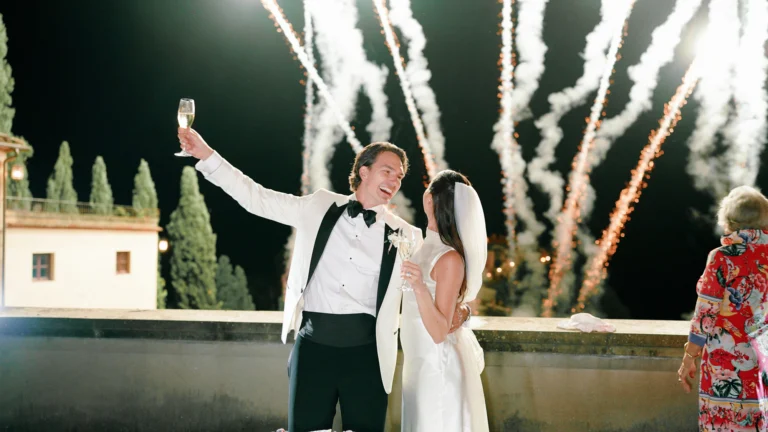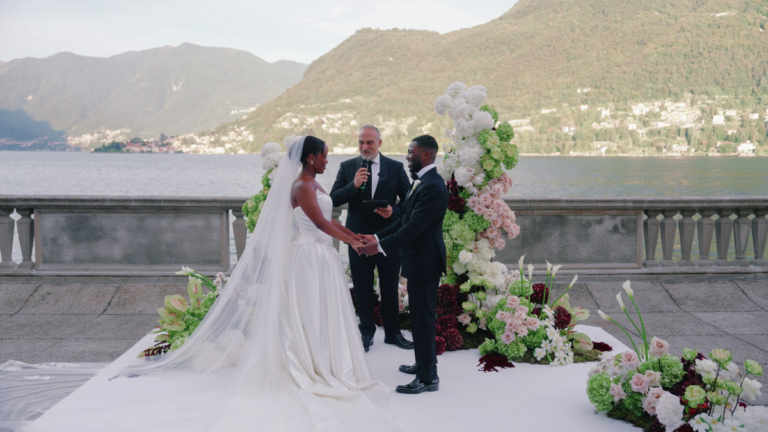
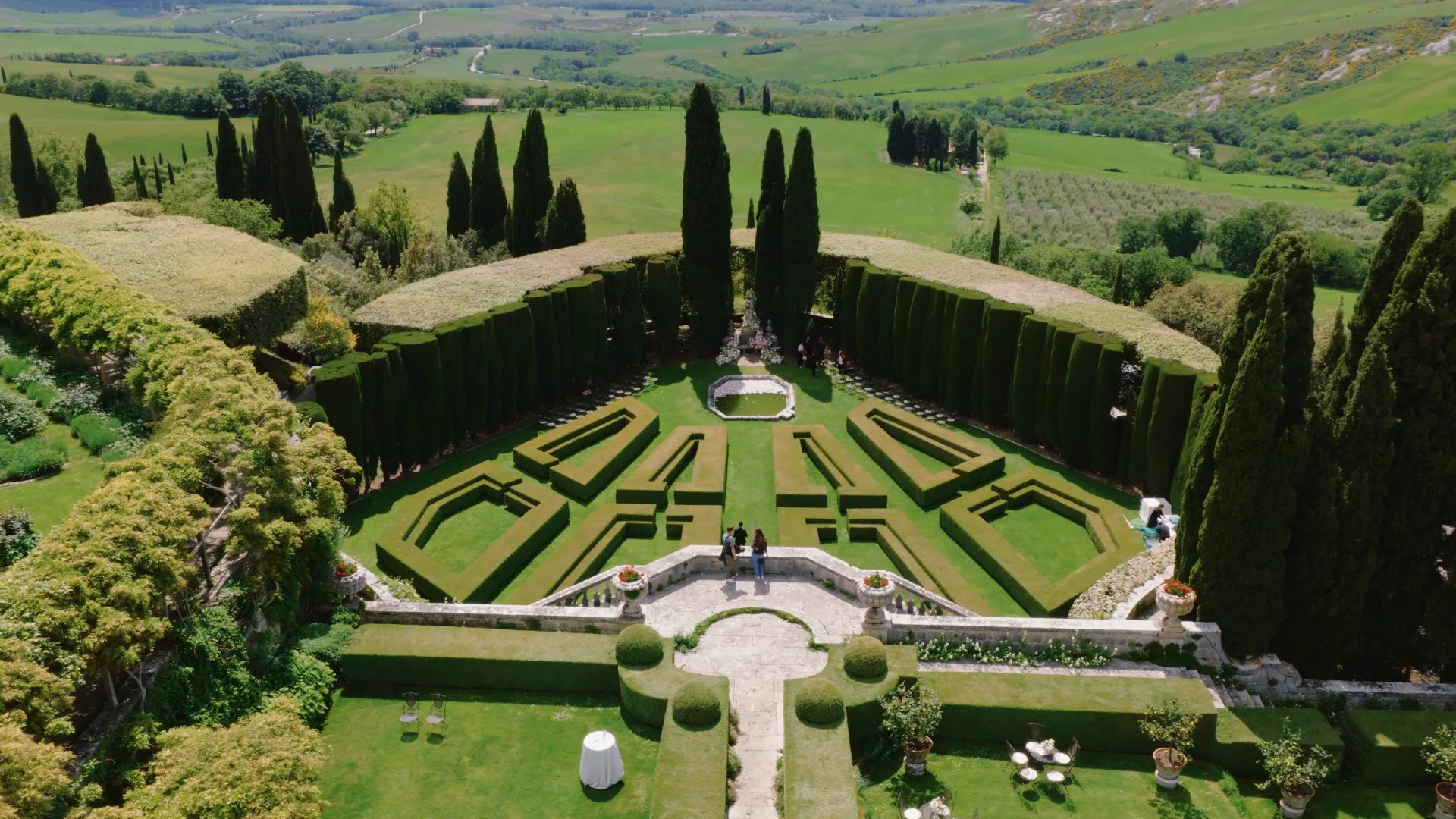

Every filmmaker who has spent enough seasons following destination weddings across Italy eventually arrives at the same private conviction: the country seems to direct itself, and the camera is only there to keep up. Long before a couple exchanges vows, the land has already composed the scene: the way afternoon light settles over a stone façade, the way a cypress-lined road narrows toward a villa gate, the way a lake at dawn holds its surface still, like some gentle giant deliberately quieting itself before the day begins. After years spent behind a lens in Tuscany, along the lakes of the north, beneath the white heat of the south, we have stopped believing this is coincidence. Italy carries a visual intelligence in its bones, one that a wedding videographer comes to know slowly, the way you learn the moods of someone you’ve filmed for years.

What makes the country singular is not one landscape but the sheer plurality of them, each region offering its own grammar of light, texture and mood, so that a wedding film shot among olive groves bears almost no resemblance to one framed against alpine water or baroque stone. And yet beneath that diversity runs something constant: a way of living that favors gesture over hurry, warmth over formality, appetite over restraint. It shapes how people move in front of a camera long before anyone calls action.
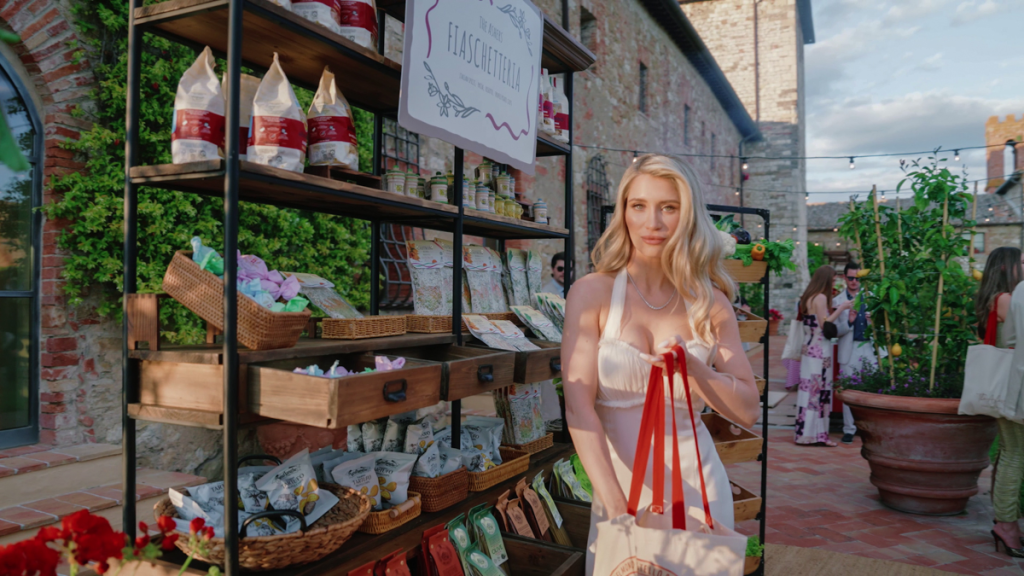
This is the terrain we want to walk through here, not as a checklist of reasons to marry in Italy, but as a filmmaker’s argument, built from what the eye actually notices. The character of the people who make guests feel like family within an hour. The improbable range of venues, from hidden gardens to cinema-famous villas. The seasons, each rewriting the same country into something unrecognizable. The food, the craft, the strange cultural crossroads this peninsula has always been. And finally, the question that matters most to anyone considering a wedding film here: how to recognize, among so much beauty, the eye capable of doing it justice.
A Warmth the Camera Can Feel
Weddings in Italy tend to feel different almost from the first hour, because the people around them aren’t performing hospitality, they simply have it. The villa keeper who greets a bride by her first name within the hour. The florist who lingers to explain why she chose one variety of rose over another. The neighbor who leans out a window to wish the couple well as the crew carries equipment past his door. None of it is staged, and that absence of performance is precisely what a trained eye learns to wait for.

For a videographer, this matters more than it might seem. A wedding film lives or dies on the honesty of what happens between rehearsed moments, and honesty requires people who feel unobserved even while being watched closely. This is the secret to looking natural on camera. Italians, by temperament, rarely hold a camera at arm’s length. They fold it into the afternoon the way they fold in a good glass of wine or an unplanned dance, and couples absorb that ease almost by osmosis. A bride who has spent three days surrounded by people who touch her arm when they speak, who insist she eat something before the ceremony, who treat her fiancé like a nephew returning from abroad, arrives in front of the lens already softened. She has nothing left to guard.

This is where cinematic instinct meets something no amount of lighting or lens choice can manufacture. A skilled wedding videographer can shape atmosphere through pacing and framing, but cannot invent the trust that lets two people forget they are being filmed. Italy tends to supply that trust before the first frame is shot, through drivers, chefs, seamstresses, the entire quiet architecture of local generosity. The resulting footage carries a particular texture, unforced and alive, the kind that no direction alone could stage from nothing.
Read also: How Wedding Videographers Work Without Being Seen
One Country, a Thousand Backdrops
Ask a location scout what makes Italy difficult to summarize and the answer usually comes back the same: the country refuses to hold still as a single idea. Drive three hours in any direction and the architecture changes register, the vegetation shifts, even the quality of the air seems to reorganize itself around a different palette. This is what gives a wedding videographer working across Italian regions such an unusual range of tools, because the raw material itself keeps changing shape.

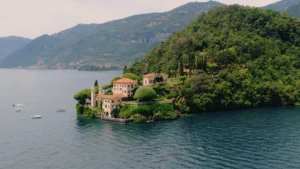
In Tuscany, a property like Villa Cetinale offers the kind of formal, sculpted grandeur that photographs like a Renaissance stage set, all cypress corridors and stone stairways climbing toward a chapel on a hill. Travel south into Puglia and the register turns rougher and more sun-bleached, where a converted masseria or a fortified castello sits low against flat, silver-green groves, its thick walls holding onto shadow well into the afternoon. Head north instead, to the shore of Lake Como, and Villa Pizzo delivers something closer to still water and formal gardens descending toward the lake in terraces, mist occasionally softening the far shore into something painterly. Three ceremonies, three entirely different films, none of them interchangeable.

This geographic range is not simply pleasant variety. For anyone shaping a wedding video with real visual ambition, it becomes a matter of authorship. A director who understands how each region behaves under different light, how stone absorbs it in the south and water scatters it in the north, can build a film that feels specific to that couple and that place, rather than a template applied indifferently across a season. Italy rewards this kind of attentiveness. Its landscapes carry enough character on their own that a videographer’s task becomes less about invention and more about listening closely enough to let each setting speak in its own voice.
Read also: Destination Weddings in Italy: North, Central & South Compared
Villas Cinema Already Loves, Gardens Shaped by Centuries
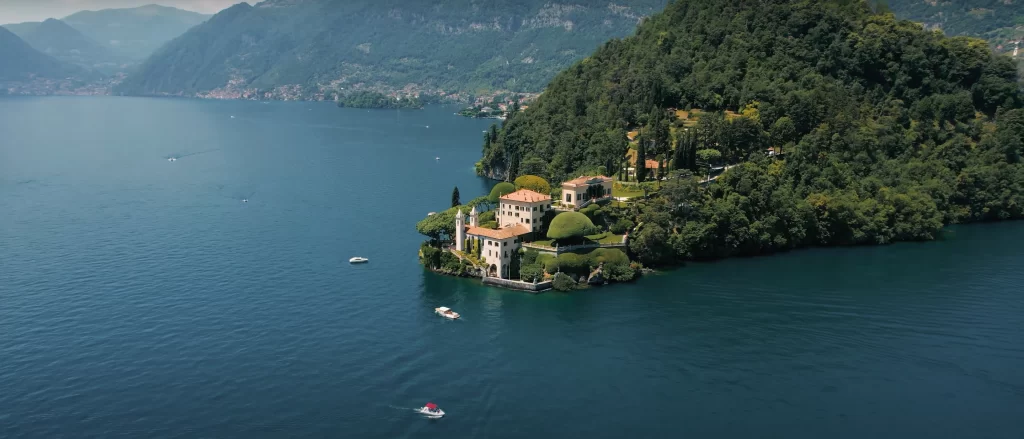
Some properties arrive with a filmography already attached to them. Villa del Balbianello, perched on its promontory over Lake Como, has appeared in productions ranging from period dramas to a Star Wars installment, its terraced gardens and loggia framed by water on nearly every side. Couples who choose it inherit more than a view. They inherit a visual vocabulary that directors have spent decades refining, learning exactly where the eye wants to rest and where the light performs best across a given hour.
This is the peculiar advantage of working across Italy’s art cities and UNESCO landscapes, places where an Italian garden was designed centuries ago by someone thinking in terms of sightlines, proportion and shade long before anyone imagined a lens capturing it. Boxwood hedges clipped into geometric patterns, cypress avenues aligned to draw the eye toward a specific horizon, fountains placed exactly where afternoon light would catch the water: this is composition inherited rather than invented. A videographer arriving with a camera on such ground is not building a scene from nothing. He is reading one that already understands rhythm, symmetry and depth.
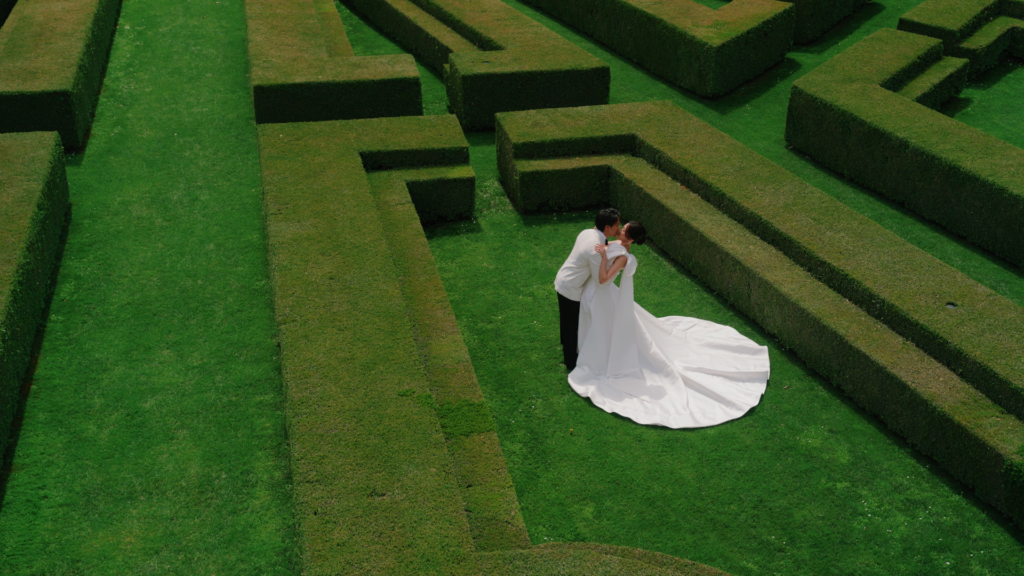
What makes this pairing so compelling for a wedding film is the tension it creates between permanence and immediacy. The garden has stood, largely unchanged, since long before either partner was born. The two people walking through it that afternoon are living the most unrepeatable day of their own story. A skilled director learns to hold both truths in the same frame, letting centuries-old stone and fresh, unguarded emotion coexist without one overwhelming the other. The result rarely feels like a backdrop being used. It feels closer to two timelines briefly intersecting, one architectural and slow, the other human and fleeting, each lending the other a kind of gravity it could not achieve alone.
Read also: Villa del Balbianello Weddings: A Love Story Like No Other
Learning to See the Eye Behind the Camera
Choosing a wedding videographer in Italy today means navigating a landscape far more crowded, and far more polished, than it was even five years ago. Every studio’s website now presents beautifully graded highlight reels, ninety seconds of golden light and tearful glances cut to music that could belong to any couple, anywhere. This is precisely where a discerning search should slow down rather than speed up. A showreel reveals editing instinct and little else. What actually exposes a filmmaker’s competence is a full-length wedding film, watched start to finish, where pacing cannot hide behind a highlight cut and where the handling of a wandering toddler or a delayed ceremony says more about craft than any drone shot ever could.
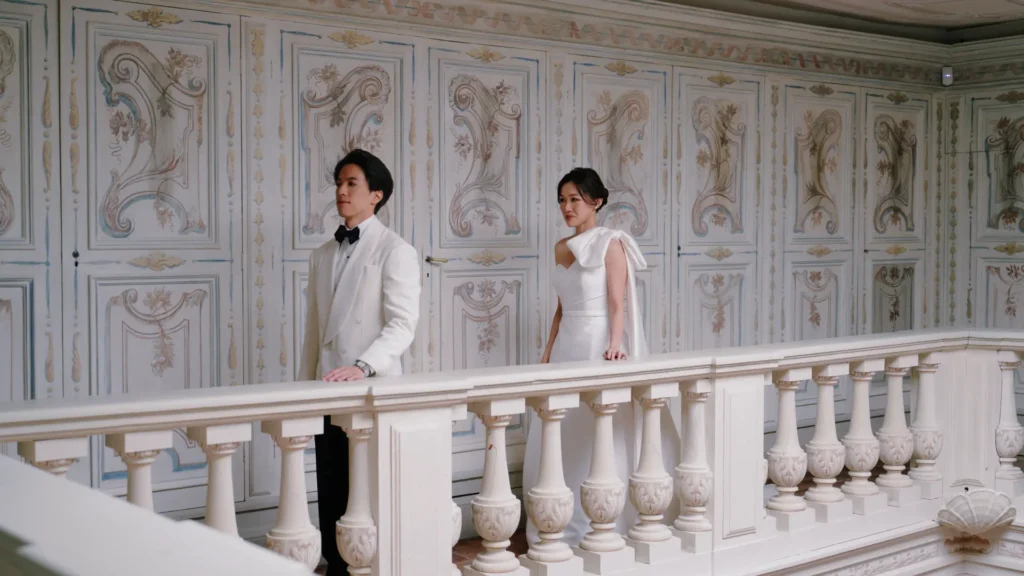
The rise of AI generative tools has complicated this search further. Footage can now be enhanced, stabilized or partially synthesized in ways that blur the line between what a camera actually witnessed and what software quietly constructed afterward. Couples researching studios online would do well to ask directly how a videographer works with raw material, and to treat vague or evasive answers as a signal worth heeding. Authenticity in a wedding film is not a stylistic preference. It is the entire premise.

None of this replaces conversation. A video call before booking tends to reveal more in twenty minutes than an entire portfolio can in an hour, because tone, instinct and taste surface naturally when two people simply talk. Does his sensibility toward light and composition align with what the couple imagines for their own day. Does he ask thoughtful questions about the venue, the guests, the rhythm of the celebration, or does he recite a standard package. Every hesitation deserves a direct question, asked without apology. A director worth hiring will welcome the scrutiny, because he already knows the difference between a wedding film built on trust and one built on templates.
A Different Italy for Every Month on the Calendar
Summer gets most of the attention when couples imagine marrying in Italy, and understandably so. Long evenings, gardens in full bloom, terraces that stay warm well past midnight. Yet treating June through September as the only worthwhile window overlooks what the rest of the year quietly offers, both visually and practically. A wedding film shot in late April, when wisteria spills over stone walls and the light carries a softer, more diffused quality than the sharper glare of August, has an entirely different mood, closer to watercolor than to postcard.

Autumn brings something else again. Vineyards turn copper across Tuscany and Piedmont, mist settles over the lakes in the early morning, and the low afternoon sun casts long shadows that a cinematographer can use to build real depth into a frame. Winter, often dismissed too quickly, delivers its own quiet drama: candlelit interiors, frescoed halls warmed by fireplaces, the particular intimacy of a smaller guest list gathered indoors while rain traces patterns on tall windows outside. None of this reads as a compromise once captured well. It simply asks a videographer to work with a different palette, exchanging open-air wide shots for something more contained and atmospheric.

There is also a practical dimension worth stating plainly. Venues and vendors operating outside peak months tend to have more flexibility, both in scheduling and in the attention they can devote to a single celebration, since they are not managing three weddings on the same weekend. Couples willing to move their date into shoulder season often find themselves with wider choice among the country’s most sought-after properties, along with vendors who arrive less depleted and more present. For a director building a wedding film, this translates into a calmer set, longer preparation windows, and ultimately more room to observe rather than rush. Italy does not close for the season. It simply changes its lighting design.
Read also: Best Time of Year to Get Married in Tuscany
Grain, Nostalgia, and the Grammar of Dolce Vita
There is a reason Super8 and VHS keep resurfacing in Italian wedding films long after digital cameras made them technically unnecessary. Something about the imperfection of analog grain, the slight wobble of a handheld frame, the warm bleed of color at the edges, seems to belong naturally to this country’s visual identity. Italy has always photographed like a memory even while being lived in real time, and these older formats simply make that quality explicit.

Part of this comes from cinema history itself. The loose, sun-drenched intimacy associated with La dolce vita imagery, all cigarette smoke and unguarded laughter caught mid-motion, still shapes how many people picture Italian romance today, decades after the films that first defined it. A videographer working with Super8 inserts is not simply chasing an aesthetic trend. He is reaching into a visual lineage that Italy itself helped establish, then letting it resurface inside a contemporary wedding film.
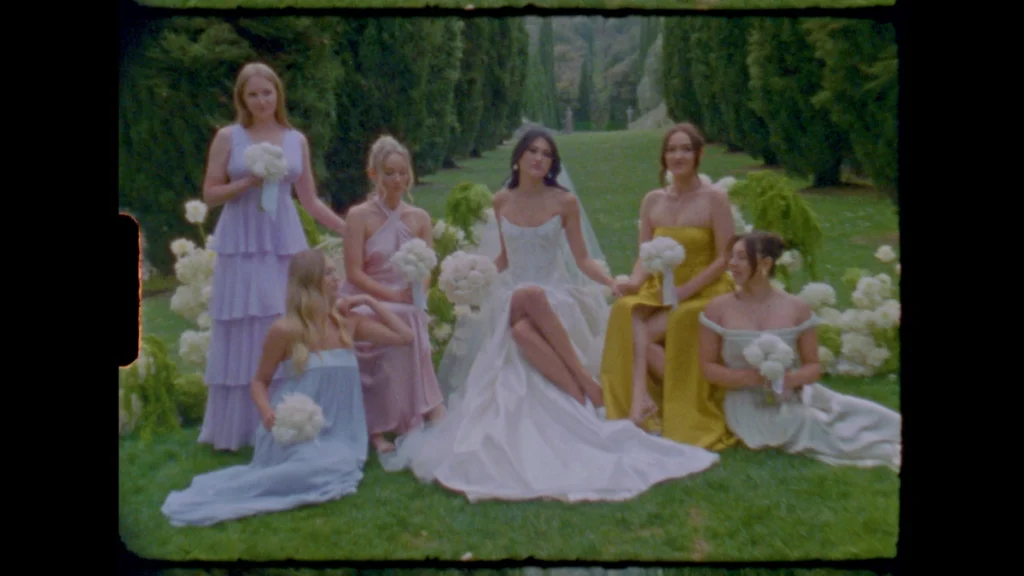
What makes this pairing genuinely useful, rather than merely decorative, is what it does to a couple’s behavior in front of the lens. A large cinema camera announces itself and often stiffens people into performance. A small Super8 unit, or the low-fidelity charge of VHS, tends to disappear into the background of an evening, its unpolished texture signaling that nothing here needs to look flawless. Couples relax accordingly. Stolen glances, an unrehearsed laugh, a hand reaching for another without knowing it is being filmed, all of it surfaces more readily once the pressure of composed perfection lifts.

A skilled director treats these formats as another instrument within a broader visual language rather than a gimmick layered on top of it, cutting between crisp modern footage and grainier inserts to build rhythm and depth into the final film. Used with restraint, this contrast does something particularly Italian: it lets a wedding feel simultaneously of this moment and slightly outside of time, the way memory itself tends to behave.
Read also: The Story Of Wedding Videography: Capturing Love Through The Ages
A Team Assembled with Intention
Behind every wedding film that feels effortless sits a group of professionals who rarely appear on screen but shape almost everything the camera eventually captures. A skilled wedding planner does more than manage logistics. She controls timing with a precision that gives a videographer room to breathe, spacing the day so that light, movement and emotion arrive when they can actually be caught rather than rushed past. Anyone who has filmed a ceremony crammed too tightly against a reception knows how much that single decision affects the final cut.

The florist designer plays an equally structural role, though her contribution often reads as purely decorative. Color choices, the height and density of arrangements, how blooms interact with a given architectural backdrop, all of it becomes part of the visual language a director works with once the cameras start rolling. An arch built too densely can swallow faces in shadow. One designed with restraint and an eye for negative space becomes an active collaborator in composition, framing a couple rather than competing with them. What experienced Italian wedding professionals tend to share, regardless of specialty, is an instinct for working alongside each other rather than in isolation.
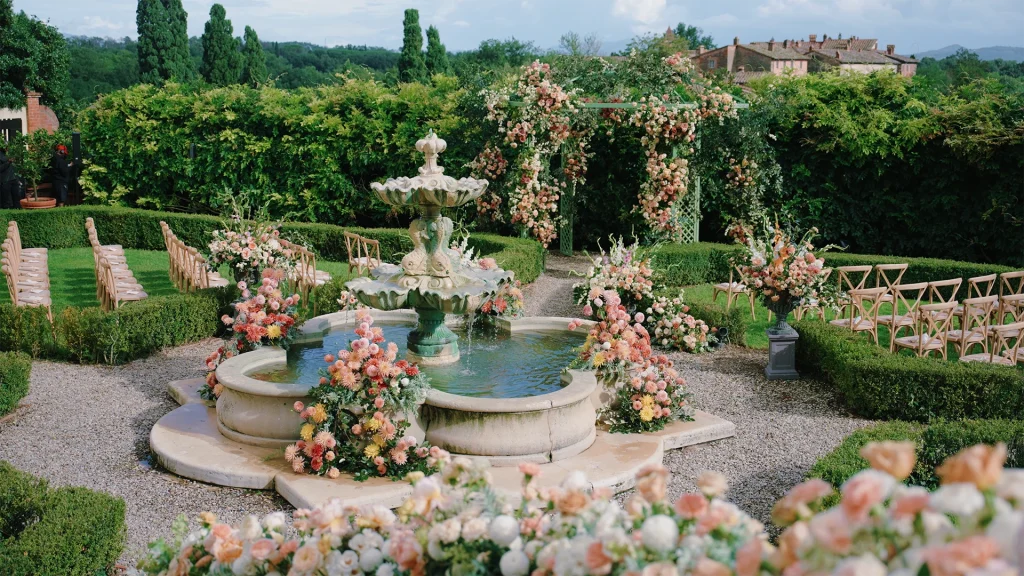
A planner who understands how a videographer moves through a room will position seating and timelines with sightlines in mind. A designer who has worked several seasons alongside the same production team learns which colors read well on camera and which flatten under certain lighting conditions. This kind of familiarity cannot be improvised on the day itself. For a couple assembling their ideal wedding team, the lesson is straightforward without being simplistic: choose people who have collaborated before, or who at minimum understand how their craft intersects with the visual outcome. A wedding film gains its texture from dozens of decisions made well before the ceremony begins, and the finest ones are rarely visible. They simply make everything that follows look inevitable.
The Table Where Cultures Meet
Food in Italy has never functioned as mere refreshment during a celebration. It performs, in its own quiet way, alongside everything else the day offers visually. A pizzaiolo working dough by hand in front of guests, flames visible through the mouth of a portable oven, becomes as much a piece of live theater as any first dance, the kind of unscripted movement a camera catches almost by instinct.

Bartenders assembling a spritz table by candlelight, orange slices caught mid-air under warm light, add their own rhythm to an evening already thick with sound and motion. None of it needs staging. It simply needs a director attentive enough to recognize when craft becomes spectacle.

This generosity at the table mirrors something older and more structural about Italy itself. Sitting at the crossroads of the Mediterranean for centuries, the peninsula absorbed influences from every direction, Byzantine, Arab, Spanish, French, and folded them into a culture unusually comfortable hosting difference. That inheritance shows itself clearly today in how effortlessly Italian venues accommodate ceremonies belonging to entirely different cultures and traditions, from Hindu celebrations layered with color and ritual to Jewish weddings built around their own sequence of blessings, each finding space within a country that has spent its history learning to welcome rather than exclude.

For a filmmaker, this convergence of cuisine, ritual and open hospitality offers something rare: material dense enough to build an entire visual narrative around, without needing to manufacture drama that isn’t there. A cinematic wedding film thrives on precisely this kind of texture, where light falling across a shared table says as much about two people’s story as any vow exchanged earlier that day. Italy keeps offering that material generously, season after season, couple after couple, asking only that whoever holds the camera knows how to look closely enough to receive it.