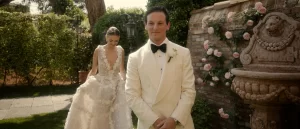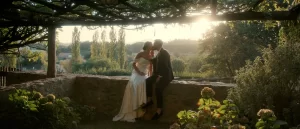


A wedding lasts only a few hours, but its memory changes your life forever. Long after the flowers have wilted and the toasts have faded from anyone’s precise recollection, it is the moving image that keeps the day alive, breathing, capable of returning them to a glance exchanged across a crowded room or to the particular quality of light that fell across a terrace at seven in the evening. This is the quiet promise behind every wedding video: not documentation, but a second life granted to a single day. For couples who have never stood in front of a camera on the most consequential occasion of their lives, the presence of a videographer can feel abstract until the day itself arrives. What actually happens, hour by hour, behind the elegant restraint of a well-made wedding video is rarely discussed openly, and yet understanding it changes everything about how the day is experienced.

There is a rhythm to it, a choreography built long before the first shot is taken, shaped by conversation, by trust, by an intimate reading of two people who may come from entirely different worlds and traditions. This piece follows that arc from beginning to end. It begins where the real work quietly begins, in the exchange of ideas between a couple and their videographer months before any vows are spoken, and moves through the choices of place, the unfolding of the morning light, the discretion required to remain present without ever becoming a disruption. It continues into the editing room, where raw footage is shaped into something with structure and breath, and closes on the moment a couple sits down, often much later, to watch themselves again. Throughout, the aim is the same: to show how a wedding film comes to hold not just images, but atmosphere, character, and the particular grammar of a couple’s own story.
Read also: Directing, Editing, Storytelling: Behind the Scenes of a Wedding Film
Before the Yes: The Call That Shapes Everything
Months before any of it becomes visible, there is a conversation. Not yet about shot lists or timelines, but about who two people actually are together, how they speak to each other, what makes them laugh, what makes them go quiet. A screen sits between videographer and couple, and yet somehow the distance tends to dissolve within the first few minutes, replaced by something closer to a first, careful portrait sketched entirely in words. This is where the character of a wedding film begins to take shape, long before a single frame is captured. A couple might describe a wedding rooted in the customs of their grandparents, spoken in more than one language, carrying rituals unfamiliar to anyone outside the family. Another might want nothing but stillness and understatement, distrustful of anything that feels staged.

These aren’t details to be noted and set aside. They are the material from which an entire visual language will later be built. Among the questions that surface, one tends to matter more than most: whether the couple imagines their film unfolding with the patient, observational eye of documentary, or with the deliberate framing and rhythm of cinema. Neither is superior to the other, though each demands an entirely different discipline behind the camera, a different relationship to light, movement, and proximity. A couple drawn to spontaneity might resist too much composition. Another, raised on the visual grammar of film, might crave wide shots that breathe, transitions with a certain gravity, an atmosphere closer to storytelling than reportage. By the time the call ends, a videographer has usually gathered far more than logistics. There’s a sense, however faint, of the tone the finished film should carry, the pace it should move at, the emotional register it needs to honor. Everything that follows, every choice of lens and light, answers back to this first, unhurried exchange.
What Truly Matters
No two weddings hold weight in the same places, and part of the early conversation involves asking a couple to name, honestly, what they want remembered with the most attention. Some couples want the vows themselves, spoken quietly and often imperfectly, captured with enough intimacy that the words remain legible years later. Others care more about the toasts, the unscripted tremor in a father’s voice, the joke that lands or doesn’t. For some, it’s the table itself, dressed and lit just so, holding a kind of stillness worth preserving. Others still want the first dance treated as its own small film, a suspended moment rather than a formality to be logged.

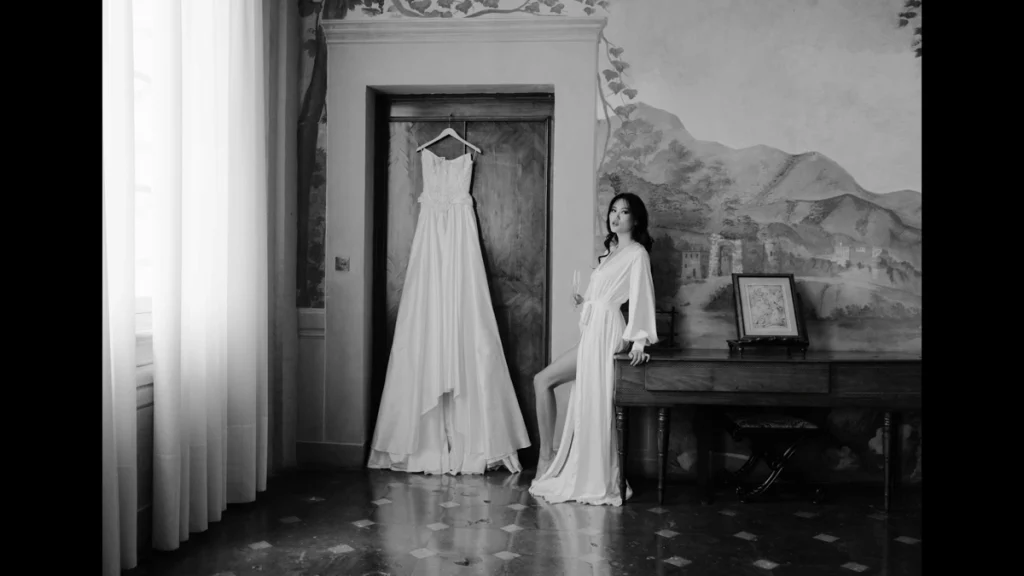
Occasionally a bride asks for something quieter and more private: the hour before everything begins, hair half finished, light falling through a window while she sits alone with her thoughts. These requests, delicate as they are, carry real weight. A sequence like that calls for restraint, patience, an eye that knows when to stay outside a door and when a closer, more sensual frame is warranted rather than intrusive. Naming these priorities early changes the shape of the entire day’s coverage, well before any equipment is unpacked.
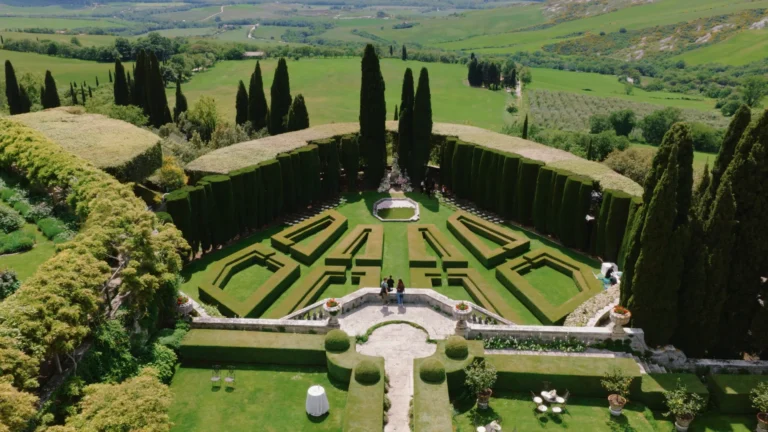
It determines whether a second camera is needed to hold two vantage points during the ceremony, or whether the couple wants the tactile grain of VHS threaded through their footage, its imperfection standing in for memory itself. It shapes whether Super8 makes an appearance, with its warmth and its soft, wandering romance, or whether drones are called in to reveal the scale of a property that deserves to be seen from above, its gardens and coastline unfolding at once. Every format carries its own temperament, and pairing the right one to the right moment is where a director’s instinct quietly begins to show.
The Landscape as Co-Author
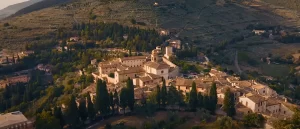
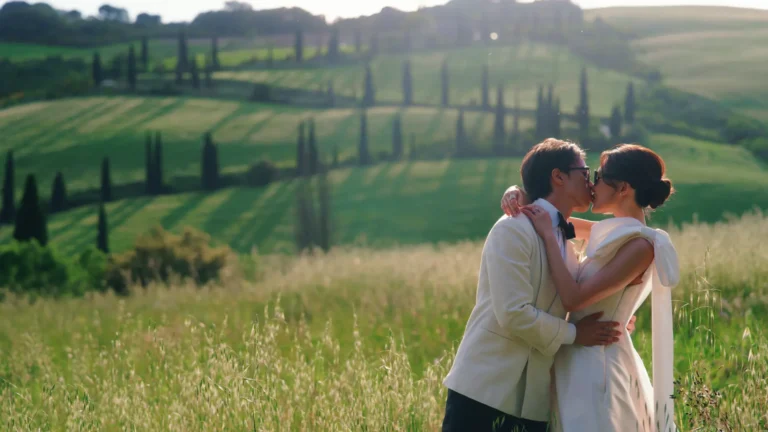
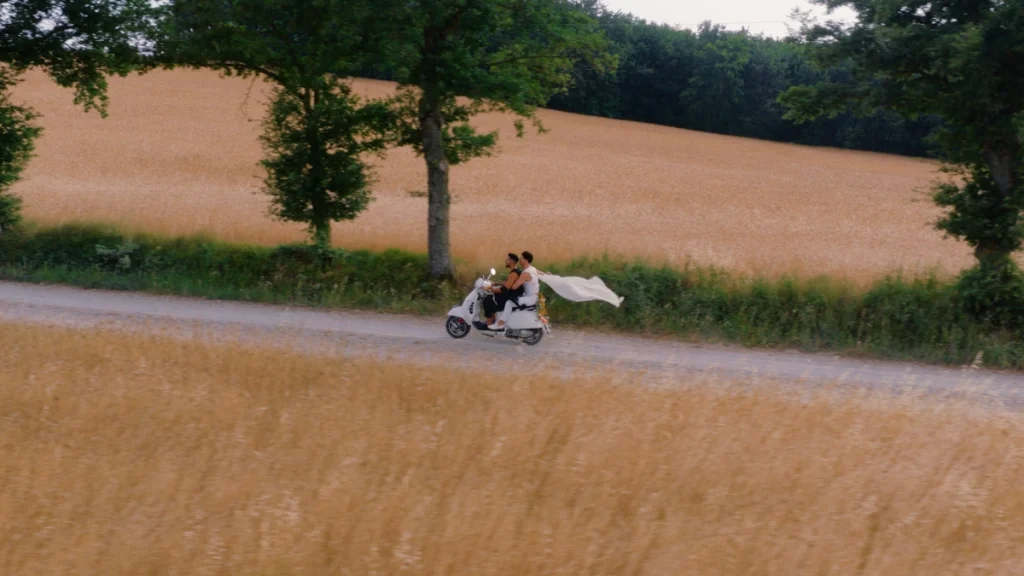
No wedding film exists apart from the place that hosts it. The land, the architecture, even the particular slant of afternoon light belonging to a region all become collaborators in the finished work, whether anyone behind the camera acknowledges it or not. A couple marrying beneath the cypress-lined hills of Tuscany will end up with a film built on long golden hours, soft dust rising from gravel roads, stone farmhouses that seem to hold centuries inside their walls. The pace there tends to be unhurried, almost pastoral, because the countryside itself refuses to be rushed.
Move north to Lake Como and the register shifts entirely. Water changes everything about how a place reads on screen, introducing reflection, symmetry, a kind of theatrical grandeur drawn from villas that once hosted italian nobility. Mist rolling off the lake at dawn carries its own cinematic weight, one that a filmmaker unfamiliar with the region might not think to wait for. Further south, the Amalfi Coast offers something more vertical and dramatic, cliffs dropping toward turquoise water, light bouncing off pastel façades in a way that demands a different kind of exposure altogether.

Puglia, by contrast, feels older and more sunburnt, its whitewashed trulli and open masserie calling for wide, patient frames that let heat and silence do their own storytelling. None of this is incidental. A videographer who has worked repeatedly within a specific region carries knowledge that no amount of preparation from a distance can fully replace, an instinct for where the sun will fall by five in the afternoon, which stretch of coastline photographs poorly at midday, how local weather tends to behave in a given month. Choosing someone rooted in that landscape isn’t a matter of convenience. It shapes, quite literally, how the wedding will be seen.
Read also: Italian Videographer: Why Choosing a Local Professional in Italy Makes All the Difference
The Day Opens: Getting Ready, First Light
Filming begins long before anyone sees the videographer arrive. It begins with a knock, a room still scattered with garment bags and half-empty coffee cups, a bride sitting in front of a mirror while someone pins something into her hair. This early hour carries a particular texture unlike anything later in the day, quieter, less performed, closer to the private register of ordinary life than to ceremony. The instinct required here has little to do with direction. A skilled videographer learns to read a room before touching a camera, gauging who feels comfortable being watched and who needs a few minutes to forget the lens exists at all.

Sisters laughing over shoes. A mother fastening a necklace with trembling hands. A groom pacing near a window, rehearsing words under his breath. None of it is staged, and none of it should feel arranged. The work lies in becoming unremarkable enough that these moments continue unfolding as though no one is documenting them. Light plays its own quiet role in these hours. Morning light tends to be soft, forgiving, often filtering through curtains or landing across a dressing table in a way no artificial source could replicate. A videographer attuned to atmosphere will chase that light rather than impose upon it, letting a bride’s reflection catch the glow from a window instead of directing her toward it.

There’s a kind of trust being built in these opening scenes, one that shapes everything that follows. Wedding parties who feel at ease early in the day tend to remain open to the camera later, during vows, during the reception, during moments that call for real intimacy. That ease isn’t accidental. It’s cultivated through restraint, through a presence that watches closely, asks little, and interferes almost never.
Moving Unseen
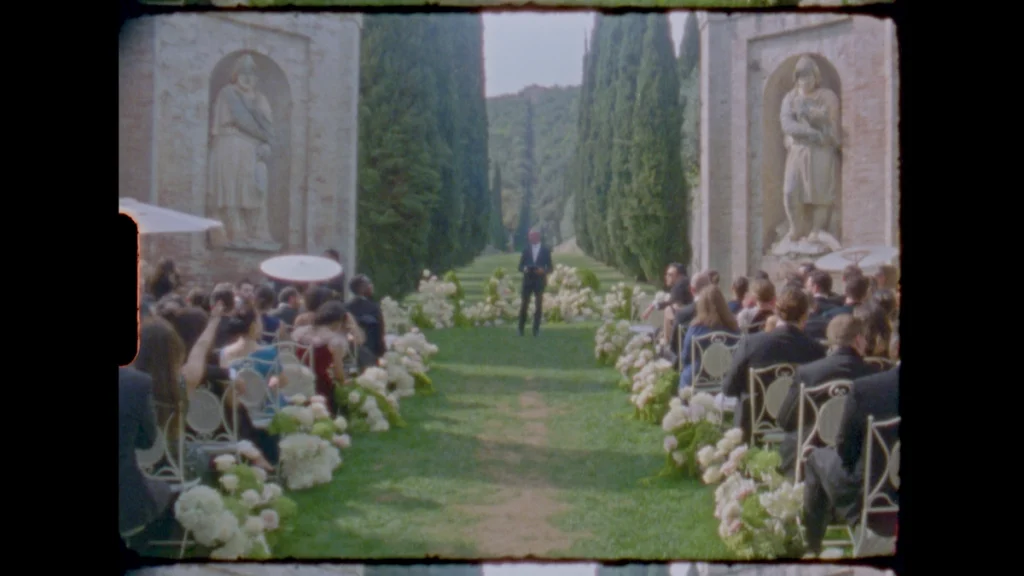
Once the ceremony begins, the discipline required shifts again. A guest list of a hundred people, sometimes several hundred, means a videographer is now working within a crowd rather than a private room, and the challenge becomes one of near disappearance. Weaving along the edges of a garden aisle, crouching low behind a row of chairs, finding an angle that captures a father’s expression without stepping into anyone’s sightline. The goal isn’t invisibility in some absolute sense but a kind of practiced restraint, an ability to be everywhere important without ever registering as a presence guests need to account for.

What makes this possible is less about equipment than instinct, an anticipation of where emotion is about to surface before it does. Knowing, from years of watching hundreds of ceremonies unfold, the exact moment a reaction will happen. This kind of readiness can’t be scripted. It has to be earned through repetition, through having stood in enough gardens and ballrooms to recognize the shape of a moment just as it’s beginning to form.

Then there’s the reception, looser and less predictable, where a director’s sensibility matters most precisely because nothing is staged. Dancing that grows wilder as the night wears on, a grandmother pulled onto the floor against her protests, cake frosting ending up somewhere it shouldn’t. And weather, inevitably, has opinions of its own. A storm rolling in over Puglia an hour before an outdoor ceremony, a schedule slipping by forty minutes because a florist ran late. None of it derails a well-prepared crew. Adjusting quickly, without visible panic, is simply part of the job, and often it’s these very disruptions that produce the footage a couple treasures most.
Read also: Does the Perfect Wedding Exist? Tips for Managing Challenges and Surprises
A Company of Professionals
No wedding film exists in isolation, and one of the least visible truths about the day is how much of its final quality depends on people who never appear on camera at all: the wedding team. The photographer working alongside a videographer, often within inches of the same frame, has to be read almost intuitively, each anticipating where the other will stand so neither ends up in the other’s shot. Good pairs develop something close to a shared choreography over time, an unspoken sense of who moves left during the vows and who holds steady for the wide angle.

The wedding planner, meanwhile, functions as something closer to a producer than people often realize. Timing an outdoor ceremony to catch the last hour of usable light, adjusting a reception’s schedule so a couple’s exit happens while the sky still holds color rather than after dark, these decisions shape a wedding film’s atmosphere as much as anything a camera does. A planner who understands visual pacing, who knows instinctively that fifteen minutes can mean the difference between flat midday sun and something golden and forgiving, becomes an unspoken collaborator in the day’s overall look.

Florists, too, leave their mark on the frame in ways rarely credited. An arch built with enough negative space for a couple to be seen clearly against it, table settings considered from the angle a lens will actually see rather than only from eye level, these small accommodations matter enormously to anyone building a coherent visual narrative from the day’s material. None of these professionals report to one another in any formal sense, yet the best weddings tend to reveal a quiet understanding running underneath everything, each vendor sensitive to how their work will read on screen. What results, when this cooperation is working, feels less like a series of separate services and more like a single, considered direction guiding the entire day.
From Raw Footage to a Finished Story
Once the last guest has left and the equipment is packed away, the real shaping of the film begins. What comes back from a wedding day is hours of footage, unordered and unfiltered, containing far more than could ever belong in a final cut. The first task is one of judgment rather than technique, sitting through everything with a critical eye, deciding which glance, which exchange, which fragment of a speech actually carries the emotional weight the story needs. Most of what was filmed will never be seen. That discipline of removal is, in many ways, where the craft reveals itself most clearly.
Editing follows, a slower and more deliberate process than people often imagine, closer to composing than assembling. Pacing matters enormously here, knowing when a shot should linger a beat longer than expected, when silence between two images says more than any music could. Color grading comes next, a stage frequently underestimated, where the emotional temperature of an entire wedding video gets calibrated, warmer or cooler, softer or more saturated, depending on what the day itself demanded.

Different formats serve different purposes, and part of a videographer’s role involves shaping the same material into several distinct forms. A trailer, tight and evocative, meant to be watched in under three minutes and often the first thing a couple shares with family. Shorter reels built for social platforms, designed to move quickly without losing intimacy. And the feature film itself, the complete and unhurried version that holds the entire arc of the day. Woven through all of it, VHS grain, the flicker of Super8, and sweeping drone footage of the property add texture that pure digital cinematography can’t replicate on its own, layering the piece with a sense of time and place that feels almost tactile.
Watching Themselves for the First Time
Weeks pass, sometimes months, between the wedding day itself and the evening a couple finally sits down to watch what came of it. Life has moved on by then, work resumes, thank-you notes get written, the specific texture of that day has already begun to blur at the edges the way memory tends to do. Which is precisely why the moment of watching carries such unexpected force. What tends to surprise couples most isn’t seeing themselves again. It’s noticing what they missed entirely while living it. A groom discovers, only now, the way his mother’s face changed the instant the doors opened. A bride hears, for the first time with any real clarity, what her sister actually said before her hands started shaking too much to continue.

The day, compressed into forty minutes of careful pacing and light, becomes newly legible in a way the day itself, chaotic and fast and overwhelming, never allowed. There’s a particular kind of recognition that happens in that room, something closer to meeting a version of themselves they didn’t fully witness the first time around. The wedding film, in this sense, isn’t simply a record laid over what happened. It becomes the version through which the day is finally understood, its rhythm, its atmosphere, its quieter undercurrents made visible only through the eye of someone else’s camera. This, in the end, is the particular gift a videographer offers a couple, not just images kept safe for later, but a second, clearer encounter with a day too large and too fast to be absorbed in real time. Watching it back, they don’t simply remember. They see themselves, perhaps, for the first time.