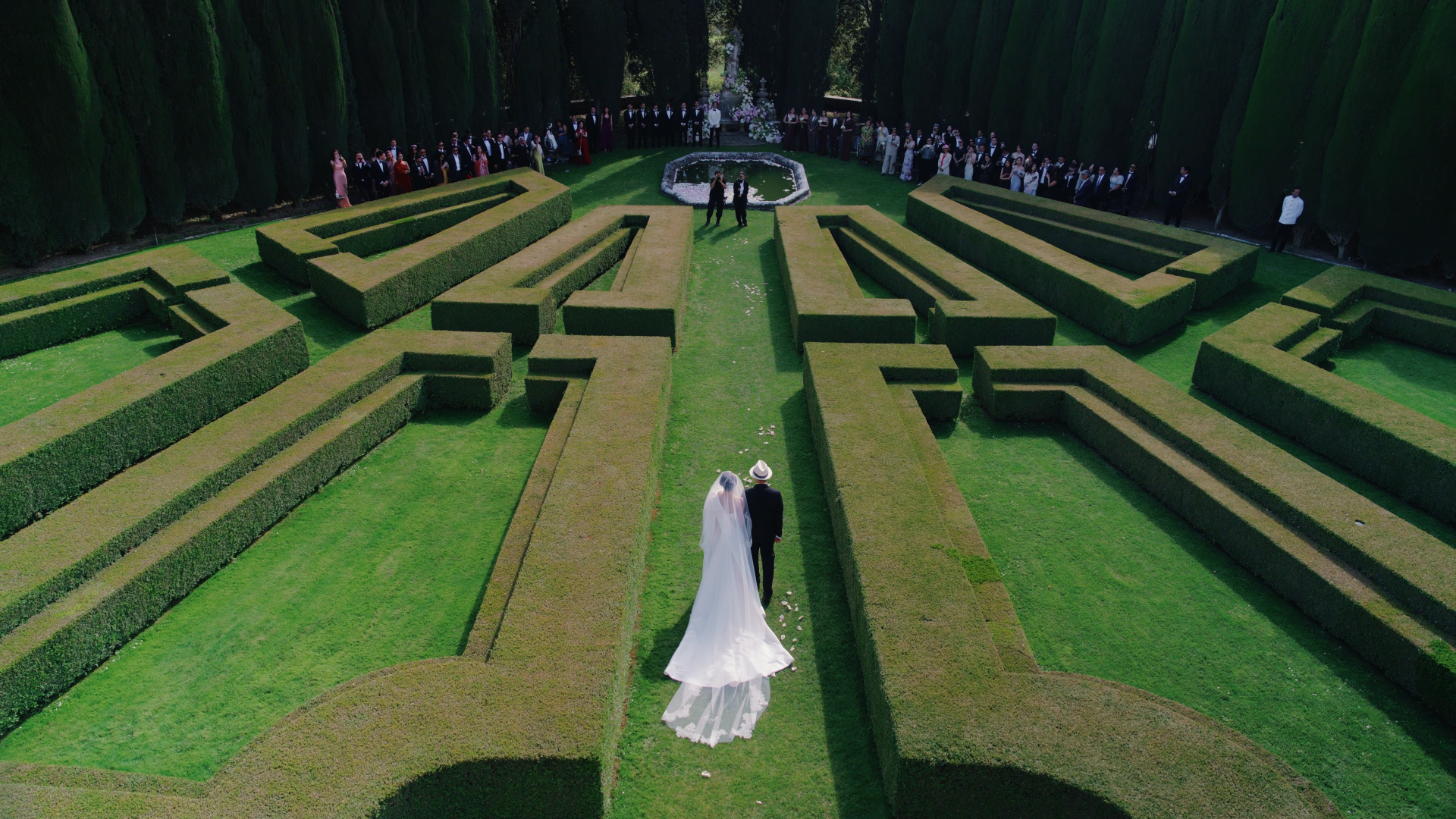

The first directorial decision of an Italian wedding is made long before a camera is unpacked, by the couple themselves. Choosing a venue means choosing a quality of light, a set of proportions, a palette of stone, water and foliage, and the tempo at which guests will move through the day. Everything a wedding film later shows has been set in motion by that signature.
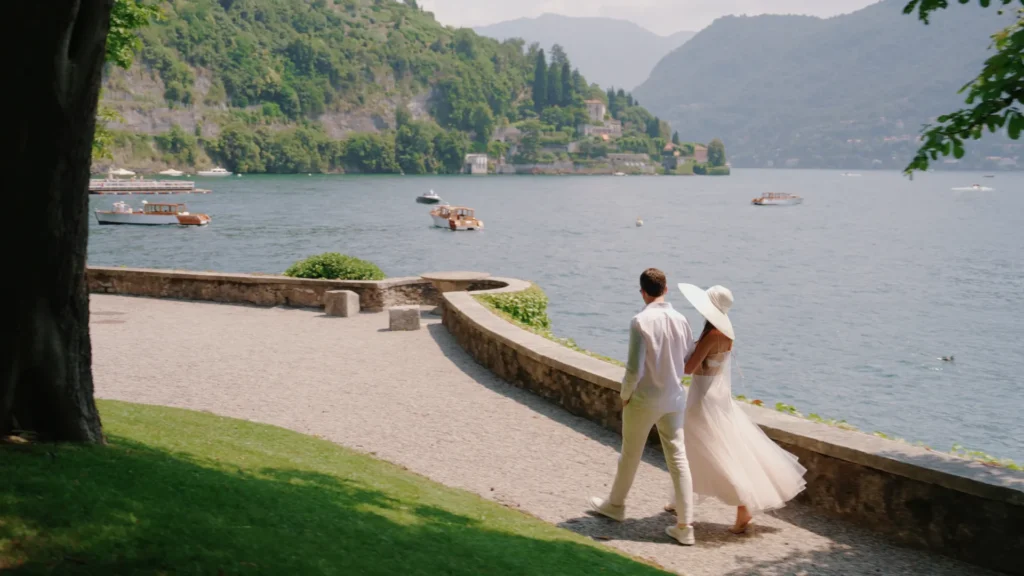
Italy offers an unusual range of answers. A terraced villa above Lake Como speaks in mirrored light, morning mist and wooden boats gliding past balustrades. A Tuscan estate has cypress avenues, pale stone and the severe geometry of an Italian garden. In Puglia the masserie stand white among olive trees centuries old, with a sea that seems to shine from every direction. The great cities of art hold frescoed salons and candlelit courtyards, interiors where a ceremony takes on the gravity of a stage. Each region has its own temperament, and couples tend to recognise themselves in one more than the others: the lake for the romantic, the countryside for the unhurried, the sea for the exuberant.
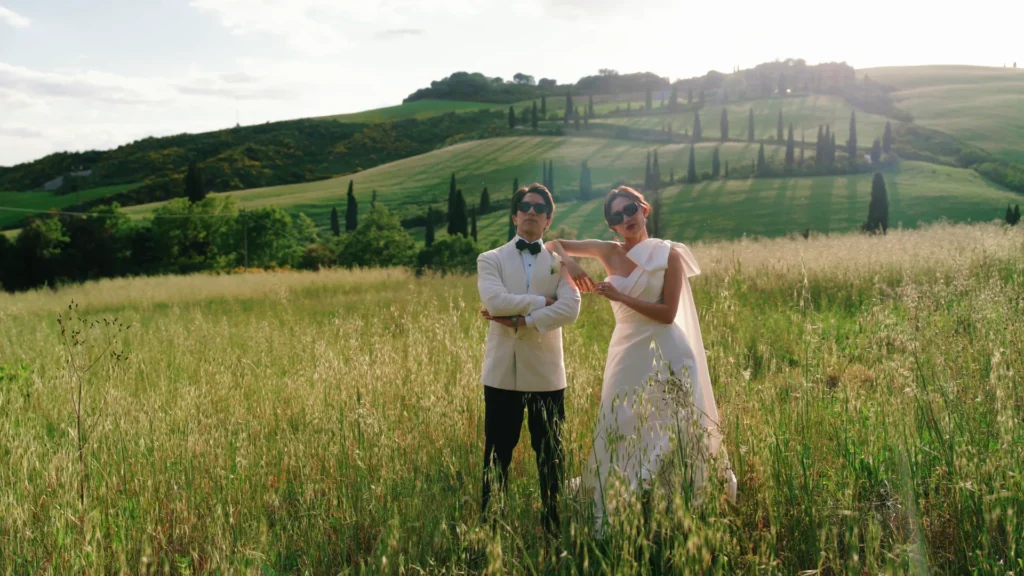
Time changes the picture again. The same villa looks different in April, with tender green and cool air, than in the amber evenings of September, and the choice of date quietly shapes the film. This article follows that thread. It looks at how each landscape behaves in front of the lens, how the seasons rewrite a place, how a florist designer dresses the scene, and which tools a videographer uses to tell it: aerial footage to convey scale, vintage cameras for grain and memory, and above all the experience of someone who has filmed the same rooms through many summers. Wedding videography at its highest level depends on that knowledge of place, a gaze rooted in the territory and able to render a house as its owners and its guests know it. The venue offers the first page. What follows depends on how well it is read.
Read also: Destination Weddings in Italy: North, Central & South Compared
The Venue Writes the First Page
Every venue speaks in a visual grammar of its own, and a film that ignores it reads like a translation done in a hurry. Proportion comes first. A salon with ceilings six metres high invites slow, rising movements and wide compositions in which the couple appear small and ceremonial. A cloister of low arches compresses the frame, draws faces close and turns every procession into a rhythm of columns and shadow. The size of a room decides how much air a scene can breathe. Materials follow. Travertine and marble return light to the room and soften skin, terracotta warms it, while dark wood and aged plaster swallow it, so that an interior of great beauty may leave the camera very little to work with. Frescoes, stucco, mirrors and gilded boiserie each make their own demands: reflections that catch a lens, pigments that turn muddy under artificial lamps.
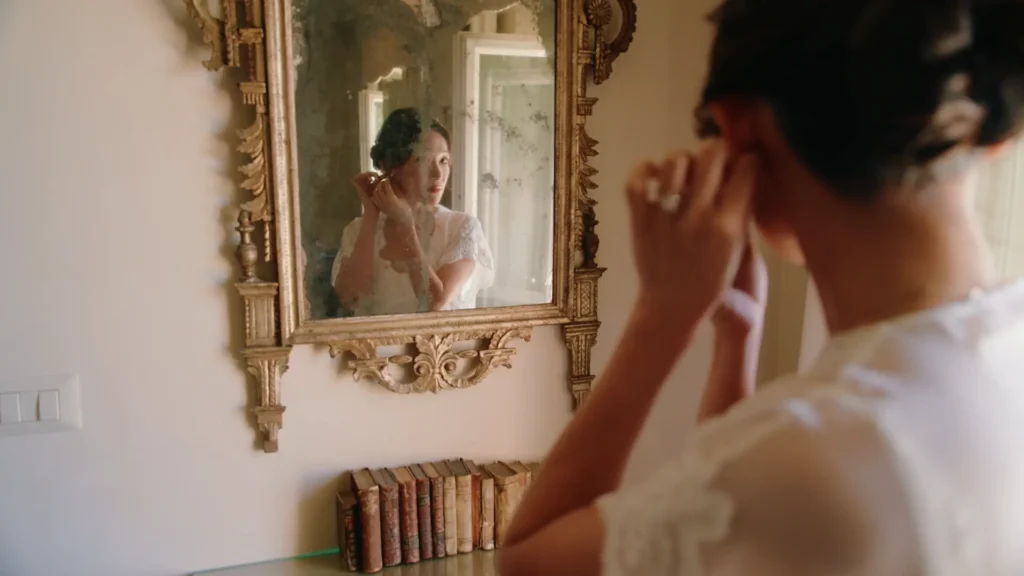
A videographer reads these surfaces the way a cinematographer reads a location before a shoot, deciding where the day may be allowed to glow and where it should stay in shadow. The direction of light is the quietest authority in the house. A west-facing loggia gives its best hour after five, a courtyard flattens at midday, a chapel with a single window offers one beam and a very brief chance to use it.

Sound matters just as much, though couples seldom consider it. Stone and vaulting hold a voice for a long moment, while an open lawn lets it vanish into the air. Vows spoken within thick walls arrive with a gravity no microphone could invent, and those pronounced under open sky depend on wind, distance and careful recording. For this reason the setting of the ceremony shapes everything that follows. Indoors, the film leans toward chiaroscuro, closeness and a measured pace. Outdoors, it opens onto horizon, movement and changing weather. In wedding videography the story begins with the space, and the couple step into a narrative whose first lines were written by the place they chose.
Read also: Indoor vs Outdoor Ceremonies: What Works Best for Wedding Videography
Lake Como and the Borrowed Light
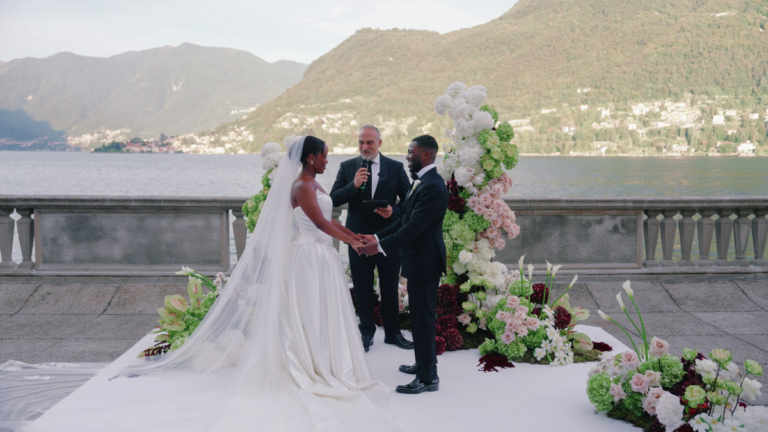
Lake Como keeps its own time. Dawn arrives as a pale veil over the water, the mountains stand in layers of grey and blue, and by mid-morning the surface has become a moving mirror that throws light back onto stone, faces and balustrades. A wedding here is lit twice, once by the sky and once by the lake, and the second light is the more theatrical of the two. The architecture seems built to receive it. At Villa del Balbianello the loggia opens onto the water like a frame cut into the hillside, and the terraced gardens descend in steps toward the shore.

Villa Pizzo keeps its gardens at the water’s edge, so that the lake is never far from the aisle. Villa Erba, with its park running down to the shore and its nineteenth century halls, offers a broader stage, where lawn, water and mountains settle into three clear planes. Staircases, arcades and parapets give a camera what a director wants most: lines that lead the eye, depth, and places where a figure can pause. The boats belong to the composition as well. A wooden launch crossing the frame at the right instant gives a wedding film its first movement, a slow diagonal against the stillness of the water, and the wake it leaves can close a scene the way a held note closes a phrase.

All of this changes by the minute, which is why a videographer who knows the lake plans around it. Clouds gather over the peaks and the colour of the water turns in seconds. A breeze lifts a veil exactly where the shadow of a cypress falls. Haze, wind and sudden brightness mean the rhythm of the footage has to be built with the lake and not against it. Cut with patience, a wedding shot here moves like a piece of chamber music: a quiet opening, a swelling of light at the ceremony, and a long, luminous coda as evening settles over the far shore.
Read also: Brittany & Eric: A Glamorous Lake Como Wedding
Tuscany, the Landscape as Set Design
Tuscany arrives already composed. Before anyone has chosen a lens, the landscape has arranged its own elements with a painter’s patience: cypresses planted in rows or standing alone on a ridge, hills folded one behind another, pale stone that turns the colour of honey as the afternoon wears on. A videographer working here behaves like someone hanging a canvas in the right room, and the first task is to see what the walls already hold.

The Italian garden adds its own severity. At Villa Cetinale the seventeenth century grounds are organised around a long central axis, with statues and cypresses guiding the eye toward a distant point. A couple walking that avenue fall into the centre of the frame without being asked. La Foce, in the Val d’Orcia, speaks a different grammar. Cecil Pinsent’s terraces and clipped hedges give way to the famous zigzag of cypresses climbing the slope beyond, where the order of the garden meets the freer order of the hills. Il Borro, a medieval hamlet in the Valdarno with stone houses, a bridge and vineyards below, offers texture in place of symmetry: worn walls, narrow lanes, cool interiors behind heavy doors, and a village through which a wedding can move like a procession.

Then comes the hour Tuscany performs better than anywhere else. In the last light before sunset the stone warms, shadows lengthen along the avenues and the air seems dusted with gold. At that moment a cinematic video acquires the depth of an oil painting: figures in the foreground, a middle ground of hedge and gravel, a far plane of hills dissolving into haze. Long lenses compress the cypresses into rhythmic columns behind the couple, and the composition builds itself in layers. The craft lies in restraint. The landscape is so generous that the temptation is to film all of it. An experienced wedding videographer chooses a handful of vantage points, trusts the geometry already in place and lets the day unfold inside it, so that the wedding film looks like a natural extension of the estate’s own design.
The South and the Sea
South of Rome the light changes its character. It stops being gentle and becomes decisive, falling from a higher sky onto white walls, pale stone and a sea that returns it at full strength. Puglia and the Amalfi coast ask for a different temperament from a film crew, and they reward it with images that carry a vividness the north rarely offers.

In Puglia the masseria is the natural setting: a fortified farmhouse of whitewashed lime and local stone, gathered around a courtyard, with olive trees whose trunks have twisted into sculpture over several centuries. The ground is pale, the walls are pale, and the sea sits a few kilometres away like a bright rumour at the end of every lane. Such surfaces bounce light in every direction, so exposure becomes a matter of judgement. Skin must stay luminous while white plaster is kept from burning into blankness, and the shaded colonnade, the arched doorway and the interior of a cool vaulted room become welcome counterweights to the glare. Handled with skill, the contrasts give a video cinematic density, with deep blacks of shade set against dazzling planes of lime.

Further north along the coast, Villa Eva in Ravello offers another version of the South: terraces and gardens suspended above the water, with the coastline spread below like a map of blue. Flowers dominate here. Bougainvillea, citrus blossom and Mediterranean shrubs arrive in saturated colours, and a good camera records them so fully that their perfume seems to rise from the frame. The mood alters accordingly. Southern weddings tend to be open and convivial, built around long tables beneath the sky, music that spills out of the courtyard, families that move freely between the garden and the dance floor. The wedding film follows suit. Its rhythm loosens, its movements grow warmer, and its story acquires the generosity of a feast. The couple remain at the centre, and the whole company of guests gathers around them in the light.
The Cities of Art
A wedding in Florence, Venice or Rome takes place inside a work of art that happens to have guest rooms. Palaces built for merchant families and cardinals keep their ceremonial layout: a courtyard to arrive in, a staircase to climb slowly, a piano nobile of tall doors, painted ceilings and mirrors darkened by centuries. Everything here suggests formality, and the day adopts its pace. Entrances are announced, processions take their time, and dinners unfold beneath vaults of fresco and stucco. Filming in these rooms is among the most demanding work a wedding videographer undertakes. The camera has to read subtle gradations: raise the exposure too far and the room turns flat and bright like a catalogue page; leave it too low and the grandeur disappears. The aim is to keep the penumbra, because shadow is what gives these rooms their depth.
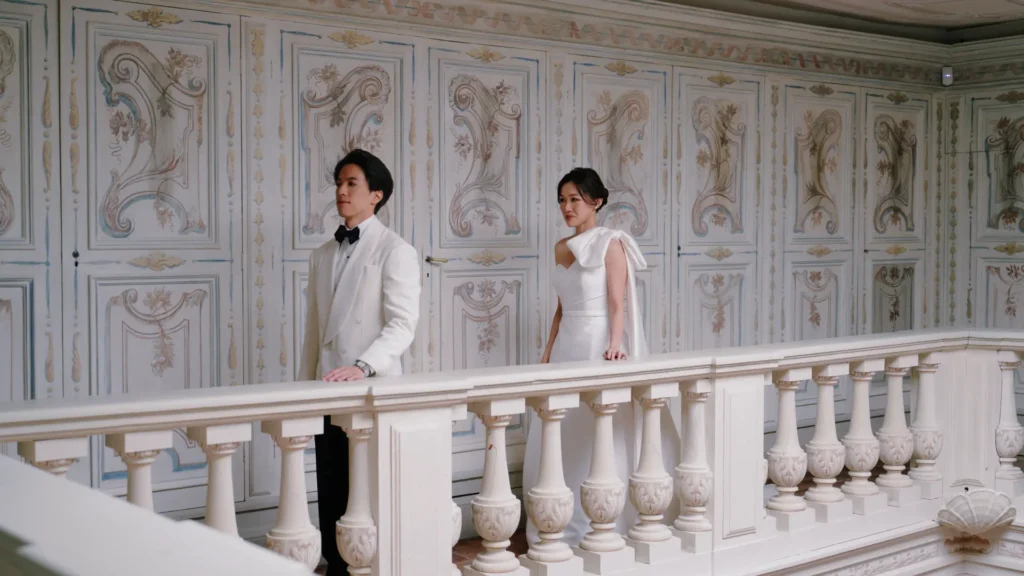
A crew that knows the palazzo knows which hour sends a bar of sunlight across the marble floor and which corner of the courtyard holds the last warmth of the afternoon. Each city adds its own character. Venice brings water, with a canal landing in place of a driveway and reflections drifting across a ceiling. Rome stacks centuries within a single courtyard. Florence offers Renaissance proportion in rooms that seem measured by a draughtsman’s hand. Composition matters more than movement here. Slow pushes, held frames and a taste for symmetry let the architecture speak at its own tempo. A film shot in this way gives back the room as the guests felt it, grand and hushed together, with the couple standing in a space that has welcomed ceremony for centuries and now makes room for theirs.
How the Seasons Rewrite a Place
A villa is never the same address twice. The house stays where it is while the world around it rearranges itself, and a couple who visit in June and marry in October may discover they have chosen two different places. April belongs to freshness. The gardens have just been clipped, wisteria hangs from the pergolas, the air is cool and clear, and the lawns wear a green so tender it will be gone by midsummer. Rain is a real possibility, and a shower crossing a lake or a Tuscan ridge can leave behind some of the most luminous skies a film will ever hold, provided the plan includes a sheltered alternative.

June and July bring long evenings. Sunset arrives after nine, dinner can linger under open sky, and the golden hours stretch far enough to hold portraits, an outdoor ceremony and an aperitivo that drifts into twilight. The cost is intensity. Midday sun is hard on faces and fabric alike, and the schedule has to shield the couple from it. September softens the picture again. The heat loosens, the sun sits lower, and in wine country the harvest brings tractors, crates and the scent of crushed grapes to the edge of the frame. October turns the landscape russet. Mist lifts off valleys and lakes in the morning, woodsmoke appears in the air, and the cooler evenings suit candlelight and rooms dressed in deep colours. Days are shorter, so the ceremony moves earlier and the film gravitates toward interiors, hearths and the glow of windows at dusk.
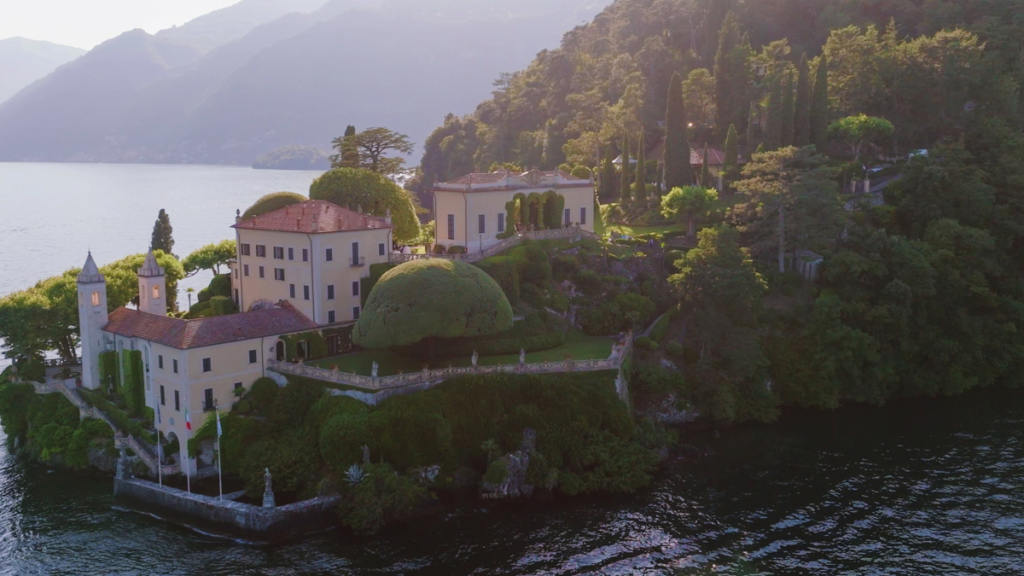
These conditions steer practical choices. A spring or autumn date calls for a ceremony with a covered option ready, while high summer favours a late afternoon service in the shade of a garden. Each season also lends the wedding film its temperament: the freshness of April, the abundance of summer, the reflective, slower mood of autumn. Choosing a date, then, means choosing the palette and pace of the final film, and a thoughtful videographer will raise the question at the first meeting, long before the calendar is fixed.
Dressing the Scene, Choosing the Lens
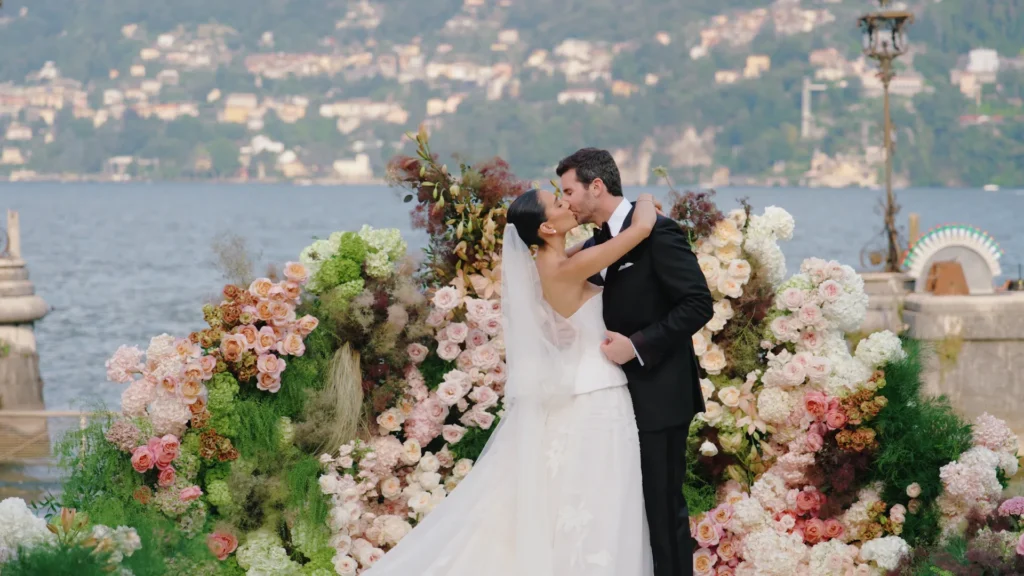
A great venue is rarely left as it was found. A floral designer with a trained eye reads the property the way a set decorator reads a script, looking for the places where the architecture invites a gesture. Garlands follow the curve of a stone staircase, a long table runs beneath a pergola in colours borrowed from the climbing roses, and a ceremony arch echoes the line of the cypresses behind it. The best work leans on the building’s own vocabulary. In a frescoed salon the palette quietens to cream and sage so the ceiling can keep its voice, while on a sea-facing terrace in the South, saturated blooms answer the intensity of the light. A good composition adds a layer to the scene without covering what is already there.
The videographer faces a parallel question, which is how to choose the means of telling it. Each instrument has a task, and the place decides which one is called. A drone lifts the camera above the roofs and gives the viewer the scale of an estate: the avenues laid out like a drawing, the villa set against the water, the long procession of guests crossing a lawn. Used with permits in hand and with judgement, it opens a film with a breath of distance, then withdraws so the story can return to faces and hands.
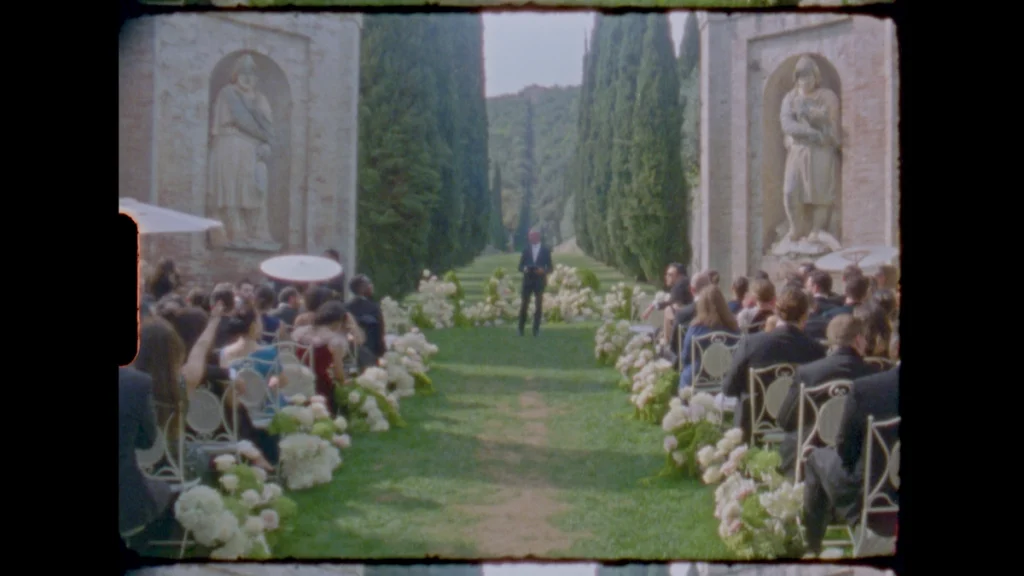
Vintage formats work at the opposite end of the register. Super 8 brings grain, a gently trembling frame and a palette that seems warmed by memory, and its short cartridges encourage a decisive eye, since each frame must be chosen with care. VHS carries the softened colours and slight smear of family tapes from another decade, a texture that makes a courtyard dance feel remembered while it is still happening. Mixed with sharp digital footage, these textures give a wedding film a second timeline. The principle that holds them together is quiet and exacting. The flowers, the drone, the old film stock: each earns its place by what it reveals of the house and the day. When the tools answer to the place, the result feels inevitable, as though the venue had been waiting for exactly this way of being seen.
A Local Eye for an International Guest List
Couples who marry in Italy often arrive from a long way off, and a venue that is new to them is familiar ground for someone who lives nearby. A videographer rooted in the territory carries knowledge that no scouting trip can supply. He knows which side of a villa catches the evening, how the wind behaves on a given terrace in May, which municipality restricts its airspace and which parish priest prefers the cameras kept to the side aisle. He knows the head gardener by name and the hour at which the caterers need the courtyard. That familiarity buys time, and time allows the film to be shaped with care instead of assembled in a hurry.

It also frees the style. Some couples dream of a wedding film in the manner of a feature, composed and directed, with scenes built to be watched in a darkened room. Others prefer something closer to a document, loose, observant, led by whatever happens in front of the lens. Both approaches are authorial, and both depend on a clear point of view held steadily through the day. A local eye can calibrate it to the place, giving a lakeside villa a more composed treatment and a family masseria a looser, more open one, always guided by the couple’s taste.

Then there is the guest list. A destination wedding in Italy gathers people who share no first language: a bride’s grandmother from Toronto, a groom’s cousins from Seoul, old friends from London, and a village band that knows only the songs of Puglia. Languages overlap, toasts are translated mid-sentence, and a laugh crosses the table before anyone has found the words for it. A videographer attentive to this notices the gestures that need no translation, and gives them time on screen. The film might end on one of them: an elderly neighbour from the village, handed a glass by a stranger from across the sea, raising it toward the lights strung over the courtyard while both of them laugh at something neither has quite understood.
Read also: Celebrating Love: The Diverse Cultures Captured Through Our Wedding Videos