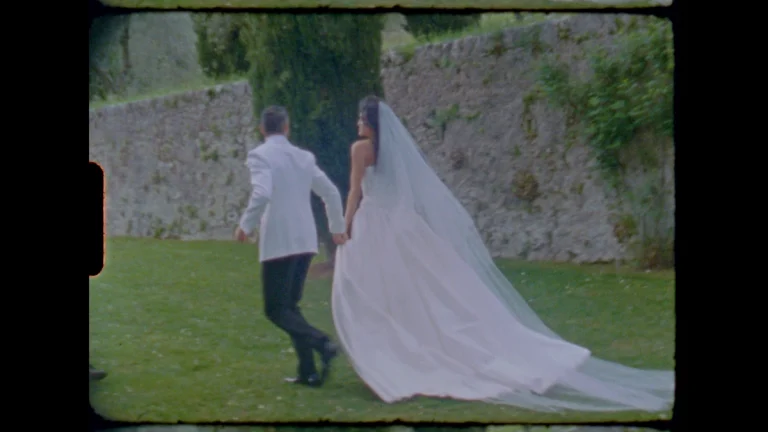


The Val d’Orcia gets under your skin slowly; it is a place that takes its time before showing you its true soul. For Angela and Jason, though, it was instant. Somewhere between the rolling wheat fields and those iconic cypress alleys, this corner of Tuscany stopped being a postcard and became the only logical place for them to marry. It just fit two people who constantly talk over each other and finish each other’s sentences. Not because the light is beautiful (which it is) but because the valley’s timeless rhythm somehow matched their own.
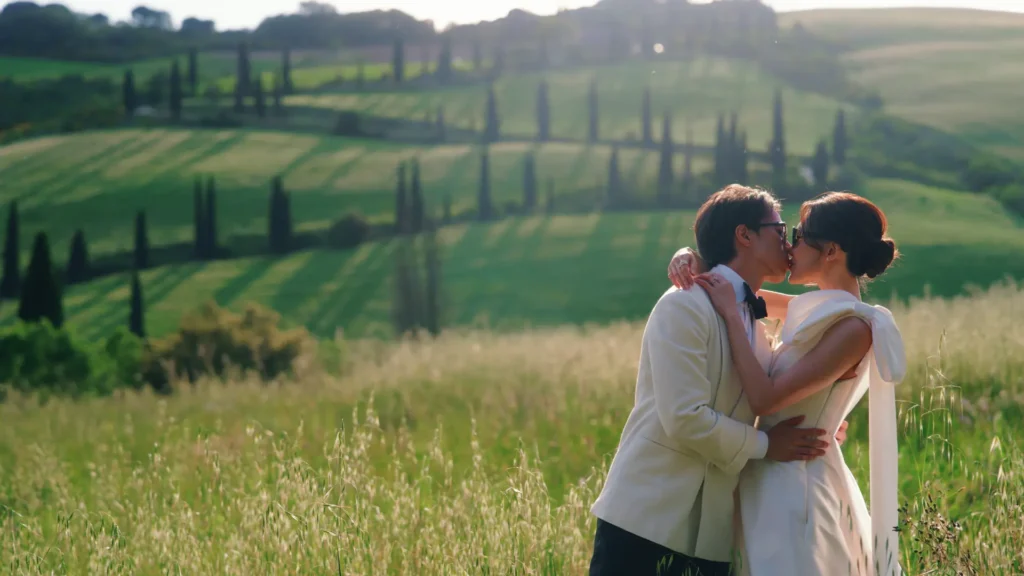
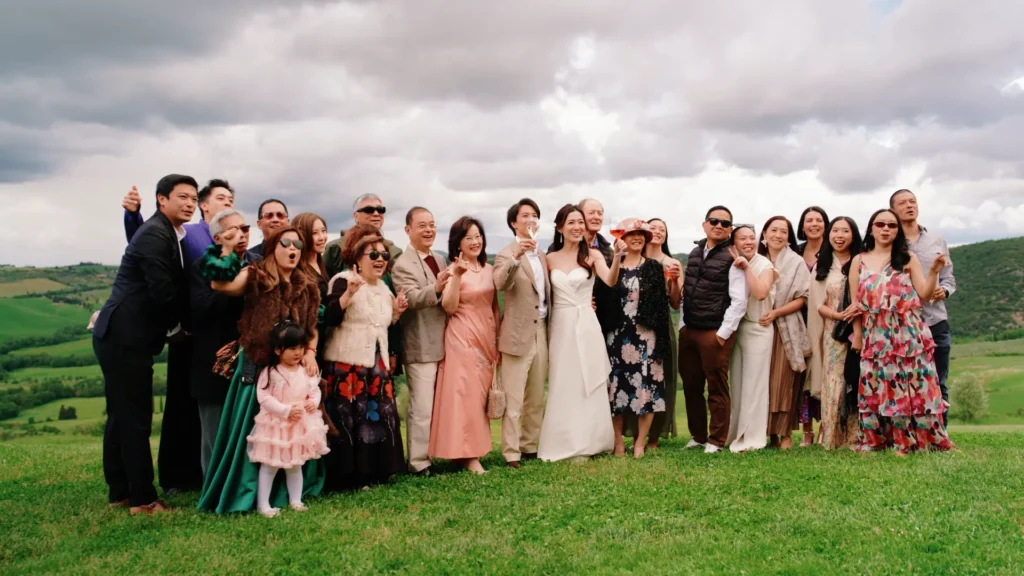
They brought nearly a hundred people, the most important ones, gathered from different decades of their lives, and asked them to celebrate their love together, inside a landscape most had only seen in paintings. What unfolded across those days had little to do with formality. Angela and Jason are the kind of couple who turn nervous energy into laughter, who treat elegance as something to be worn lightly rather than performed, and that sensibility shaped every hour that followed, from unhurried mornings spent getting ready among old friends to an evening that ended, unapologetically, on a dance floor inside a centuries-old lemon house.
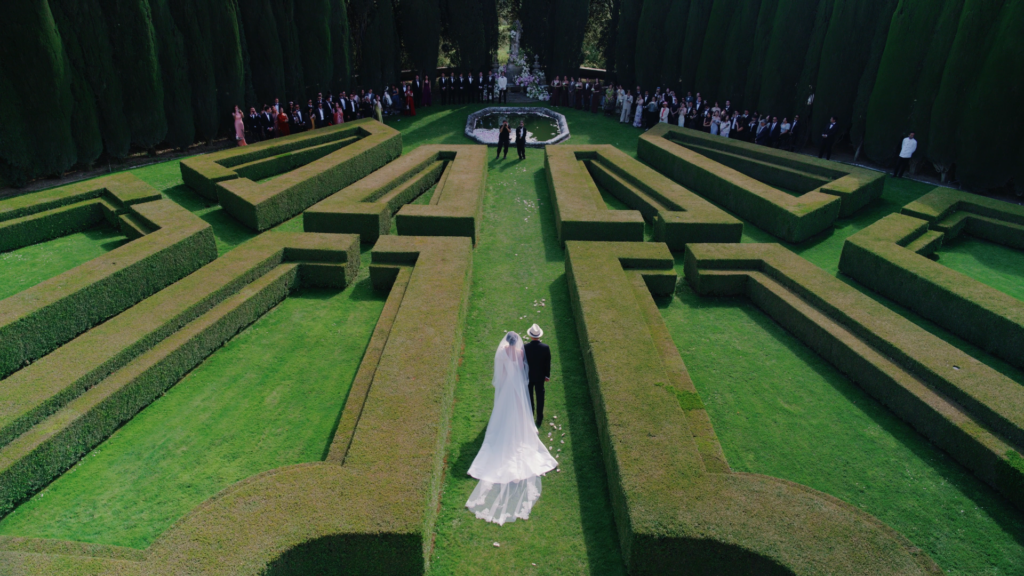
Between those two points sat a ceremony held in a garden older than most nations, where geometry and wildness have coexisted for a century, and where two people chose to make their promises in front of stone and boxwood rather than any building. A wedding film exists to hold onto exactly this kind of texture, the parts that memory tends to soften first: the particular quality of afternoon light against a groom’s collar, the half-second before a father lets go of his daughter’s arm, the sound of a string quartet drifting across cypress trees. What follows is the story of how one such weekend came together, told through the details that made it truly theirs.
Read also: 15 Best Places To Get Married In Tuscany
Tuscany: A Landscape Written by Time
Every year, couples from all around the world arrive in Tuscany carrying the same instinct, though few could explain it precisely. It has something to do with proportion. Tuscan hills were shaped by centuries of agricultural discipline long before anyone thought to call them beautiful, and that unintentional beauty, born of function rather than design, is what modern eyes find impossible to manufacture elsewhere. Add a regional obsession with wine and olive oil that borders on devotion, a painting tradition that taught the Western world how to render light, and you begin to understand why this remains one of the world’s defining destinations for a wedding in Tuscany.
Val d’Orcia occupies a particular place within that landscape. Recognized by UNESCO for the way its farmland, villages, and geometry embody a Renaissance ideal of harmony between human settlement and nature, it reads less like countryside and more like a deliberate composition. Cypress trees stand in the kind of formation no landscaper would dare invent, spaced along ridgelines and driveways as though placed there for exactly this purpose. Pienza, Montepulciano, and San Quirico d’Orcia sit within short driving distance, each offering its own register of stone streets and honey-colored facades, giving guests a reason to extend their stay and wander.
For a couple with Angela and Jason’s eye for aesthetics, people who notice framing and light without overthinking it, this terrain was never going to be incidental. It offered the kind of visual coherence that elevates a destination wedding from event to environment, where every direction the camera might turn already holds its own composition. It was inside this landscape, on a particular stretch of hillside with its own centuries of history, that they would find the exact setting for what they wanted: La Foce.
La Foce: A Narrative Built into Stone and Greenery
Long before it hosted its first wedding, this stretch of hillside had already accumulated centuries of purpose. An Etruscan necropolis discovered on the property, dated between the seventh century BC and the second century AD, hints at how long this ground has held human significance. Its position along the Via Francigena, the pilgrimage route linking northern Europe to Rome, gave it strategic weight in the medieval world, and by the late fifteenth century a hospice had risen here to shelter travelers and merchants crossing this remote stretch of southern Tuscany.
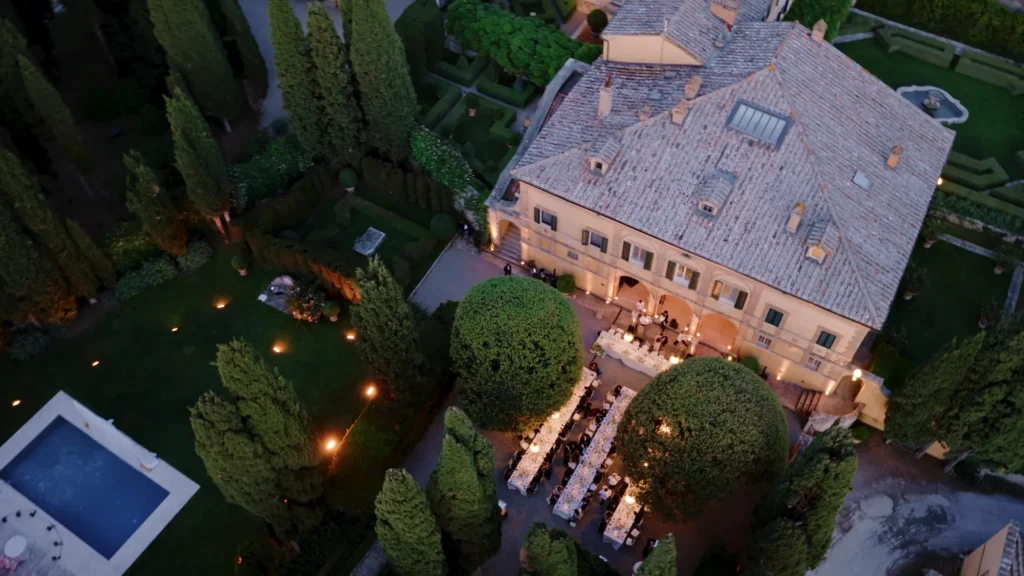
The estate’s modern identity, though, began in 1924, when Antonio and Iris Origo acquired the property and turned it into a working farm, ambitious in scale and unusually progressive for its time. Iris, an Anglo-American writer with a sharp eye for design, partnered with English architect Cecil Pinsent to reimagine both the villa and its surroundings. Between 1925 and 1939, across four distinct phases, they built what would become one of Italy’s most celebrated gardens, a project as much about patience as vision.
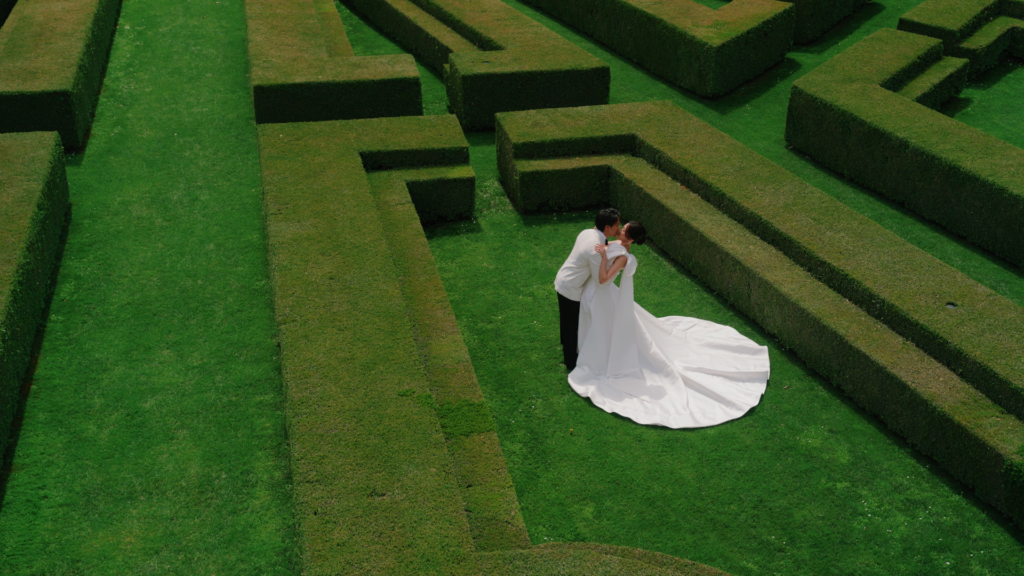
That patience is legible in every structured hedge and considered vista still standing today. It explains why La Foce, nearly a century later, has become one of the most sought-after settings for a luxury wedding in Tuscany. Couples are not simply booking a beautiful backdrop. They are stepping into decades of intention, into a landscape shaped by two people who understood how architecture and nature could be made to speak to one another. For a wedding videographer, that inheritance matters. A location this considered offers more than scenery. It offers structure, sightlines, and a sense of narrative already built into the stone and greenery, the kind of foundation on which a wedding film can be composed rather than simply captured.
Getting Ready for the Wedding
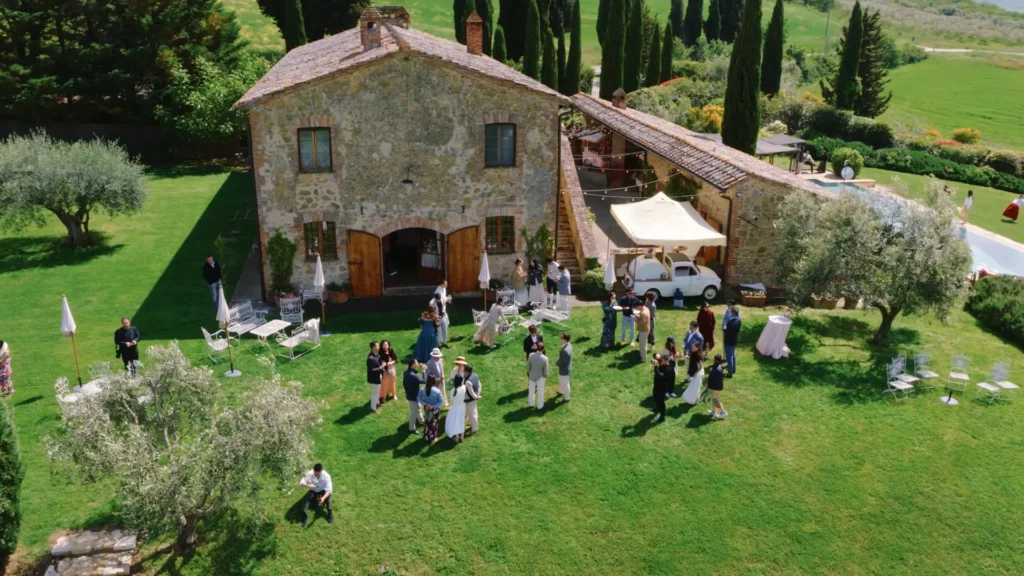
The wedding opened not with formality but with a farmhouse. Villa Apparita, an eighteenth-century casolare set above wheat fields with clear views toward Pienza and Monticchiello, gave guests their first taste of the landscape they had traveled so far to reach. A covered cottage terrace overlooked the pool, and beyond it the fields rolled out in shades of green and gold that deepened as the evening wore on. Guests arrived, embracing friends they hadn’t seen in years, trading stories over trays of Tuscan bruschetta and ice cold Spritz. The evening’s real centerpiece was an open prep station set up in full view of everyone, where Angela, unable to resist, rolled up her sleeves and attempted her own dough, laughing through a lopsided result.
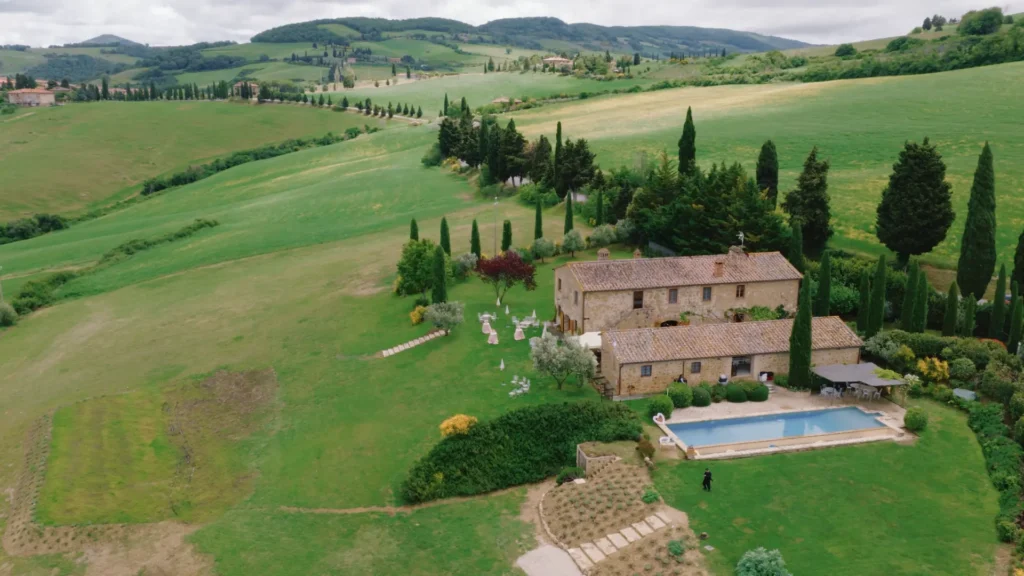
Conversation eventually settled into something more reflective, everyone aware that the ceremony waited not far ahead. At La Foce, light filtered through shuttered windows onto worn stone floors while Angela’s room filled with the particular chaos of women getting dressed together, dresses draped over antique chairs, laughter cutting through the quiet every few minutes. Coral, founder of White Studios and now recognized by Bride and Breakfast Hong Kong among 2025’s top makeup artists, worked with the unhurried precision of someone who reads a bride’s face before touching it, building something classic and quietly luminous.
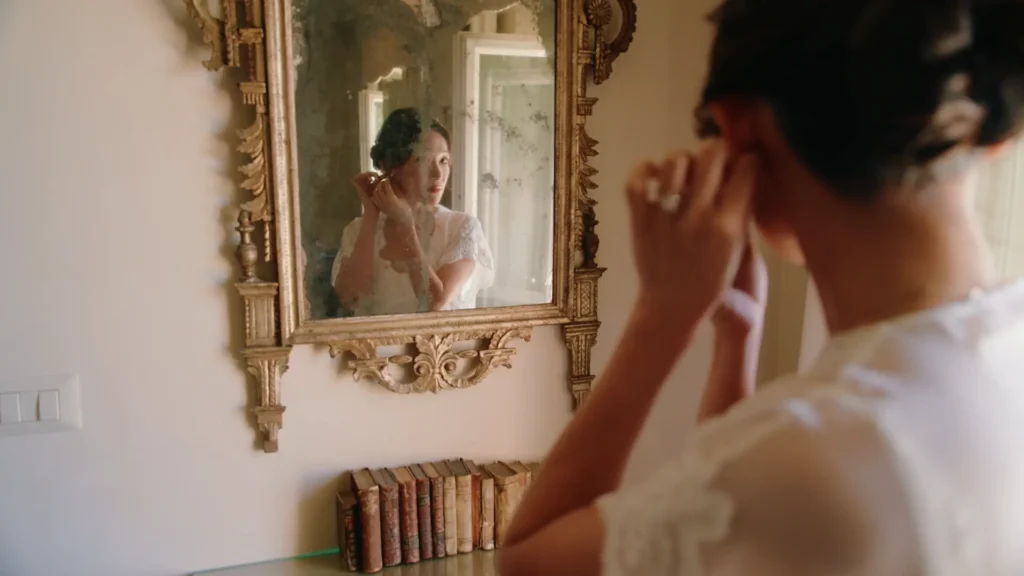
Down another corridor, in rooms that once sheltered pilgrims centuries earlier, Jason moved through his own version of getting ready with his groomsmen, their energy looser, full of the easy jokes and ribbing that surface naturally among old friends reunited. Mary Ann moved between both wings of the villa with a photographer‘s particular discipline, present but never intrusive, catching the moments people forget are happening. That same instinct matters for a videographer working the same rooms, since a wedding film’s quality often comes down to exactly this kind of restraint.
Vows, Toasts, and a Night That Kept Changing
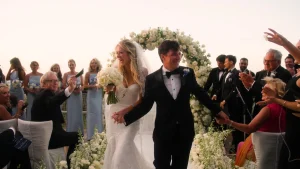
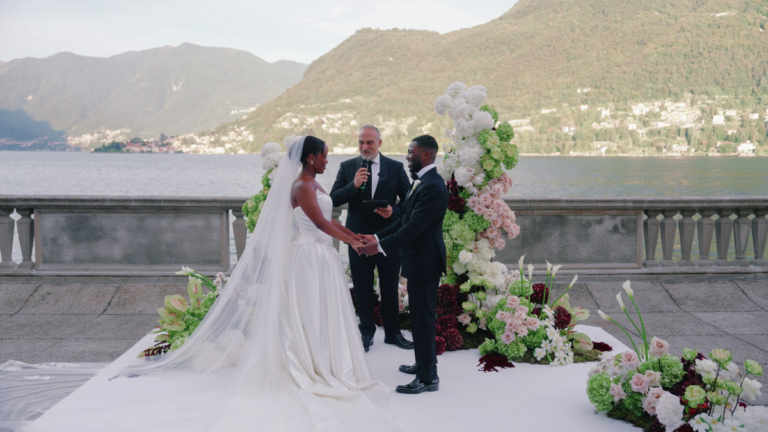
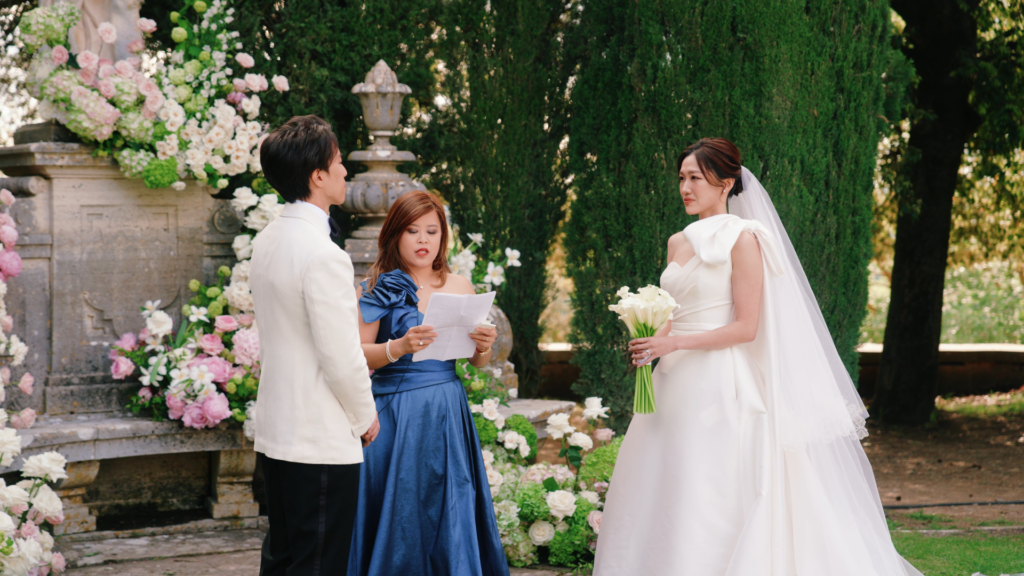
A string quartet began playing beyond the hedges, and Angela appeared at the far end of the cypress allée, her father’s arm steady beneath her hand, the boxwood walls framing her approach like wings drawn back for this exact moment. Her bouquet held nothing but white calla lilies, a symbol of purity, timeless elegance, and the beginning of a new chapter. Nadia, Cinzia, and Elena of Stiatti Flower Design had built the ceremony’s floral language around that same principle, letting the lilies converse with the surrounding architecture rather than compete with it. At the allée’s end waited the seventeenth-century statue, softened with pale pink blooms catching the afternoon light. Angela and Jason exchanged their vows there, voices occasionally breaking, while a hundred people who loved them watched in near silence.
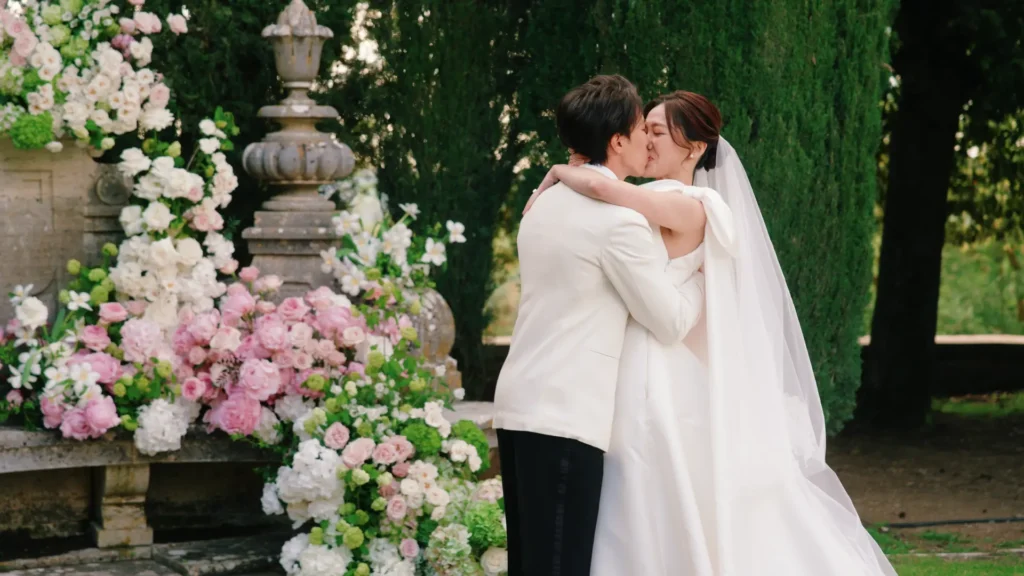
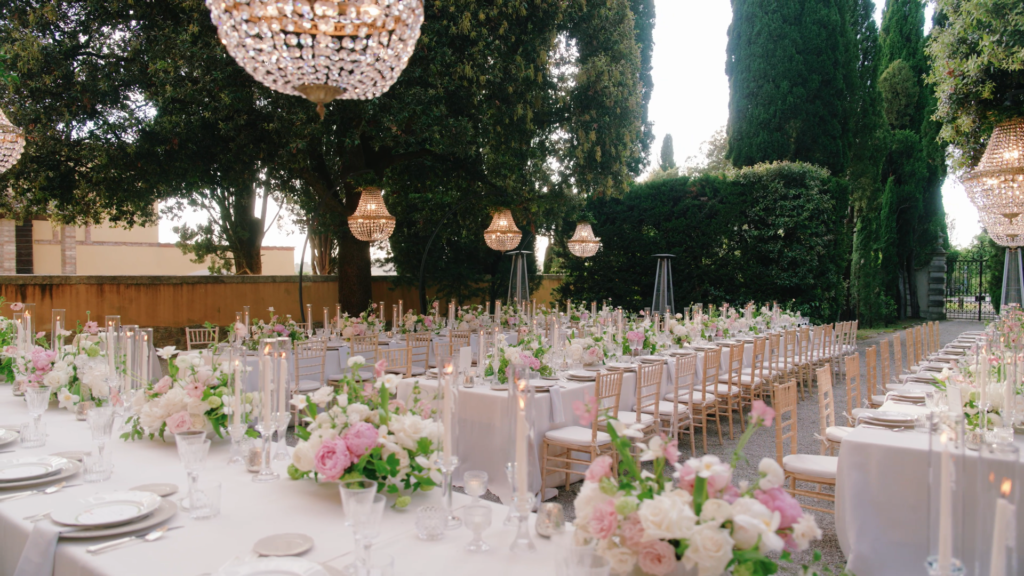
As dusk settled, tables appeared on the lawn facing the villa, dressed with a restraint that read as confidence. Candles flickered awake one by one, low arrangements of white and pale pink blooms ran the table lengths, and Galateo Ricevimenti, the Florence house working since 1995 and carrying a Platinum Award from King of Catering, sent out courses with the polish of a team accustomed to Italy’s most demanding events. Live music drifted from the villa’s steps, and speeches carried real emotional weight, glasses rising more than once.

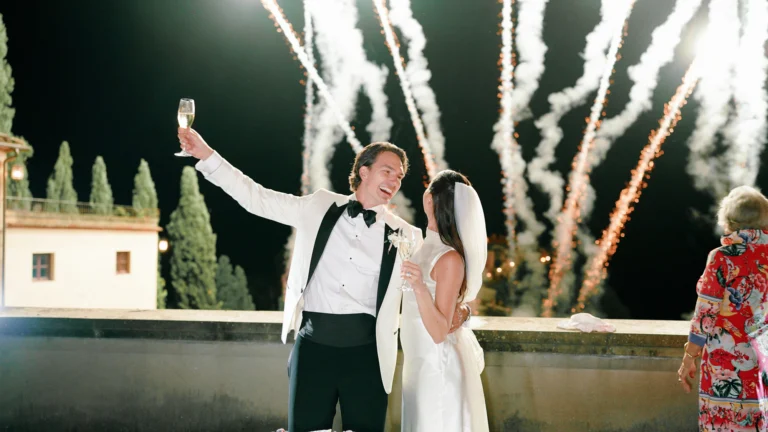
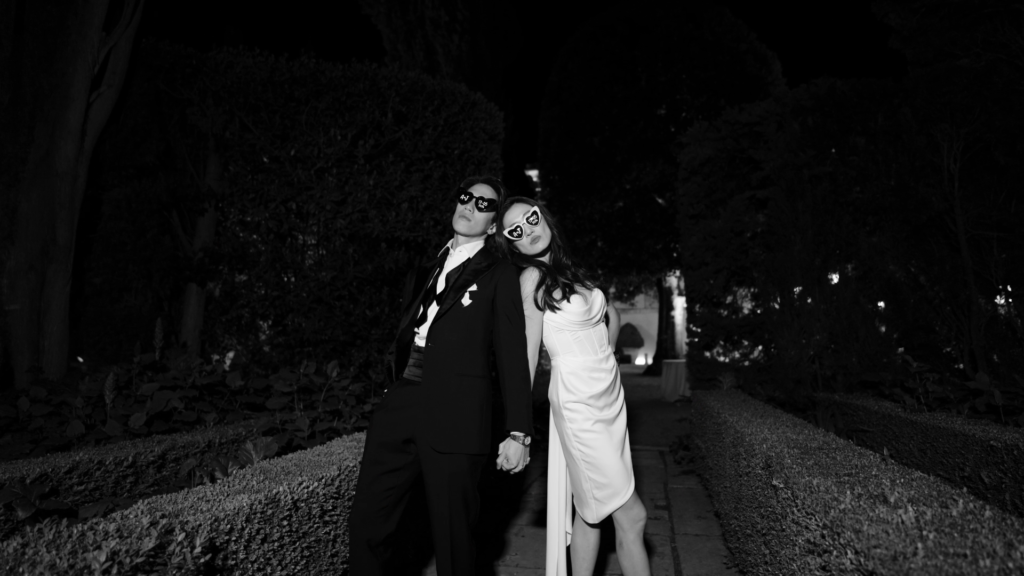
Then came the shift. Guests moved into the limonaia, its stone walls warming with anticipation, and Angela and Jason’s first dance dissolved almost instantly into something looser, trading the ceremony’s measured elegance for unguarded joy. Paolo Fabbri, working the decks with over fifteen years across international weddings throughout Europe, built his open-format set around them, reading the room as strobe lights began cutting through stone walls. A barman worked steadily near the floor’s edge, and by midnight the entire gathering moved as one loose, joyful organism, a register shift that any wedding film worth watching has to carry as fluidly as the couple themselves do.
Read also: Blossoming Love: The Crucial Role of Wedding Florists in Florence
The Right Team, and the Film That Holds It All Together
Behind a weekend that reads as effortless usually sits a planner who has spent months making it look that way. Francesca of CloudEight coordinated Angela and Jason’s celebration with a quiet precision that never announced itself, guests rarely noticing precisely because everything simply worked. The studio’s name plays on an old idiom. Everyone knows what it means to be on cloud nine, that peak of happiness everyone chases, but Francesca built her practice one level below it, on cloud eight, where the serenity lasts because it doesn’t depend on staying at the top. Turn the number on its side and it becomes the infinity symbol, which she reads as a double promise: the permanence of a marriage, and a working philosophy built around renewal and sustainability rather than excess.
A destination wedding succeeds largely on relationships built over years, not booked cold for a single event, and local professionals understand how light moves across a particular garden by season, which flowers will actually be available, how a centuries-old room behaves once filled with a hundred guests. That same understanding of rhythm and light matters just as much once the day itself is over and what remains is the footage. A wedding day compresses months of anticipation into roughly twelve hours, and most of what happens within them resists memory almost immediately, the tremor in a father’s voice, the exact angle of light against a cypress trunk, the hesitation before two people say words they’ve waited to say.
Photography and videography accomplish different things. A photograph isolates a single frame, frozen and deliberate. A wedding film restores motion and sound, the cadence of a toast, a groom’s laugh cracking mid-sentence, letting viewers hear the quartet rather than simply see it. None of this happens by accident.
An experienced videographer reads a day’s rhythm the way a director reads a script, knowing when a scene needs stillness and when it needs energy. Angela and Jason’s day moved through distinct registers, from restrained ceremony to unguarded celebration, and a wedding film built with real craft carries that same arc through to its end. What remains, years later, is not a list of vendors but a coherent piece of storytelling, golden Tuscan light woven through glances, laughter, and the people who mattered enough to travel across the world for a single afternoon in a garden.
Read also: Italian Videographer: Why Choosing a Local Professional in Italy Makes All the Difference