
Japan doesn’t reveal itself all at once. It unfolds slowly, deliberately, on its own terms. I had been planning this trip for years, not as a tourist itinerary but as a photographic expedition across four cities: Tokyo, Kyoto, Osaka and Nara. Fifteen days, one camera, and a country that turned out to be one of the most visually rich destinations I have ever pointed a lens at.

Tokyo: Light, Shadow, and the Art of Waiting
There is a particular quality to Tokyo’s light at golden hour. It cuts through the narrow gaps between buildings like a blade, flooding the alleys with amber warmth just as the city shifts from day to evening. My first truly captivating frame came in one of those unnamed backstreets: a cyclist crossing an intersection bathed in dying light, his shadow stretching long across the asphalt, a commuter blurred in the foreground. Nobody posed. Nobody noticed me. That’s the gift of Tokyo street photography. The city is so absorbed in its own rhythm that you become invisible.

I spent my mornings in Ueno, drawn to the chaotic energy of Ameyoko Market. The streets there feel borrowed from another era, with vendors, layered signage, and the smell of grilled food cutting through cold air. One morning, a shaft of warm light landed on the face of an elderly woman navigating the covered alley, shopping bags in both hands. She didn’t look up. The market swallowed her back into its flow.

The evenings belonged to the yakitori alleys. In one of Tokyo’s narrow drinking lanes, red lanterns glowing, a salaryman in a suit crossing a sliver of light between the shadows, I found one of my favorite frames of the entire trip. The contrast felt symbolic: the formality of his suit against the worn, intimate atmosphere of the alley. Japan distilled into a single photograph.

And then there was Shibuya Crossing in the rain. Standing there on a wet night, neon signs reflected in the flooded street, hundreds of umbrellas moving in choreographed chaos. It’s one of those scenes that earns its reputation every single time. The moisture in the air made the colors bleed and bloom. I shot from underneath my own umbrella and barely moved for twenty minutes. If you want to understand why street photography is such a powerful medium, Shibuya at night in the rain will explain it faster than any book.
Kyoto: Where Every Frame Already Exists
Leaving Tokyo by bullet train, I felt the pace shift before I even stepped off the platform. Kyoto doesn’t announce itself loudly. It reveals itself in morning light and quiet stone streets.
I arrived early enough to catch the city at its most honest. A woman in a yukata, pushing her bicycle along a narrow machiya-lined lane in the soft glow of dawn, the wooden facades, the golden haze filtering through the trees, the absolute stillness of the scene. She wasn’t performing for anyone. She was simply going about her morning. That image, more than any shrine or garden, said everything I needed to know about this city.

Later, wandering near one of Kyoto’s hillside shrines, I stumbled into a moment I hadn’t planned. A Buddhist monk moved quickly past a row of vermillion torii gates, his dark robes contrasting against the vivid red structures and the lush green of the surrounding maples. The soft morning light flared at the edges. I had maybe two seconds. I pressed the shutter.

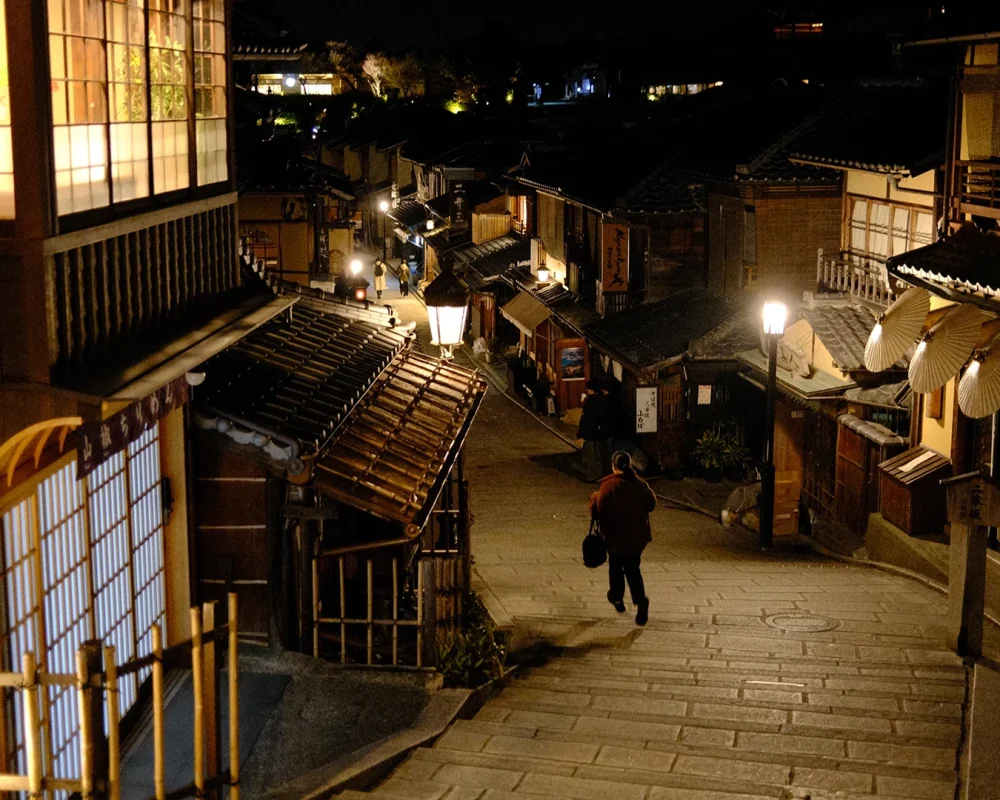
After dark, I climbed toward the Higashiyama district. The stone-paved lanes of Sannen-zaka were nearly empty after ten. Lanterns lit the descending stairways, traditional shop fronts glowed amber, and a single figure walked downhill into the darkness ahead of me. From above, the composition revealed itself: layers of rooftops, warm light pools, the old soul of a city breathing quietly in the night.
Osaka: Raw, Loud, and Endlessly Photogenic
If Kyoto taught me restraint, Osaka taught me to let go. This city has no patience for subtlety. It’s louder, grittier, more colorful, and for street photography, endlessly generous.

The nights in Osaka were unlike anything else on this trip. In Dotonbori, I found myself surrounded by young people in elaborate outfits: a woman with electric blue hair laughing freely in front of a bar blazing with neon signs, the whole scene lit in pinks and reds that made it feel like a film set. Nobody was performing for a camera. They were just alive, in the way Osaka people tend to be. Fully, unapologetically.

By day, I explored the covered shopping arcades and market streets. In a narrow lane near a tuna restaurant, a lone elderly figure stood at the entrance, backlit by striking red signage, the surrounding shadows carving the scene into something almost cinematic. A reminder that great light doesn’t only happen at sunrise.
Nara: Silence as a Photographic Subject
After the sensory overload of Osaka, Nara felt like an exhale. The sacred deer move through the park and into temple courtyards as if they own the place, because in a sense they do. According to Japanese cultural tradition, the deer of Nara have been considered messengers of the gods for over a thousand years, and spending time among them, you start to believe it.

I photographed a deer resting at the base of a covered pavilion, the silhouettes of two visitors sitting inside rendered in deep shadow against the bright park beyond. The contrast between the dark foreground and the luminous open space created a natural frame I couldn’t have designed better. Nara reminded me that street photography isn’t only about humans. Sometimes the most revealing images are the quiet ones.
What Japan Taught Me About Photography
Fifteen days isn’t enough to understand Japan. But it might be exactly enough to feel it. What I brought back wasn’t just a collection of photographs. It was a new relationship with patience, with presence, and with the act of watching without interfering.

Japan rewards the photographer who is willing to slow down. The decisive moment here doesn’t announce itself. It happens in the periphery, in the gap between two buildings, in the expression of someone who hasn’t noticed you yet. The country operates with a quiet precision that, once you learn to trust it, starts to feel like a collaboration between you and the city itself.

I’ll be back. With less agenda and more time. But the images I made on this first journey will stay with me, not as memories of places visited, but as fragments of a country I’m only beginning to understand.